
UAT MASTER’S DISSERTATION PROJECTS
Master’s dissertations within the Urban Planning and Territorial Development Master’s programme at the Faculty of Architecture and Urban Planning Timișoara are structured into two components:
Part I (Theoretical Component) consists of the preparation of a research dissertation developed in accordance with the specific profile and academic objectives of the Master’s programme.
Part II (Practical Component) entails the development and public presentation of a specialized project or a case study–based application, depending on the programme’s specialization, and directly correlated with the topic addressed in the research dissertation. This component is developed in alignment with the thematic framework and theoretical principles established in the research component.
The dissertation topic may be selected from the general themes proposed within the Master’s programme or may be independently proposed by the student, subject to the approval and supervision of the academic coordinator
2026
For the full texts please click on the pages of the brochure below.
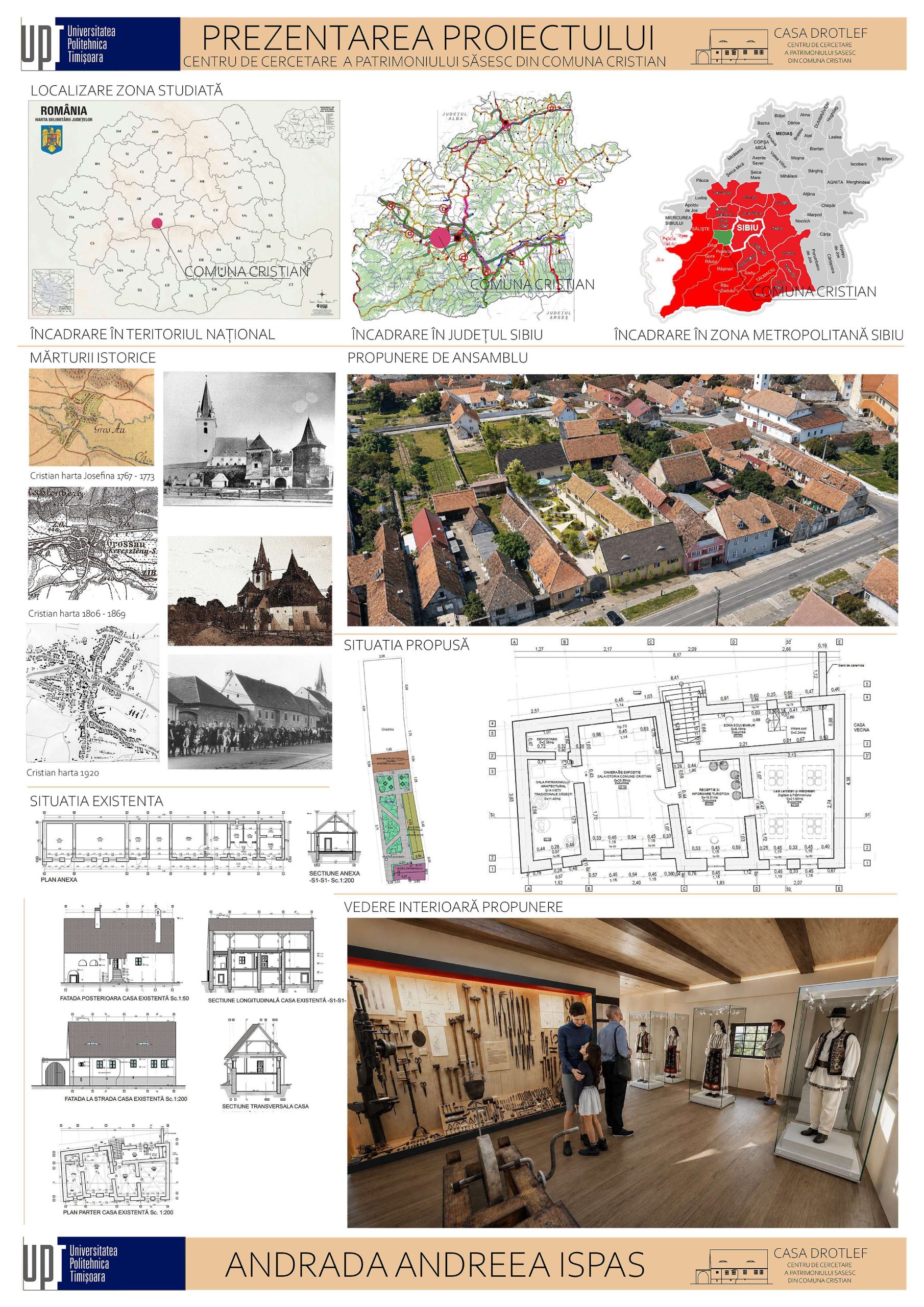
Student: Ispas Andrada Andreea
Coordinating Professor: Conf. dr. arh. Branea Ana-Maria
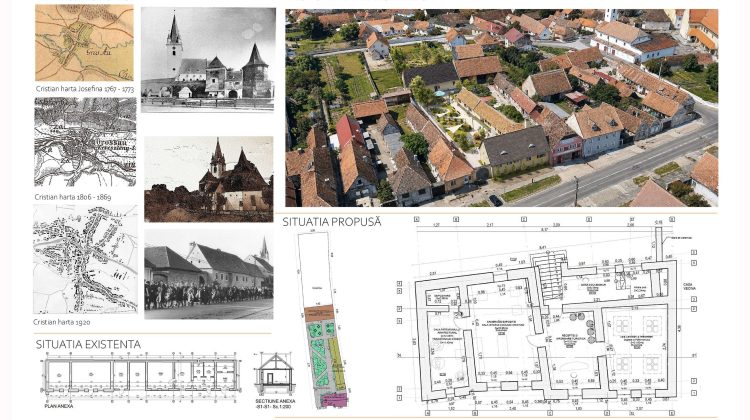
The paper analyzes the potential for the tourism valorization of the cultural and natural heritage of Cristian Commune, with a focus on the Drothlef Homestead and the development of a Saxon Heritage Research Center within the context of sustainable tourism development. The research is grounded in the need to identify a balance between the rapid development of the locality and the preservation of its local identity, as well as its built and natural heritage.
The methodology adopts an interdisciplinary approach and includes documentary and bibliographic research, case study analysis, direct observation and field research, sociological research through questionnaires, a comparative analysis of development models in Viscri and Biertan, and a SWOT analysis. The research aims both to assess the heritage and tourism potential of Cristian Commune and to identify the perceptions of local residents and visitors regarding tourism development.
The results highlight the existence of valuable cultural and natural heritage that remains insufficiently exploited from a tourism perspective. The questionnaires indicate that cultural heritage represents the primary motivation for visiting the commune, while a significant proportion of respondents consider that the authenticity of the locality has been only partially preserved. These findings highlight the need for more effective measures to protect and promote the area’s heritage.
The comparative analysis and evaluation of the existing strategy lead to the formulation of several directions aimed at developing a sustainable tourism model based on heritage conservation, the digitalization of tourism information, the creation of thematic routes, and the active involvement of the local community.
Student: Marina Bogdan
Coordinating Professor: Conf. dr. arh. Cătălina Bocan
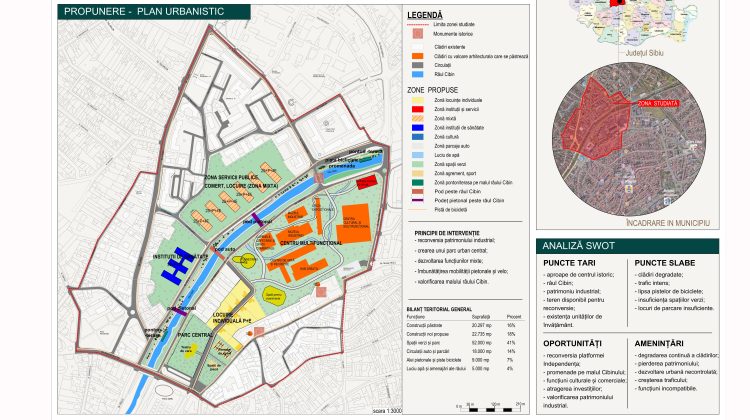
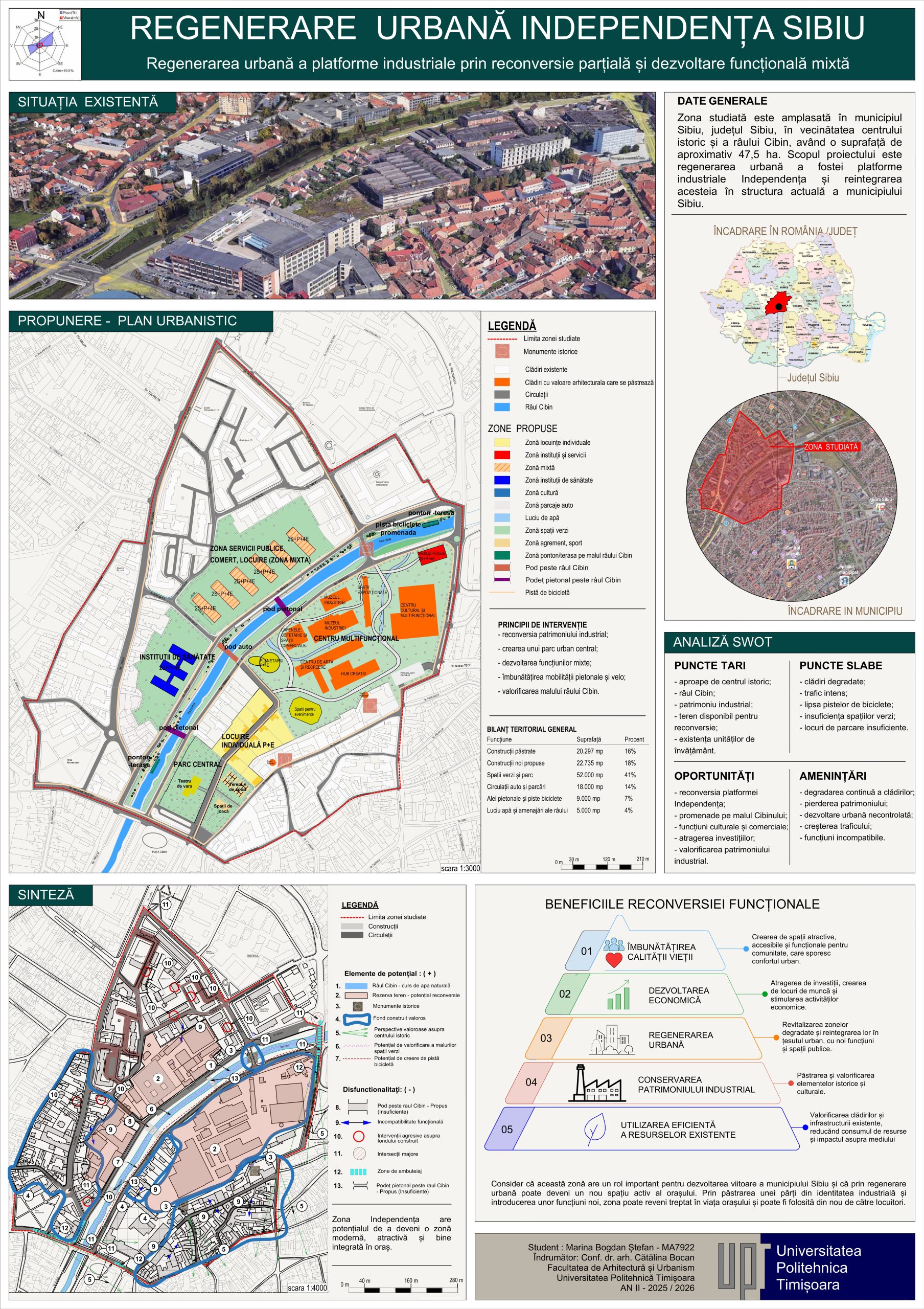
This paper analyzes the process of urban regeneration of former industrial areas and its role in the development of contemporary cities. The study focuses on the transformation of abandoned industrial sites and their reintegration into the urban structure through new functions adapted to current community needs. The first part presents theoretical aspects related to sustainable development, urban regeneration, adaptive reuse, and industrial heritage. The benefits of these interventions are discussed, including improvements in urban quality, the reuse of underutilized land, and the preservation of valuable industrial buildings.
Urban regeneration is used to transform areas that are no longer adequately utilized or have deteriorated over time. Such interventions aim to improve the quality and appearance of an area while introducing new functions that respond to the current needs of residents. The paper presents the main principles of urban regeneration and examines how they can contribute to the transformation of former industrial areas.
Industrial heritage consists of buildings, structures, and spaces that were previously used for industrial activities. The study analyzes the importance of preserving these elements and explores their potential for adaptation to new uses. In this way, industrial heritage can be valorized and reintegrated into contemporary community life. Adaptive reuse refers to the process through which buildings and spaces that are no longer in use are assigned new functions. In former industrial areas, this may involve transforming factories and industrial halls into spaces for cultural activities, services, housing, recreation, or other contemporary uses.
The research also includes several case studies from Romania and abroad, highlighting different approaches to the regeneration of former industrial areas. These examples contribute to the identification of principles and solutions that can be applied in comparable urban contexts.
The conclusions demonstrate that the regeneration of former industrial sites represents a significant opportunity for urban development, contributing to the revitalization of degraded areas, the preservation and reinterpretation of industrial heritage, and the creation of attractive, functional, and adaptable urban spaces.
Students: Agualimpia Ramírez Jihan
Coordinating Professor: Conf. dr. arh. Ileana Kisilewicz
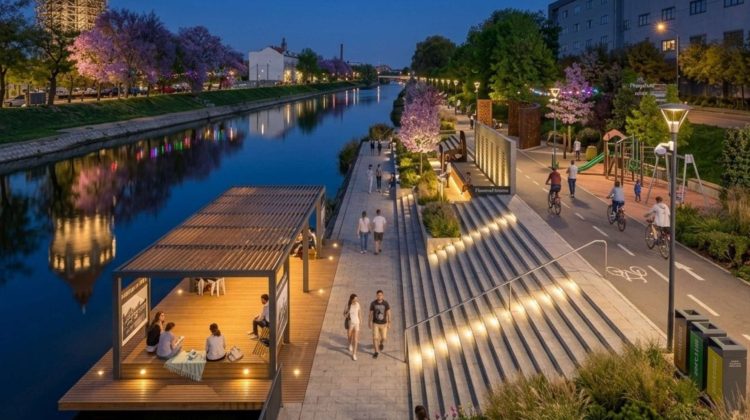
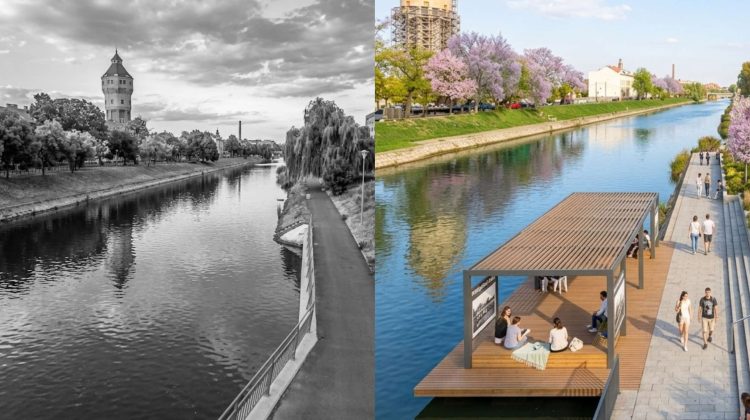
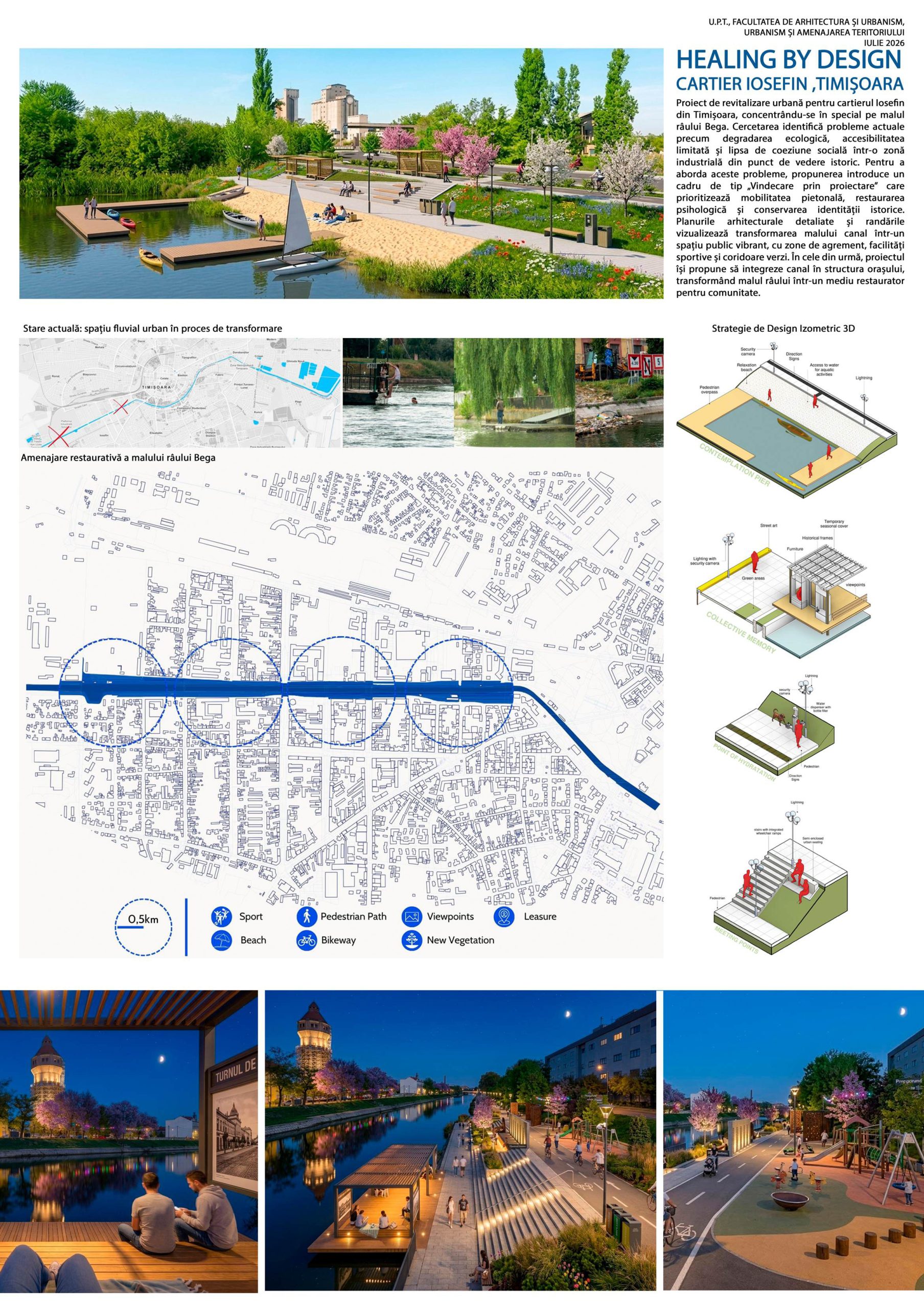
Contemporary urban development often treats urban river spaces as aesthetic and environmental infrastructure, overlooking their profound historical role in contemporary society and their relationship with collective identity and individual well-being. This has contributed to a disconnection between cities and their rivers, in which the historical, symbolic, and psychological dimensions of river landscapes are frequently neglected.
This research examines the current imbalance between water systems and human activity, as well as its influence on the psychological well-being of people living in water-centric cities. The study focuses on two case studies: the Guadalquivir River in Seville and the Bega River in Timișoara.
The objective of the research is to develop an in-depth comparative analysis and establish an analytical framework for understanding the relationship between water, the city, and human well-being. The proposed conceptual framework is translated into a set of practical and visual recommendations for architects, urban planners, and policymakers, aimed at supporting the design of river spaces that are both culturally meaningful and psychologically restorative.
Students: Feier Raul-Ioan
Coordinating Professor: Conf.dr.arh. Marius-Stelian Găman
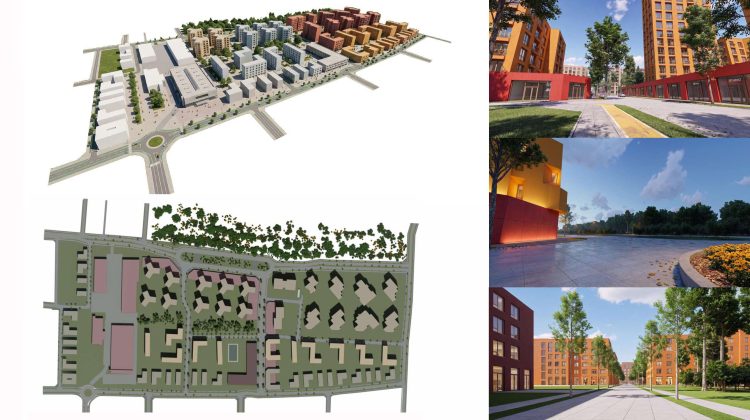
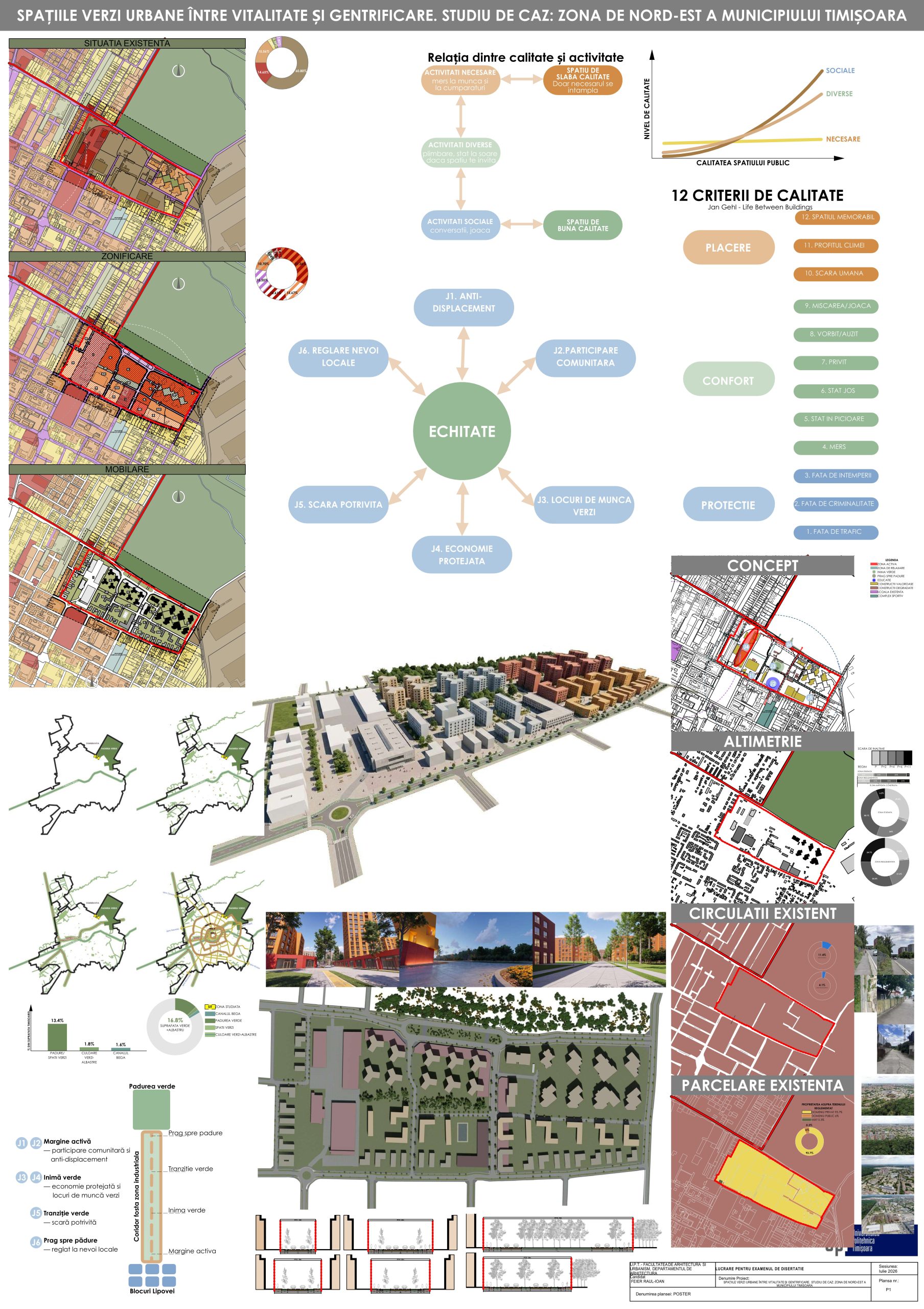
This study analyzes the relationship between urban green spaces, neighborhood vitality, and gentrification processes, combining a comprehensive theoretical overview with an applied case study of a former industrial site in the northeastern part of Timișoara, located near Pădurea Verde. Starting from the premise that green spaces can act as catalysts for urban vitality—through the continuous use of public space, the “eyes on the street” phenomenon, and functional diversity—the paper also examines their potential to generate market pressures that may contribute to gentrification. The research brings together Jane Jacobs’s classical perspectives with normative frameworks concerning the right to urban nature and environmental justice, as well as critical literature on green gentrification.
Methodologically, the study adopts a mixed-methods approach, combining theoretical analysis with practical observations conducted within relevant urban models. These methods are used to test hypotheses from the literature concerning the relationship between green spaces, urban vitality, and gentrification, as well as to develop a case study proposing a development model based on the principles examined.
Based on a deeper understanding of the subject and a refinement of the initial observations, the study concludes that the transformation of the benefits associated with green spaces into processes of socio-spatial exclusion is not a direct or inevitable outcome. Rather, it represents a complex process shaped by a combination of institutional and market conditions, including property regimes, housing policies, urban planning regulations, and complementary investments.