
Portfolio Category: LICENTA MAI
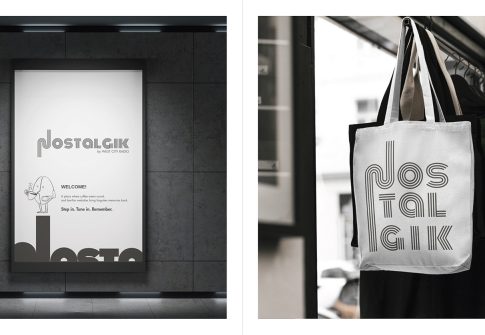
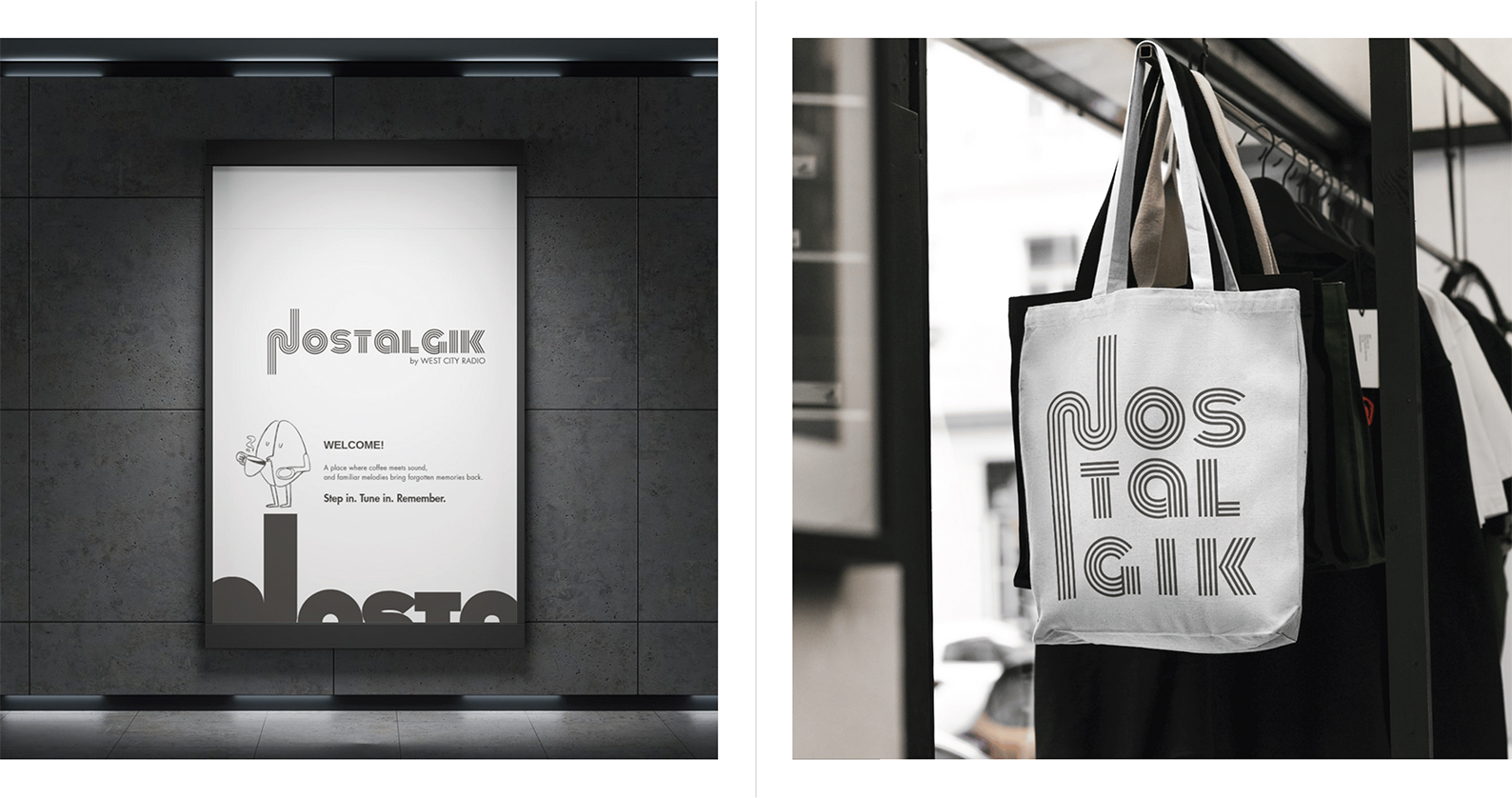
2026 | DESIGN GRAFIC | M03
RO: Exercițiul dezvoltat de generația 2025–2026 a avut ca obiect realizarea unui portofoliu de identitate și branding pentru programul arhitectural studiat în cadrul atelierului de Arhitectură de Interior 5: o cafenea cu studio de transmisiuni pentru brandul deja consacrat West City Radio.
Conceput ca parte a activităților de seminar, portofoliul este dezvoltat în trei etape principale. Prima etapă este dedicată definirii valorilor fundamentale ale proiectului printr-o serie de cinci imagini evocatoare, menite să comunice temele centrale ale conceptului arhitectural fără a recurge la reprezentări arhitecturale directe. Scopul este de a distila atmosfera conceptuală și narațiunea proiectului într-un limbaj vizual care precede imaginea arhitecturală propriu-zisă.
A doua etapă continuă această explorare prin transpunerea valorilor identificate într-o identitate verbală și grafică. Studenții definesc un nume al proiectului (brand) și dezvoltă un logo sau logotip, parcurgând un proces care include atât exerciții de type design, cât și de typesetting.
În a treia etapă, studenții construiesc structura și layout-ul general al portofoliului, testând în același timp sistemul de identitate vizuală printr-o serie de aplicații grafice. Acestea includ postere, bannere pentru social media, elemente de merchandising și inserții în spațiu, permițând explorarea identității ca sistem coerent de comunicare la nivelul diferitelor medii și scări de reprezentare.
EN: The exercise developed by the 2025–2026 cohort focused on the creation of a branding and identity portfolio for the architectural program studied within Interior Architectural Design Studio 5: a coffee shop with a live transmission studio for West City Radio.
Conceived as part of the seminar activities, the portfolio is developed through three main stages. The first stage is dedicated to the definition of the project’s core values through a series of five evocative images intended to communicate the central themes of the architectural concept without relying on direct architectural representations. The aim is to distill the conceptual atmosphere and narrative of the project into a visual language that precedes the architectural image itself.
The second stage continues this exploration by translating the identified values into a verbal and graphic identity. Students define a project name (brand) and develop a logo or logotype, engaging in a process that includes both type design and typesetting.
In the third stage, students construct the overall structure and layout of the portfolio, while also testing the visual identity system across multiple graphic applications. These include posters, social media banners, merchandising elements, and spatial insertions, allowing the identity to be explored as a coherent communication system across different media and scales.


2025 | DIPLOMA | YEAR III
The completion of the three-year program requires the development of a comprehensive interior design project, covering all stages of the design process. Both the site and the function are chosen by the student, provided that the relevance and opportunity of the proposed intervention are clearly justified.
The main objective is to define a strong spatial identity, shaped both by the qualities of the selected context and by the specific characteristics of the proposed function. Throughout the phased development of the project, theoretical and technical approaches are pursued in order to formulate spatial and formal solutions that enhance the chosen space.
This process represents a valuable exercise in preparation for professional practice, addressing adaptive reuse, the creation of an aesthetic aligned with the proposed concept, the coordination of constructive elements (finishes, furnishings, installations), the resolution of execution details for custom-designed furniture, cost anticipation, and overall budget management.
Project Development Phases
Phase I involves understanding existing conditions and defining the requirements of the proposed theme. This includes studying comparable examples of similar scale and function, as well as analyzing the site’s specific characteristics, qualities, dysfunctions, and atmosphere.
Phase II focuses on developing a general intervention concept, generating two preliminary design proposals, and further detailing one selected option.
Phase III consists of producing the technical project documentation, detailing the solution developed in the previous phase at a technical design level.
Phase IV represents the execution detailing stage. The final phase includes preparing detailed drawings for at least three key design elements (such as custom furniture pieces or constructive details), finalizing finishes and materials, and documenting them within the written report, cost estimate, and material palette.
For the full texts please click on the pages of the brochure below.
Diploma Projects
Student: Boglárka Bálint
Coordinating Professor: Conf. Dr. Arch. Diana Giurea
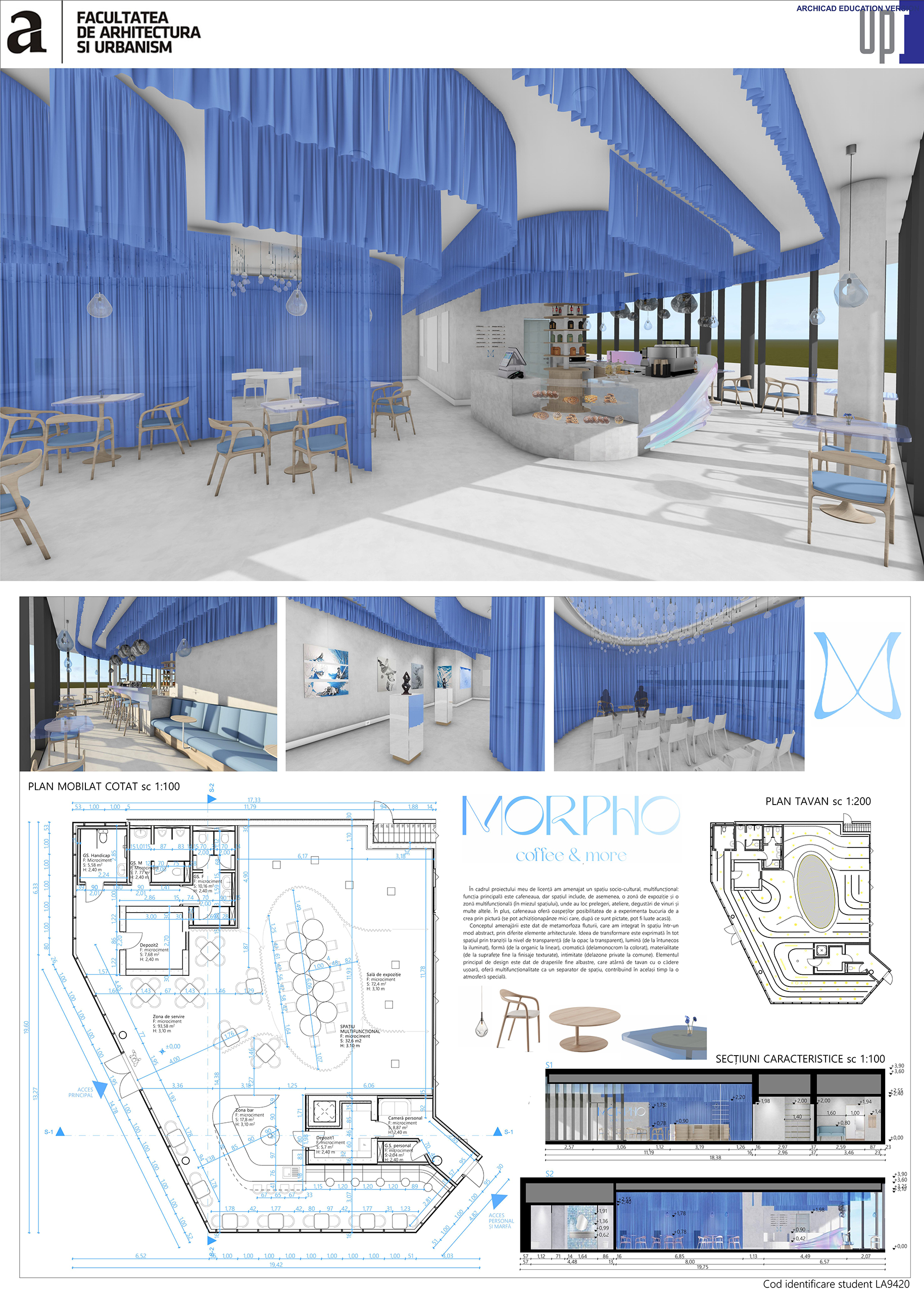
As part of my bachelor’s degree project, I created a unique space with a distinctive design that engages all the senses and offers a culinary experience for those who enter: a specialty coffee shop with an art gallery, designed in the ISHO Pavilion in Timișoara.
This café offers more than just refreshments and relaxation; it contributes to the personal and cultural development of individuals. In addition to admiring the artworks, guests have the opportunity to experience the joy of creating through painting (small canvases can be purchased and, once painted, taken home).
The design concept is inspired by the metamorphosis of the butterfly, which I integrated into the space in an abstract way through various architectural elements. The idea of transformation is expressed throughout the space through transitions in transparency (from opaque to transparent), light (from dark to illuminated), form (from organic to linear), color (from monochrome to vibrant), materiality (from smooth surfaces to textured finishes), and intimacy (from private to communal areas).
The main design element consists of fine blue curtains hanging lightly from the ceiling, providing multifunctionality as space dividers while also contributing to a special atmosphere.
This study includes the preliminary research necessary for the proper implementation of the project, the verification of the hypothesis—can a multifunctional space be created based on the concept of metamorphosis?—as well as a complete description of the design solution, and the list of materials and objects used.
In conclusion, I successfully designed a socio-cultural and artistic center within the ISHO Pavilion building, which hosts numerous events and features a permanent gallery. Through the resolution of the concept, the café offers a sensory experience, engaging sight, hearing, touch, smell, and taste. MORPHO Coffee & More supports emerging artists and promotes artistic practice, thereby enhancing the appreciation of art within the community.
Student: Bodan Bianca Ioana
Coordinating Professor: S.l. Dr. Arch. Otilia Tudoran
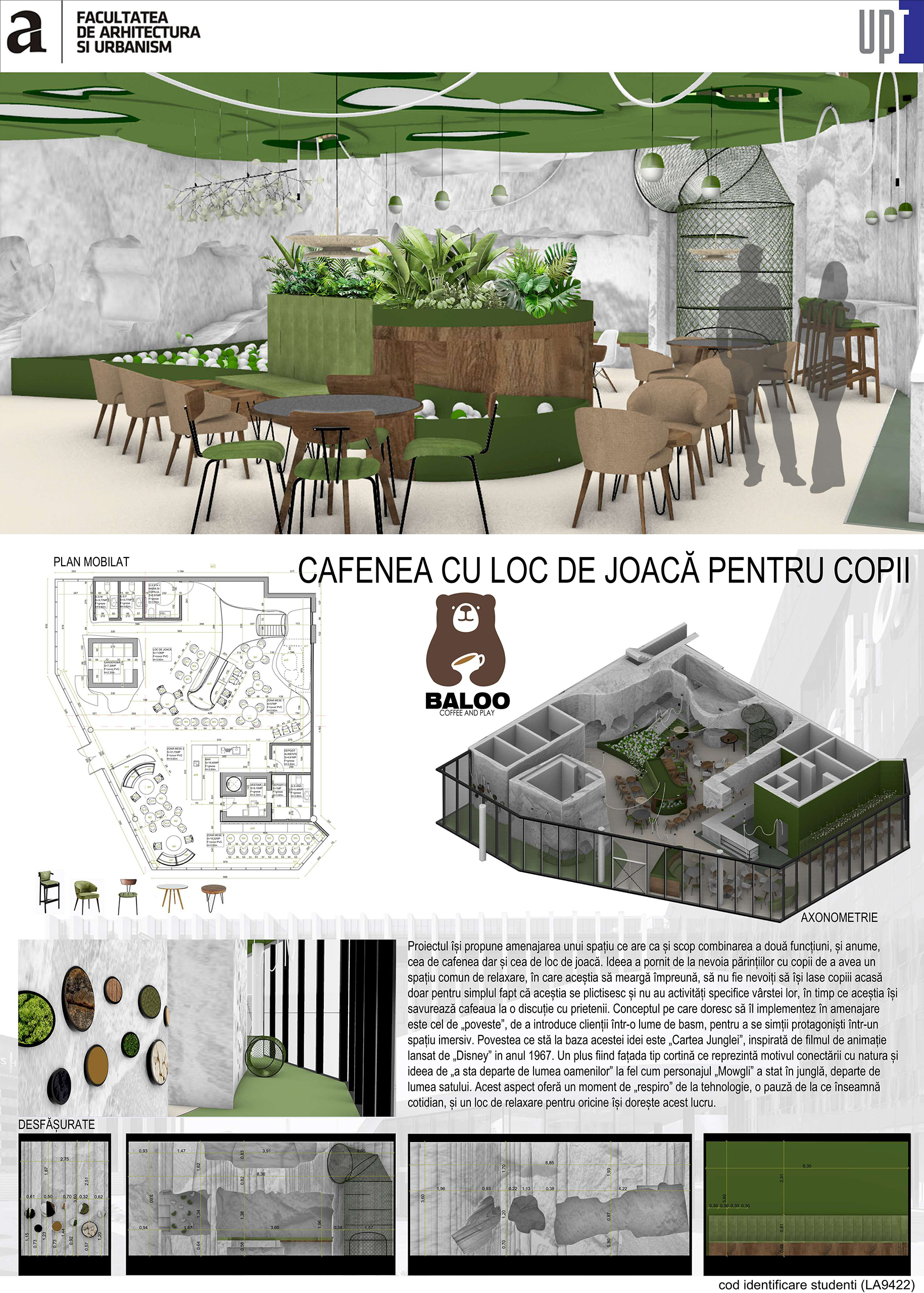
The chosen space will be designed taking into account the architectural program of which it will be part, more precisely it will combine two architectural programs, namely the café, but also the playground. The space will serve all people, regardless of age, and it will also be easily accessible, being located on the ground floor.
The idea of a cafe with a playground started from the need of families with children to have a common meeting place, where their children can have interactive activities, playgrounds, while parents enjoy their coffee, the little ones end up not getting bored on an outing with adults.
The game is also introduced into the world of adults, where they can also enjoy an unforgettable experience. Every adult was once a child, and this helps to combine their needs and the possibility of starting from a common point for both categories, namely the story, which is also the concept behind the cafe’s layout, a story known to both children and adults. The chosen story is “The Jungle Book”. This story correlates with the chosen space, through nature, with the help of the showcase and the exterior of the building area. Bringing the “jungle” into the heart of the ISHO residential complex represents a respite from technology in a pleasant and modern ambiance. The motif of the showcase represents the idea of staying away from the “human world”, just as the main character of the story, Mowgli, stayed in the jungle with the animals, and away from the village population. The beneficiaries have an “exit” from the city world, in a relaxing space, with activities that will take them out of their daily routine.
Students: Gligor Denisa
Coordinating Professor: Conf. Dr. Arch. Andreea Anghel
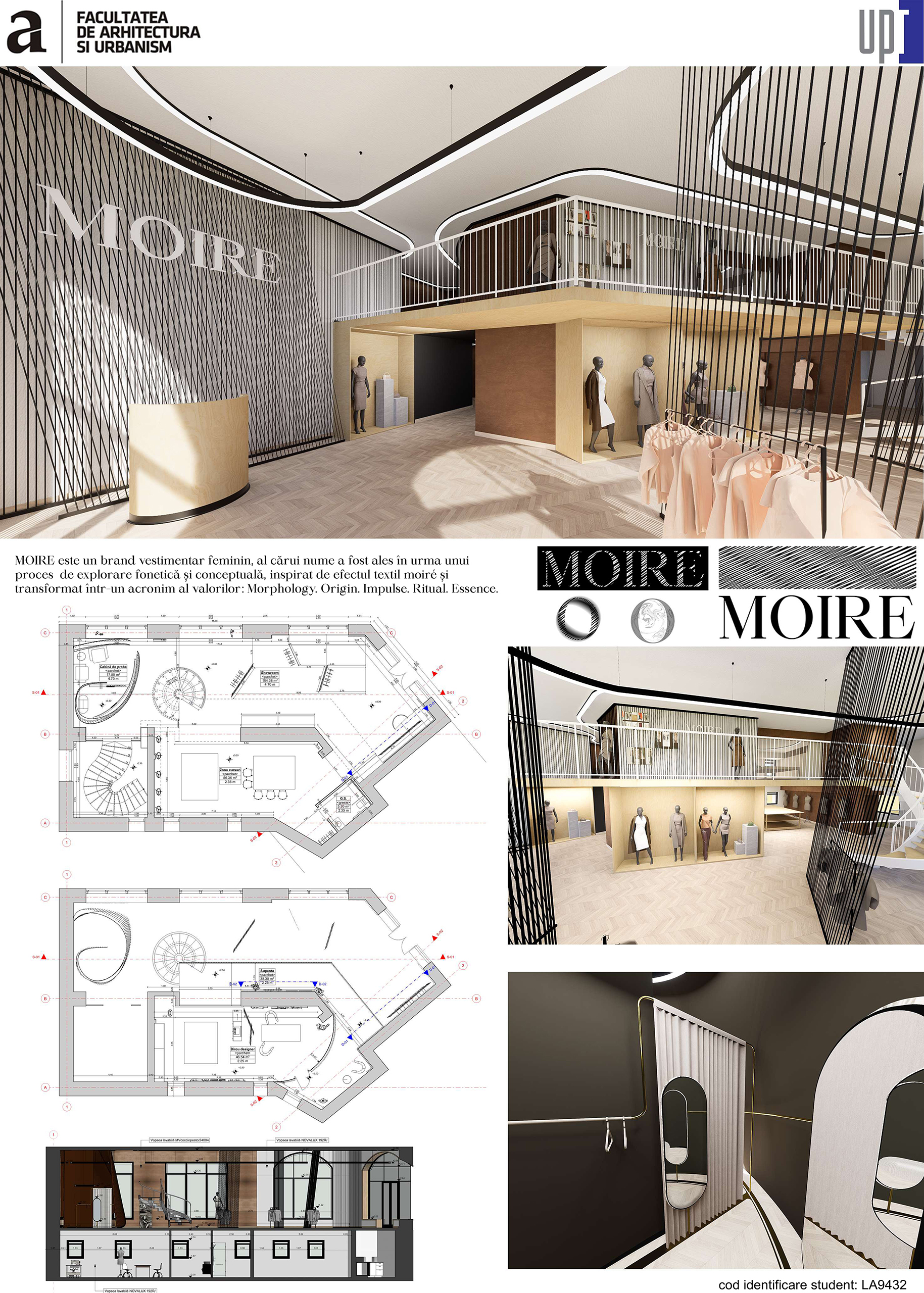
This project presents the design proposal for a womenswear showroom with an area dedicated to sewing workshops, located within an existing space on the ground floor of a historic building in the center of Timișoara: Palatul Bănățean, Piața Sf. Gheorghe no. 2. The intervention aims to enhance the relationship between interior design and brand identity through a unified visual language inspired by the process of garment production.
The space has a total surface of 595.99 sqm, distributed across three levels—basement, ground floor, and a partial mezzanine—and occupies part of the building’s basement and ground floor. Currently functioning as a political headquarters, the project proposes its refunctionalization into a womenswear showroom.
The working hypothesis starts from the premise that, in the context of a fashion showroom, interior design can serve as a direct extension of brand identity, actively contributing to visual communication and to shaping a coherent user experience.
The design concept is inspired by the transformation process of garment patterns, exploring the transition from two-dimensional surfaces to three-dimensional volumes. This principle is spatially translated through the use of ruled surfaces made of tensioned cables, evoking both the structure of woven fabrics and the fluid dynamics of material in garment construction. The interior aims to balance rigidity and flexibility, generating an atmosphere aligned with the brand’s values.
The visual identity of the brand “MOIRE” reflects the same idea of rhythm and layering, inspired by the visual effect created through superposition. The name selection and logo development express, both visually and symbolically, the essence of the project and contribute to integrating the interior design into a coherent spatial–brand communication system.
The project was developed based on the analysis of the existing historically valuable space, currently affected by provisional interventions, and on the need to adapt it to a commercial function. The functional layout is organized into public, semi-public, and private areas according to activities and user categories, while the design concept is implemented through reversible materials and constructive elements compatible with the building’s heritage status. The choice of furnishings, materials, and overall spatial scenography supports the brand identity and proposes a coherent experience that balances functionality and expressiveness.
Student: Hadar Amanda Vivienn
Coordinating Professor: Asist. Dr. Arch. Brîndușa Havași
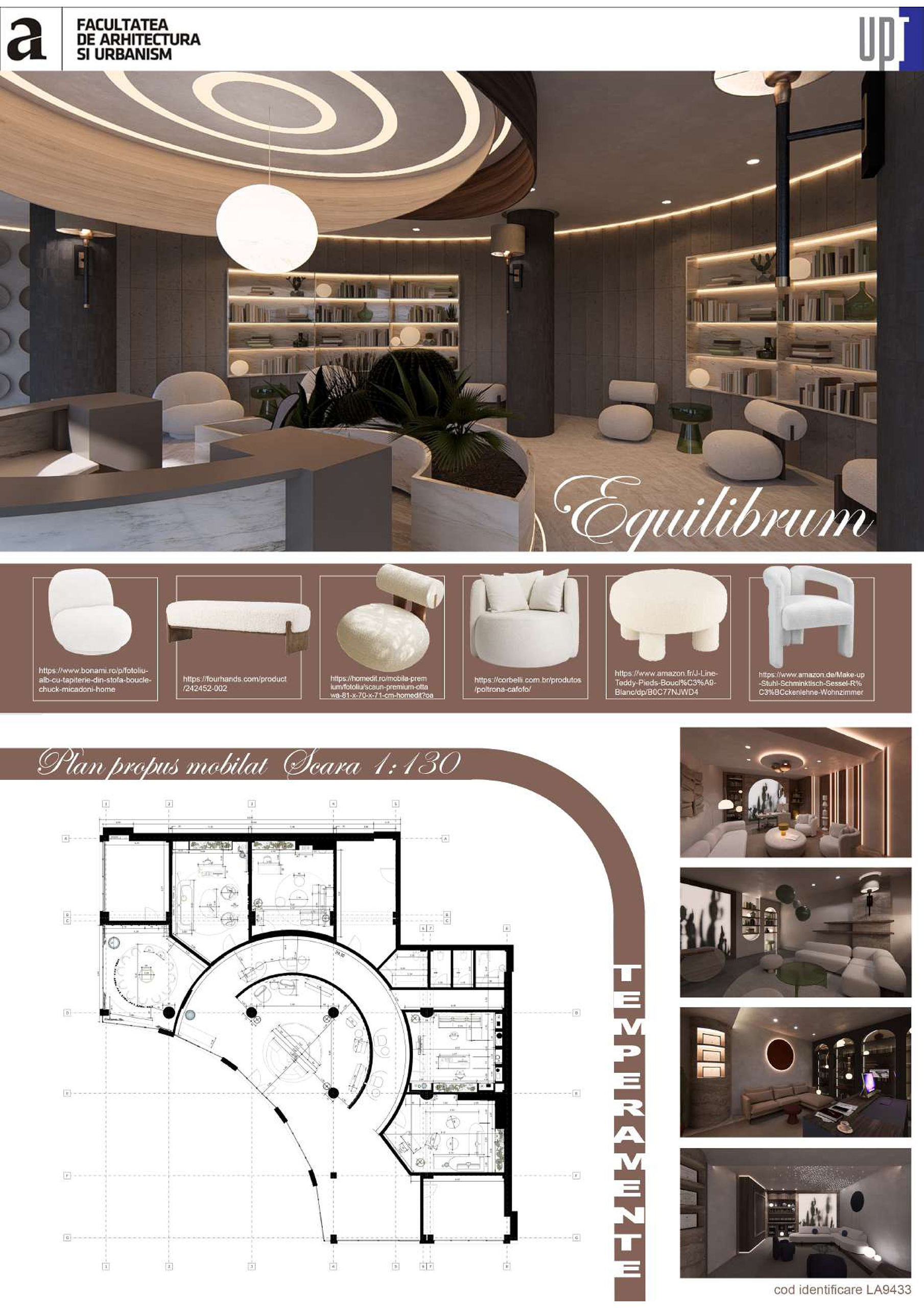
This bachelor’s thesis proposes the design of a psychotherapy center based on the concept of balance between body and mind, achieved through a calm, minimalist, and harmonious atmosphere. The chosen intervention space is defined by a semicircular storefront and imposing, obstructive structural elements, such as columns, which have been integrated into a contemporary interior concept inspired by nature and the aesthetics of simple lines.
Starting from the real need of urban residents to enhance their emotional well-being in environments tailored to their personal needs, the project proposes a spatial organization that merges functionality with aesthetics. The access area—the reception with a semicircular library—acts as a neutral transitional space, offering a first impression of the concept of balance. It can be described as a “central node” from which the four temperaments and relaxation areas branch out.
The thesis explores how interior space influences the psychotherapeutic process, aiming to adapt therapy rooms to the four temperament types: choleric, sanguine, phlegmatic, and melancholic. The proposed psychotherapy center, titled Equilibrum, is conceived as a unified and aesthetically coherent space, with subtle variations that evoke different moods and sensations suited to each temperament.
The methodology includes theoretical documentation on temperament psychology and interior design principles, as well as applied research based on surveys and questionnaires conducted personally with close contacts (friends, family members, colleagues), tracking their preferences according to temperament profiles. Additionally, a functional analysis was carried out on three similar spaces identified online and on a real psychotherapy center in Târgu Mureș — Del Alma. Conversations with psychotherapist Daniel Popescu, one of the city’s most renowned specialists, helped shape a professional perspective on the relationship between space and the therapeutic process. To complement the research, the book Surrounded by Idiots by Thomas Erikson was studied, offering a clear and detailed analysis of the four temperament types.
The proposed outcome is an innovative interior design that integrates psychology and design into a unified, minimalist, and modern concept. Through the use of a neutral color palette, similar textures, and curved forms, the space conveys a calm and welcoming ambiance, inspired by spa-like environments. At the same time, each therapy room is subtly differentiated through details that evoke the dominant traits of the corresponding temperament: control and professionalism for choleric; optimism and energy for sanguine; calm and stability for phlegmatic; and depth and introspection for melancholic.
The thesis emphasizes the importance of personalizing space according to the psychological characteristics of its users, demonstrating that a thoughtful design approach can support the therapeutic act and contribute to the individual’s sense of balance.
In conclusion, the project offers an innovative therapeutic space that enhances the existing architecture through a carefully crafted design, adapted to current needs and oriented toward balance and harmony.
Student: Truică Daiana-Cristina
Coordinating Professor: S.l. Dr. Arch. Alexandra Keller
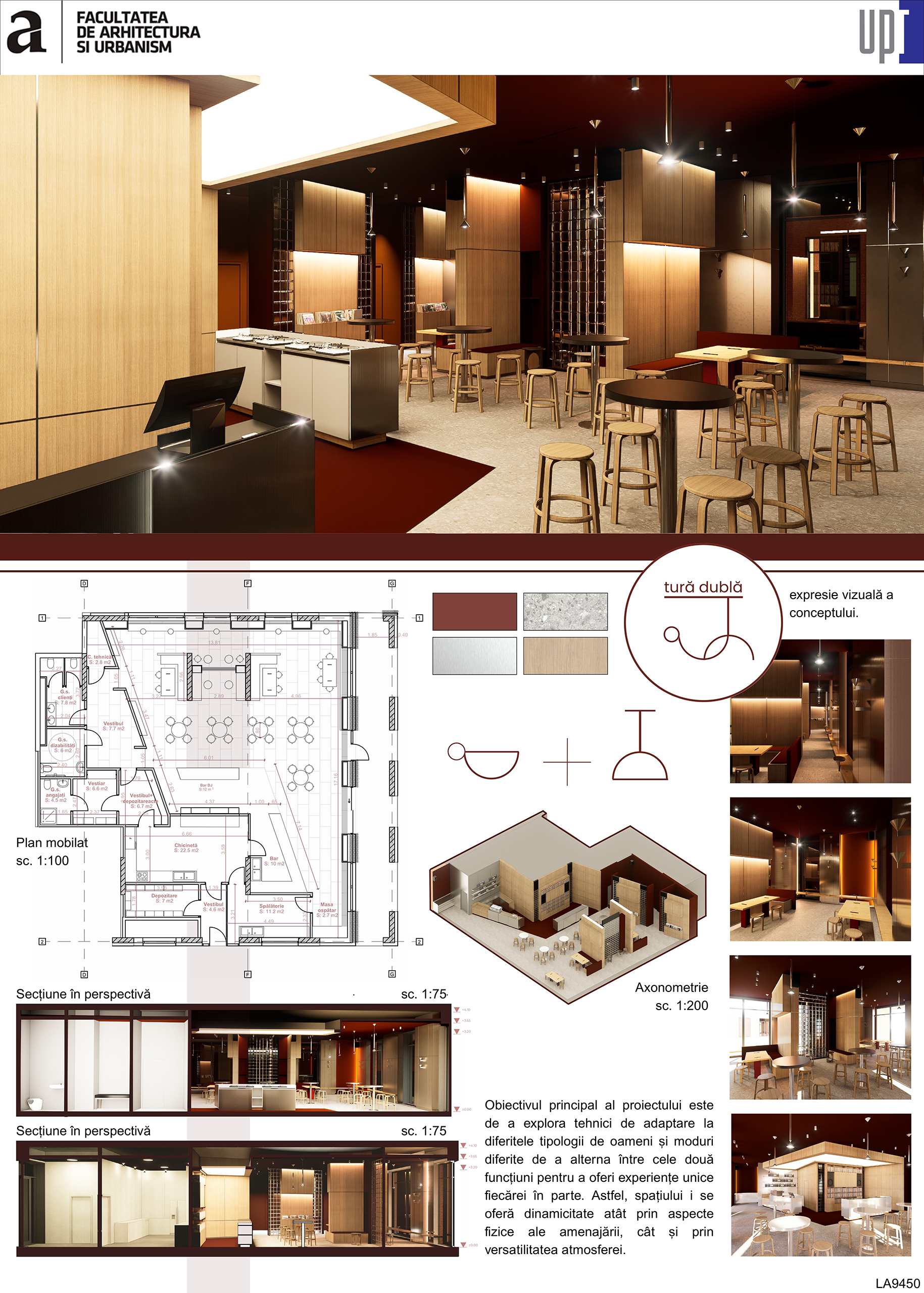
Located in a former industrial area, the Paltim complex was built on the site of the old Hat Factory, from which it also takes its name. In recent years, this area has undergone significant development in terms of urban infrastructure, shifting from its industrial past towards a residential future, becoming a point of interest in a constantly evolving city. This, a place that once lacked social activity is being transformed into one that brings together various types of people duet o the diversity of its current functions: Nokia, the North Train Station, the residential complexes „Paltim”, „City of Mara”, „Monarch”,the second building of the University of Medicine Timișoara, the Bega river shore, and others.
My bachelor project aims to design a space with a dual function, an urban café during the day and a music bar in the evening. The concept of „Tură Dublă” („Double Shift”) is meant to suggest both the two distinct functions of the space and the idea of work shifts, making a subtle reference to the site’s industrial past. The main objective of the project is to explore ways of adapting to various types of people and to alternate between the two functions in order to offer unique experiences for each. Thus, in the process of designing this space, I considered a multitude of aspects to ensure the environment is as inclusive as possible, taking into account the different needs of a diverse audience and identifying methods to transform the daytime space into a nighttime one, allowing them to be perceived differently and have their own identity. Some of these elements include natural and artificial lighting, furniture, directional flow, contrast of materials, contrast of materials, all contributing to the creation of a flexible, captivating space.
Regarding the „listening bar” function, increasingly present in major urban centers, it is a current trend embodied by venues that promote listening and reconnection with music in a social context. This trend dates back to the 1920s, originating in Japan, where it emerged through spaces where people could gather together to drink and listen to music [1]. Given the absence of such a function in the city, I considered this conxept to be a suitable match for the location, duet o the diverse, multigenerational public.
Student: Vincze Erika-Antonela
Coordinating Professor: Spec. Mob. & Interior Design Carmen Săndescu
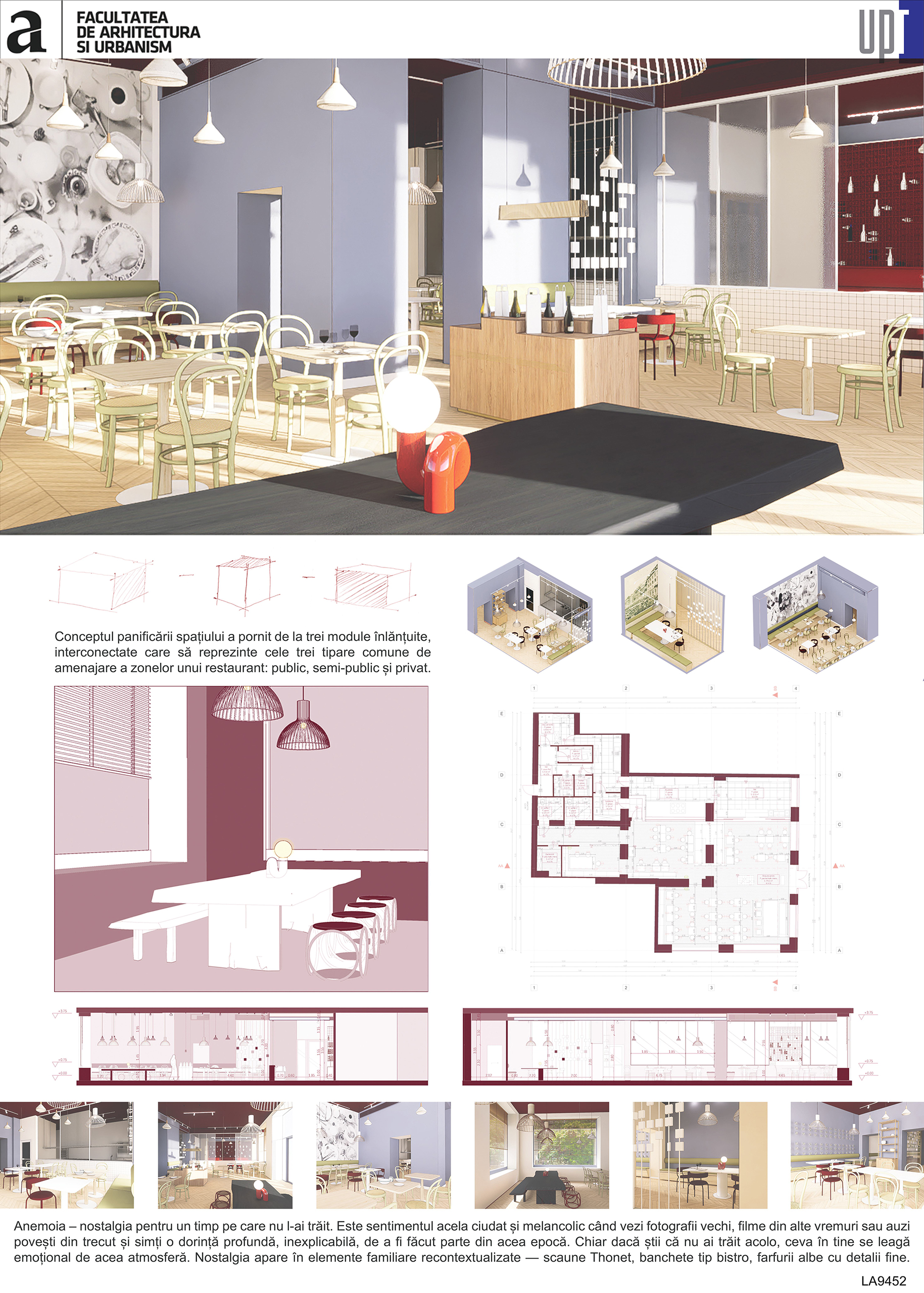
Located in the historic main district of Timișoara, the chosen space for refunctionalization is situated on the ground floor of a building first attested in a 1929 postcard. However, the exact moment of its construction cannot be precisely identified, as the boulevard itself took shape following the demolition of the old fortifications and the urban planning strategies implemented at the end of the 19th century. The building already appears on the 1893 masterplan designed by Ybl Lajos and Kovács Aladár (information sourced from the historical–urban study of the Cetate district conducted by Lecturer Dr. Architect Bâldea Maja and Associate Professor Dr. Architect Gabriela Domokoș-Pascu).
Starting from the relatively fragile and undated history of the space, a common thread was identified—a subtle emotional fiber called nostalgia—which became the guiding theme of the design and its stylistic influences. By exploring concepts related to emotional consumption, dining rituals across cultures, and contemporary marketing strategies, the term anemoia emerged, most often associated with places, sounds, or flavors. According to recent marketing studies, invoking nostalgia in the selling process generates feelings of calm and relaxation in the consumer, increasing the desire to engage with or consume the targeted product. Yet nostalgia, studies show, often transcends the consumer’s own lived experience. This emotion is referred to as anemoia, defined in The Dictionary of Obscure Sorrows by John Koenig as “nostalgia for a time you never lived.”
The proposed interior concept is built around this emotion—anemoia—interweaving visual and symbolic references from various eras and cultural contexts. The technique of temporal collage was employed in the selection of furniture, merging stylistic influences from different periods to create an atmosphere that feels both timeless and familiar. Rich textures, warm color palettes, and decorative details subtly evoke fabricated yet believable memories—a world that feels known, even if never actually experienced.
Here, every object, color, and texture contributes to an emotional narrative, inviting the visitor not only to consume, but to feel. The space becomes a symbolic extension of the idea of home—an inner refuge where time seems to pause. In a society marked by a fast pace and emotional fragmentation, the project proposes a return to essentials: connection, stillness, and the genuine joy of sharing a meal.
In this context, the association with the name “dor” came naturally. It is one of the most emotionally charged and culturally significant words in the Romanian language—endemic and without a direct equivalent in other languages or dialects. Rather than functioning as a simple noun, it represents a cultural concept. In meaning, “dor” lies at the intersection of absence, nostalgia, and affection, its semantics extending beyond everyday language.
Likewise, the designed restaurant aims to dwell, at a soulful level, within the intersection of these three powerful feelings, embodying a symbolic expression of emotional depth and a profound affective relationship with the past, with what is missing, and with one’s identity. With warmth, intimacy, and familiarity at its core, the space is envisioned as a place of reunion and rediscovery—with tastes, with memories, and with loved ones.
Student: Voina Vanessa
Coordinating Professor: Conf. Dr. Arch. Cristina Povian
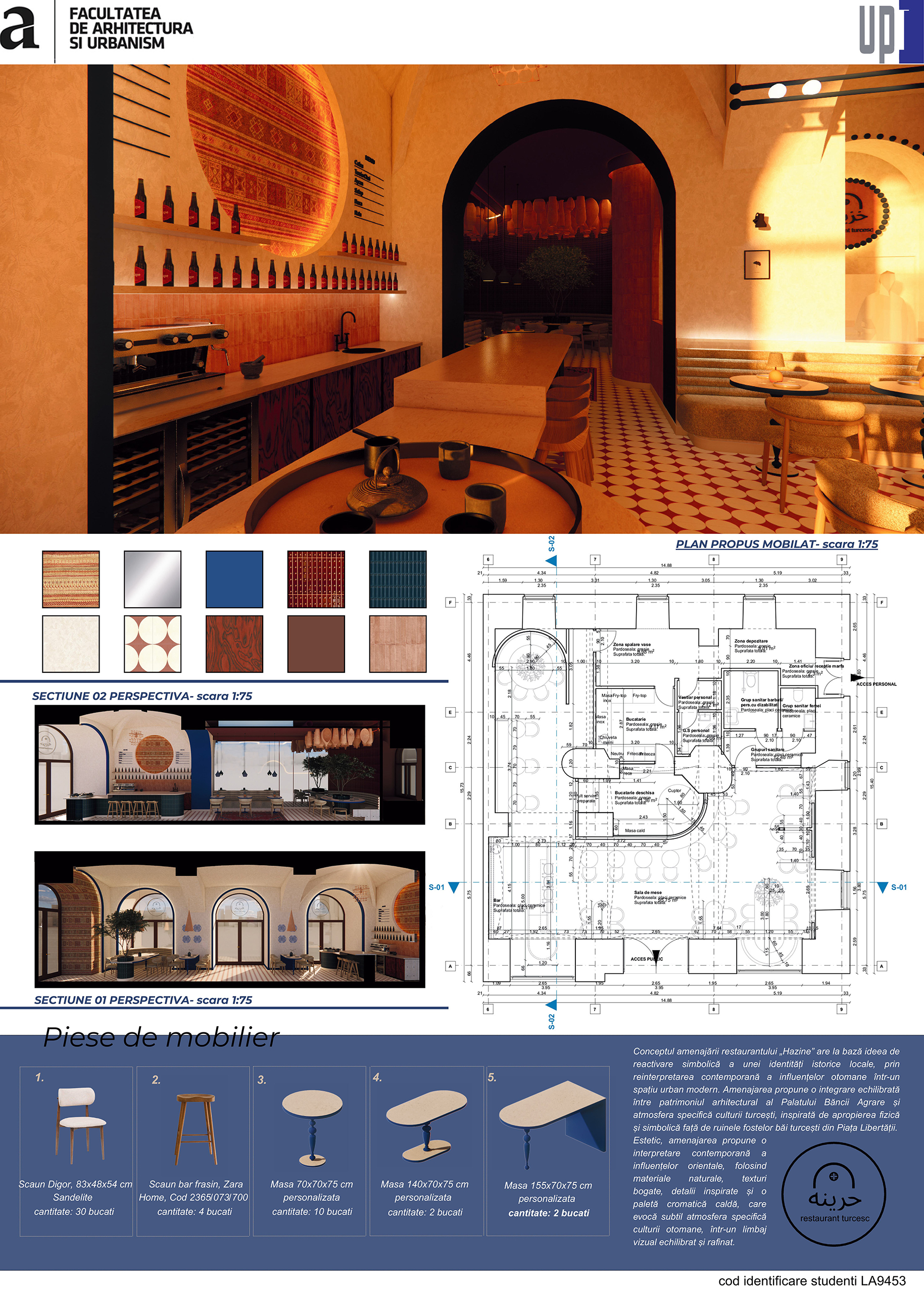
This bachelor thesis proposes the development of a Turkish restaurant, called Hazine, in the historical center of Timișoara. The space chosen for the intervention is located on the ground floor of the Palace of the Agrarian Bank, a building with architectural and historical value, located in Libertății Square. Starting from the location of the space in an area with a strong historical charge, in the immediate vicinity of the ruins of the Turkish baths, the project proposes the symbolic reactivation of a historical layer often ignored, but essential in shaping the urban identity of Timișoara.
At the same time, a real need was identified among the local public for a public eating place with a Turkish specificity, offering not only gastronomic services but also a coherent cultural experience. The objective of the research was formulated as an attempt to integrate these historical values into a contemporary space for the general public, while responding to current HoReCa standards.
The central hypothesis assumes that a space with architectural and symbolic value can gain a new contemporary function while preserving its identity—provided it is approached through a carefully developed design concept that is closely tied to the historical context and specific character of the place. The resulting project proposes a balanced and coherent solution, both aesthetically and functionally. Natural and durable materials were used, adapted to the demands of a public space, while the visual elements were selected to subtly evoke Ottoman influences without replicating historic styles.
In conclusion, the project succeeds in highlighting the historic character of the site through a carefully constructed contemporary design, adapted to the current needs of the users and harmonized with the architectural and cultural specificity of the area.
2025 | PROIECTARE DE INTERIOR 2 | M02
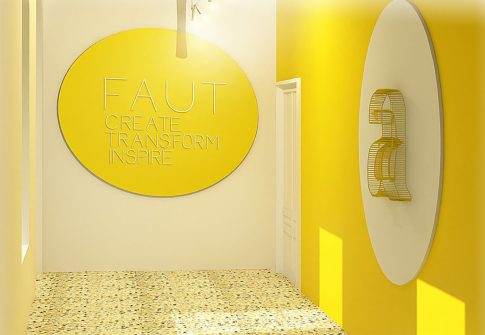
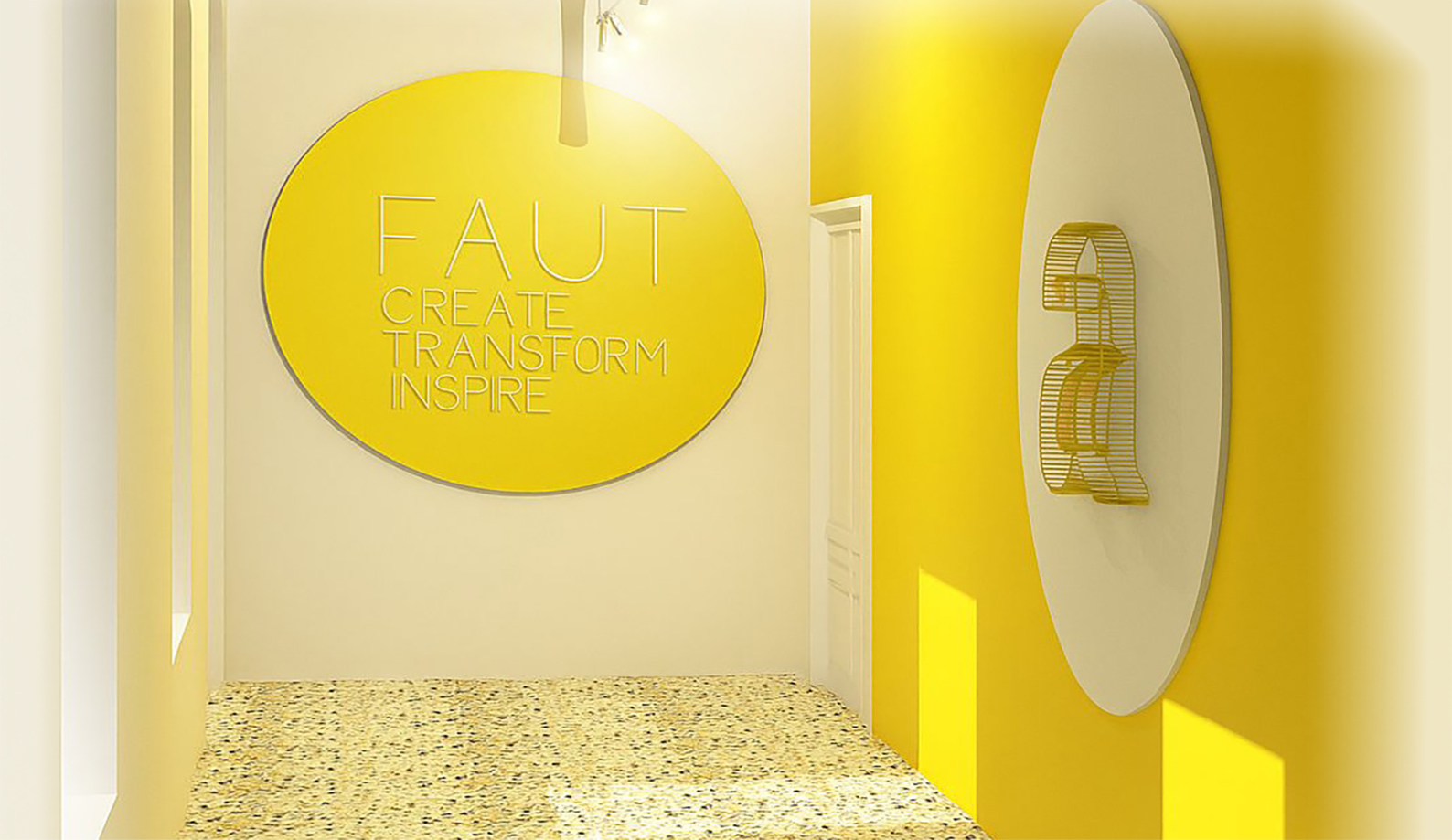
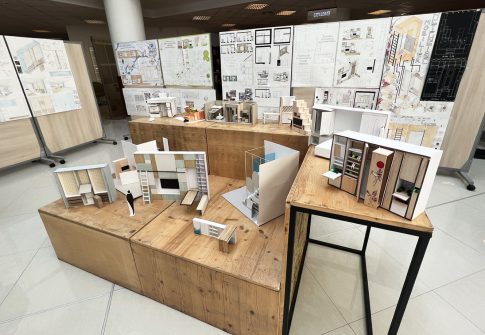
RO: Studenții au avut ca temă amenajarea unui spațiu tip atelier multidisciplinar destinat chiar lor, studenților din cadrul specializării. Folosind ca suport spațiile fostei Facultăți de Chimie, au rezolvat un spațiu de învățământ cu caracter flexibil, bazat pe învățare prin colaborare, ce a presupus un grad mare de flexibilitate în configurarea amenajării. Rezolvările au avut de integrat în mod complex funcții variate: spații de predare, de lucru (individual și în echipă) și de machetare, bibliotecă de materiale, zone de expunere a proiectelor și machetelor și zone de relaxare. Etapele proiectului au presupus dezvoltarea conceptului și schemei de zonificare, proiectul tehnic cu dezvoltarea propunerii de amenajare, faza de detaliere ce a inclus și prototiparea unei machete de studiu și proiectul concluziv.
EN: The students had to design a multidisciplinary workshop-type space intended for themselves, the students of the specialization. Using as support the spaces of the former Faculty of Chemistry, they solved a flexible educational space, based on collaborative learning, which assumed a high degree of flexibility in the configuration of the layout. The solutions had to integrate various functions in a complex way: teaching, working (individual and team) and modelling spaces, a materials library, areas for displaying projects and models and relaxation areas. The project stages assumed the development of the concept and zoning scheme, the technical project with the development of the layout proposal, the detailing phase which also included the prototyping of a study layout and the conclusive project.
2025 | DESIGN GRAFIC | M03
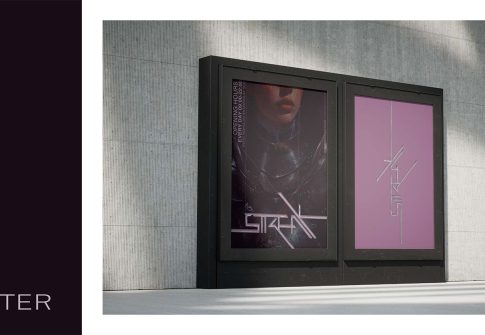
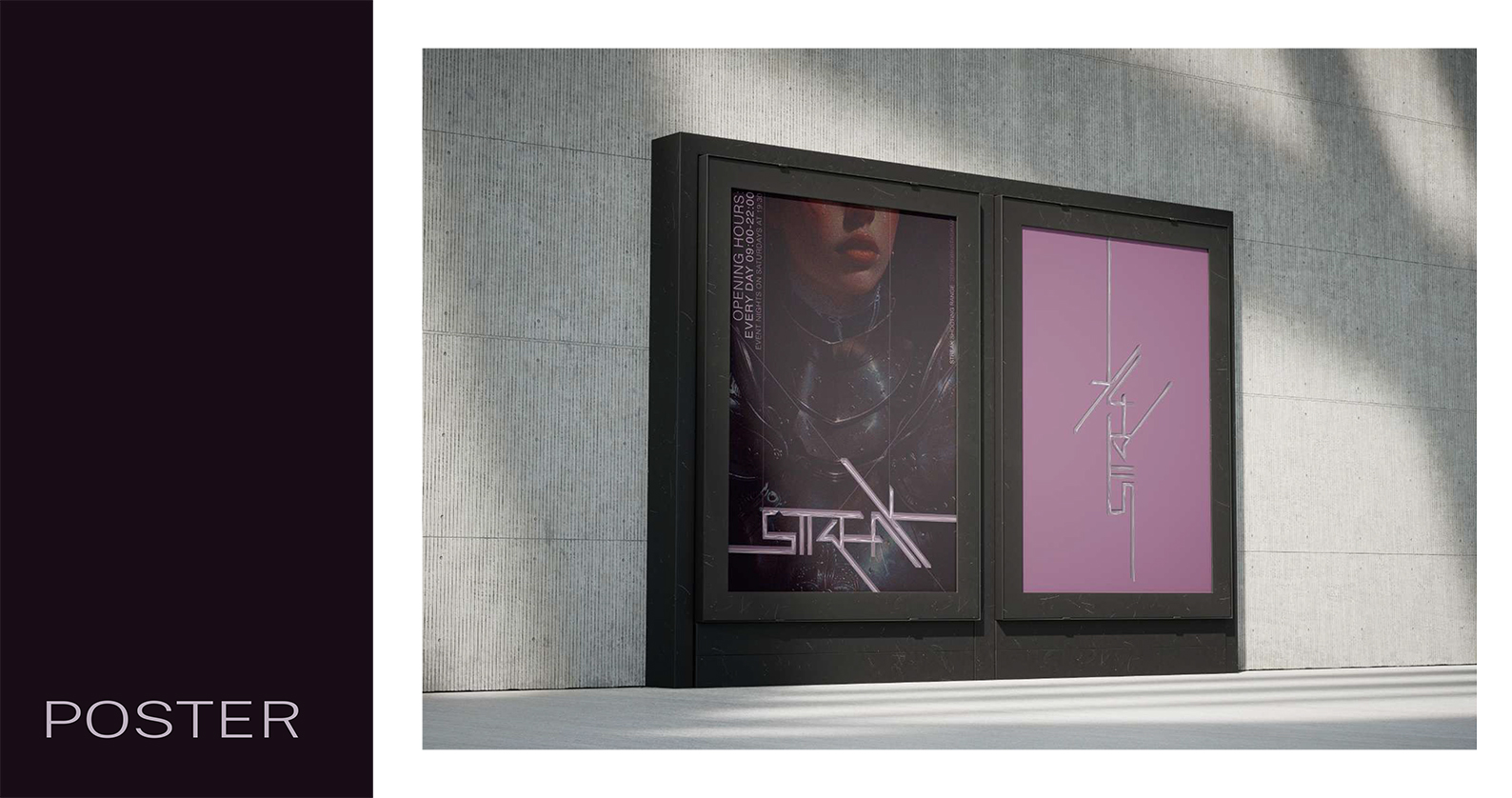
RO: Exercițiul dezvoltat de generația 2024–2025 a avut ca obiect realizarea unui portofoliu de identitate și branding pentru programul arhitectural studiat în cadrul atelierului de Arhitectură de Interior 5: un poligon de tir sportiv.
Conceput ca parte a activităților de seminar, portofoliul este dezvoltat în trei etape principale. Prima etapă este dedicată definirii valorilor fundamentale ale proiectului printr-o serie de cinci imagini evocatoare, menite să comunice temele centrale ale conceptului arhitectural fără a recurge la reprezentări arhitecturale directe. Scopul este de a distila atmosfera conceptuală și narațiunea proiectului într-un limbaj vizual care precede imaginea arhitecturală propriu-zisă.
A doua etapă continuă această explorare prin transpunerea valorilor identificate într-o identitate verbală și grafică. Studenții definesc un nume al proiectului (brand) și dezvoltă un logo sau logotip, parcurgând un proces care include atât exerciții de type design, cât și de typesetting.
În a treia etapă, studenții construiesc structura și layout-ul general al portofoliului, testând în același timp sistemul de identitate vizuală printr-o serie de aplicații grafice. Acestea includ postere, bannere pentru social media, elemente de merchandising și inserții în spațiu, permițând explorarea identității ca sistem coerent de comunicare la nivelul diferitelor medii și scări de reprezentare.
EN: The exercise developed by the 2024–2025 cohort focused on the creation of a branding and identity portfolio for the architectural program studied within Interior Architectural Design Studio 5: a sports shooting range.
Conceived as part of the seminar activities, the portfolio is developed through three main stages. The first stage is dedicated to the definition of the project’s core values through a series of five evocative images intended to communicate the central themes of the architectural concept without relying on direct architectural representations. The aim is to distill the conceptual atmosphere and narrative of the project into a visual language that precedes the architectural image itself.
The second stage continues this exploration by translating the identified values into a verbal and graphic identity. Students define a project name (brand) and develop a logo or logotype, engaging in a process that includes both type design and typesetting.
In the third stage, students construct the overall structure and layout of the portfolio, while also testing the visual identity system across multiple graphic applications. These include posters, social media banners, merchandising elements, and spatial insertions, allowing the identity to be explored as a coherent communication system across different media and scales.
2025 | PROIECTARE DE INTERIOR 1| M02
RO
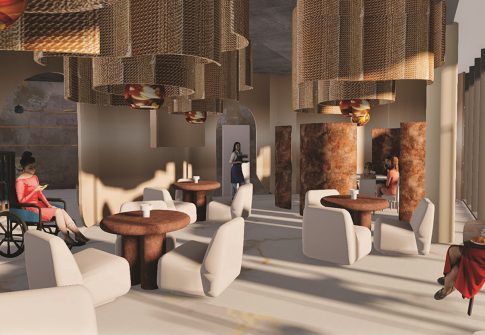
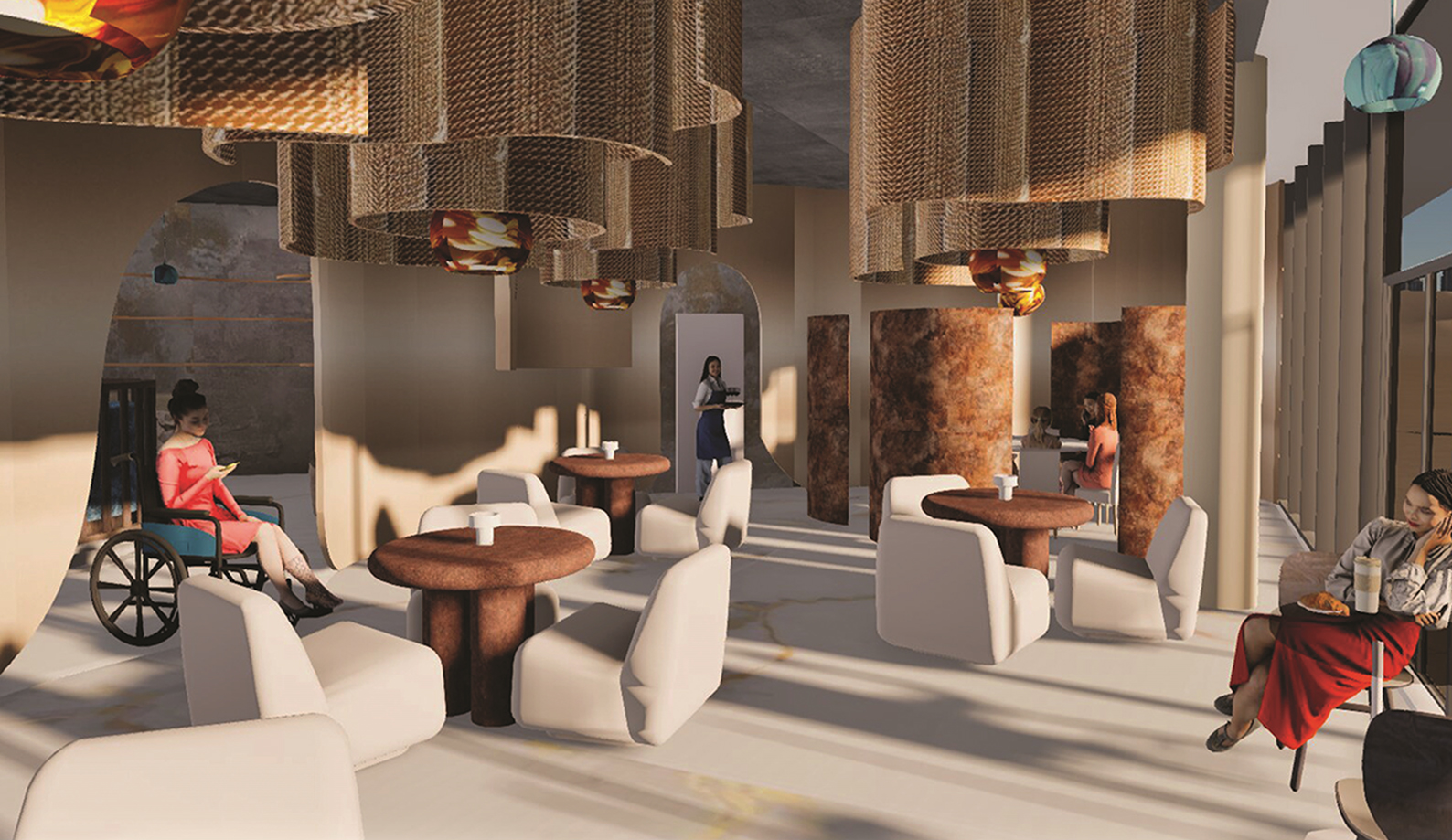
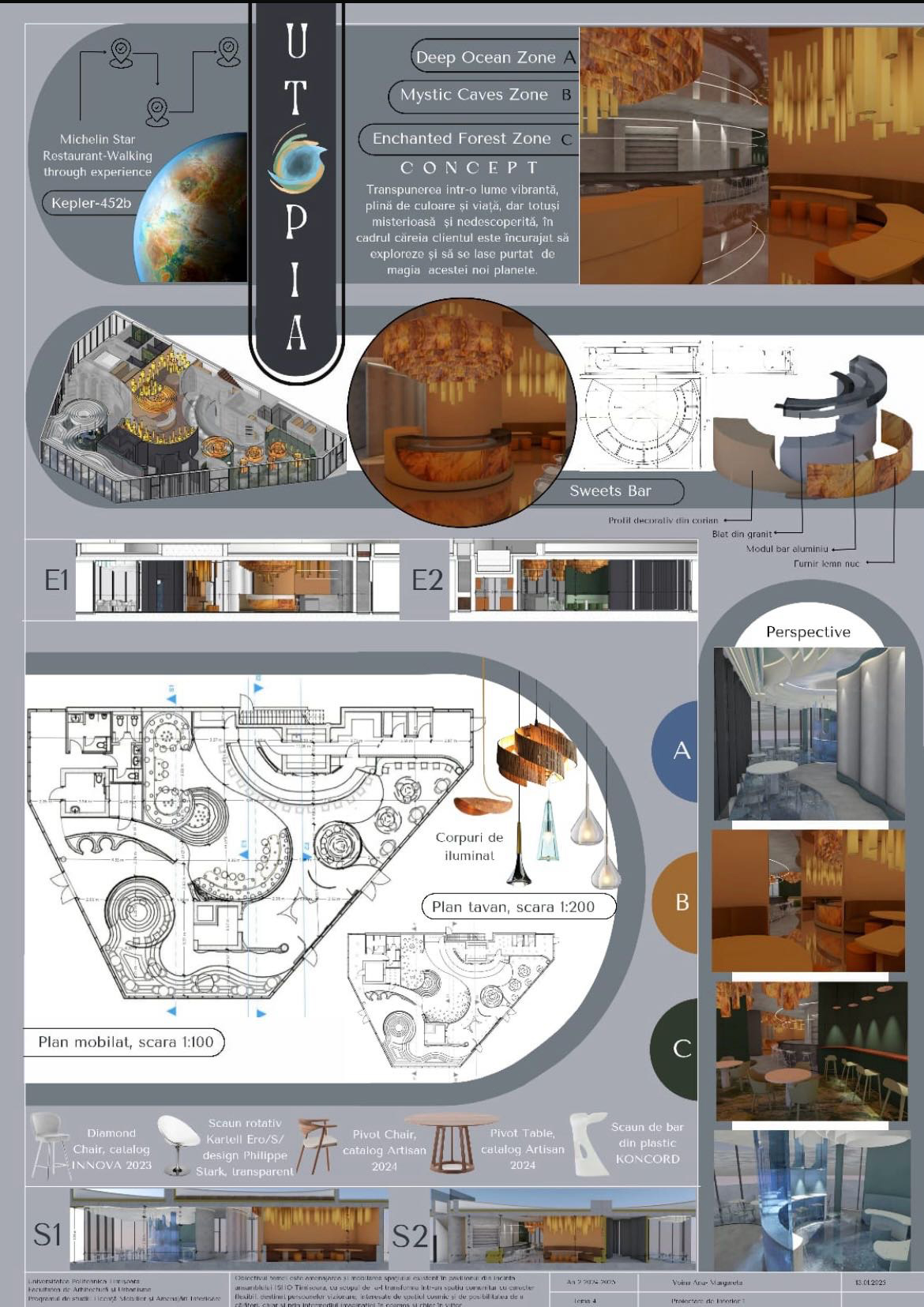
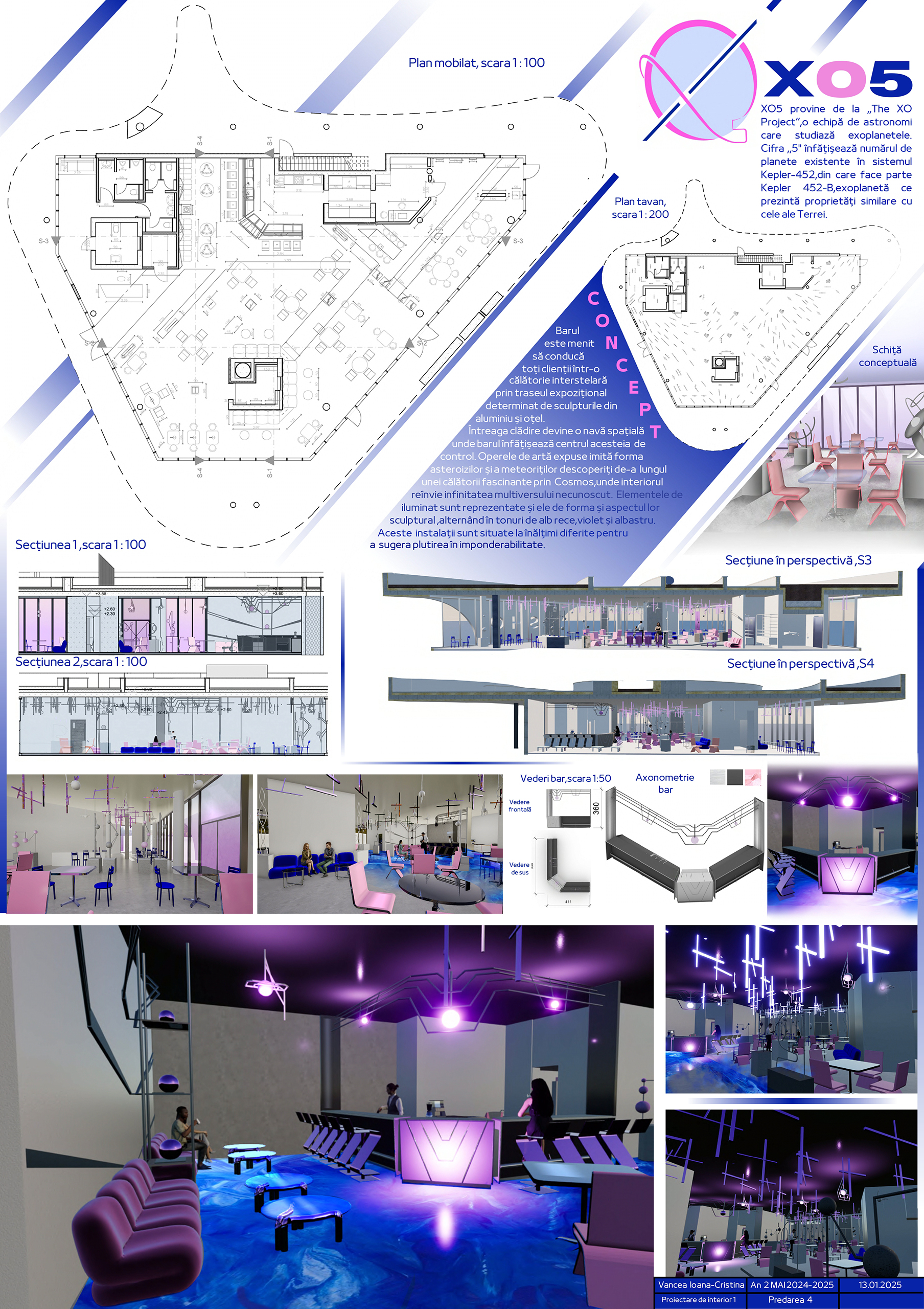
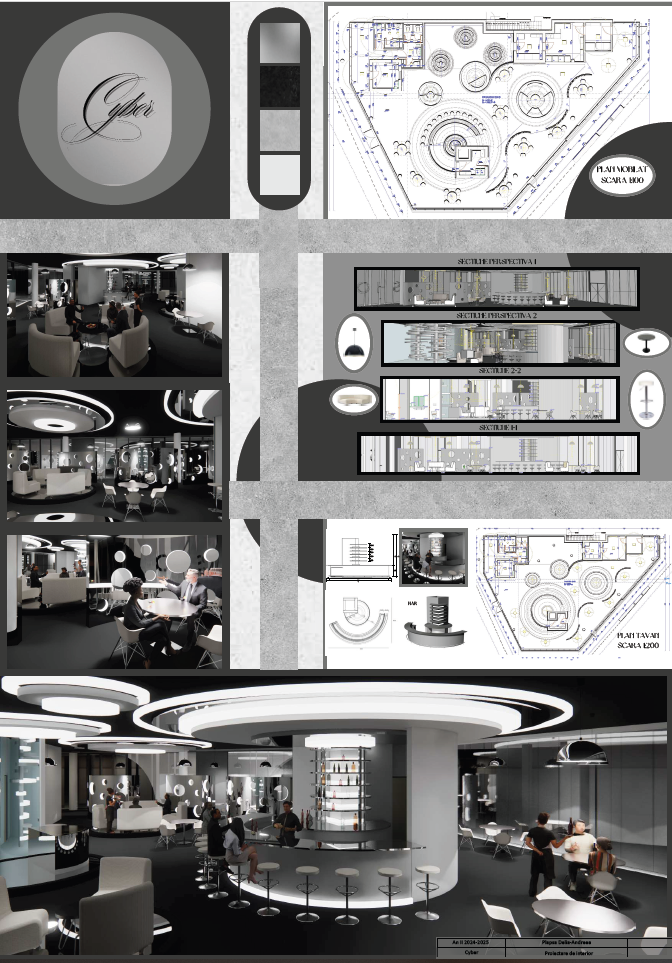
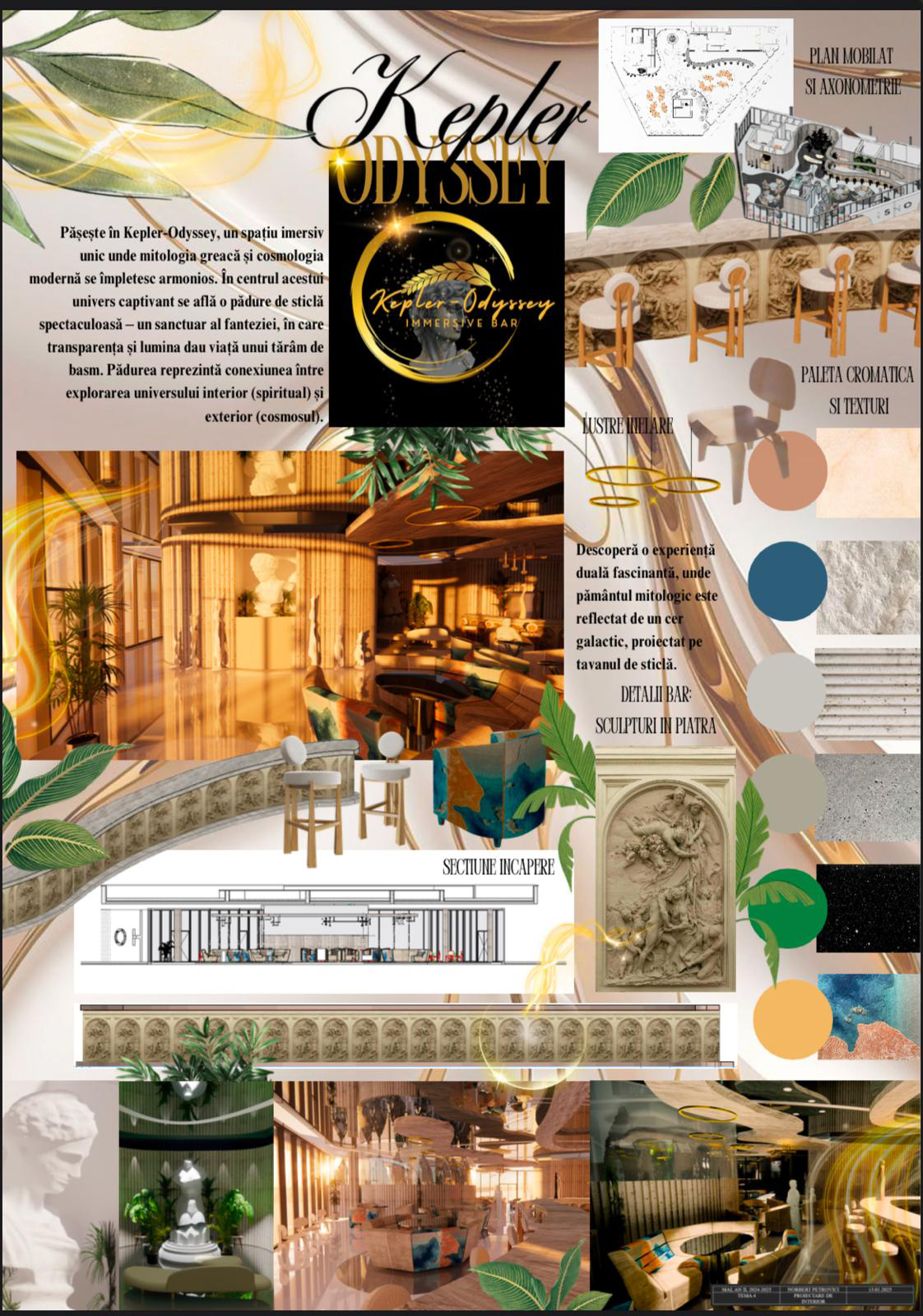
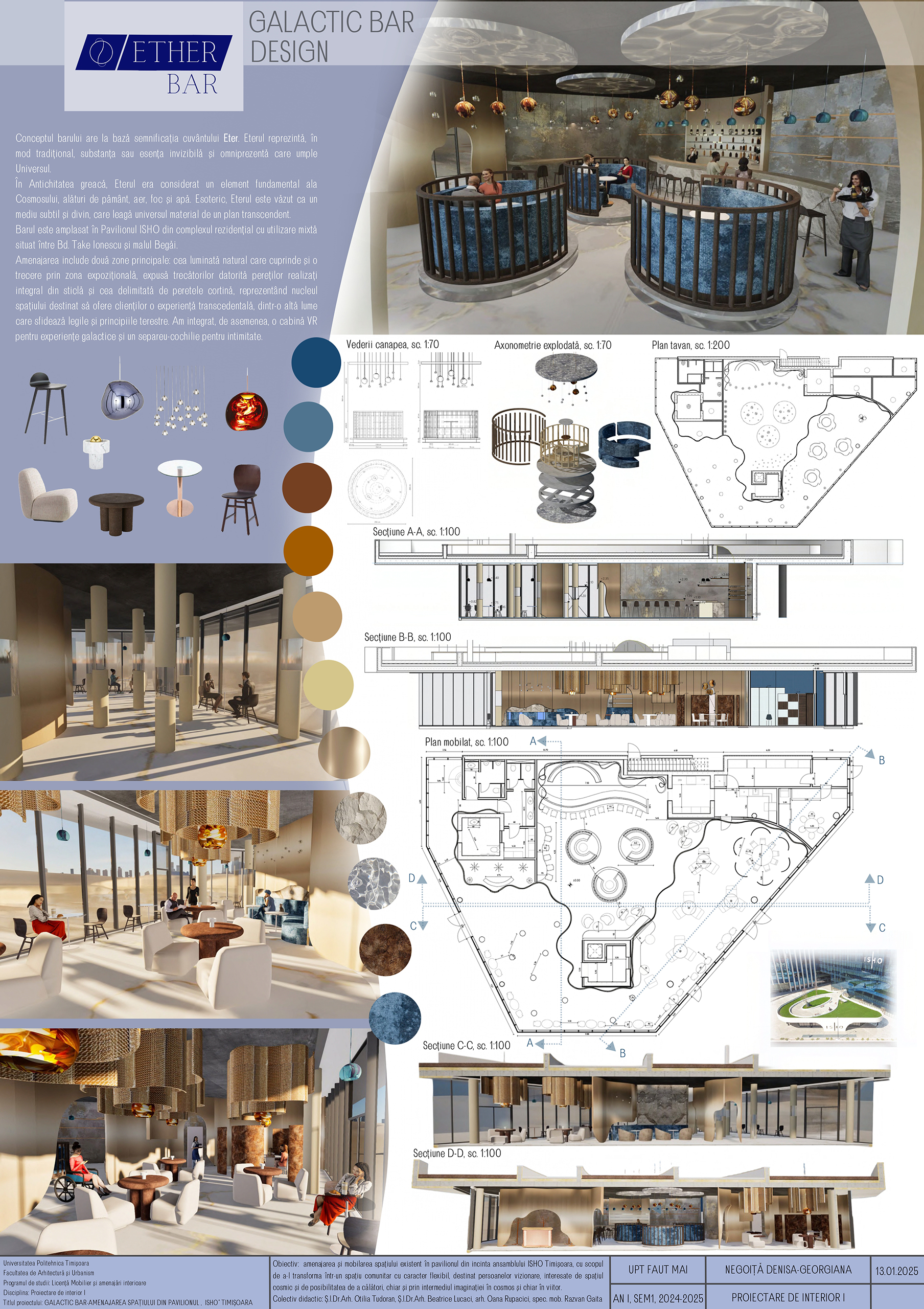
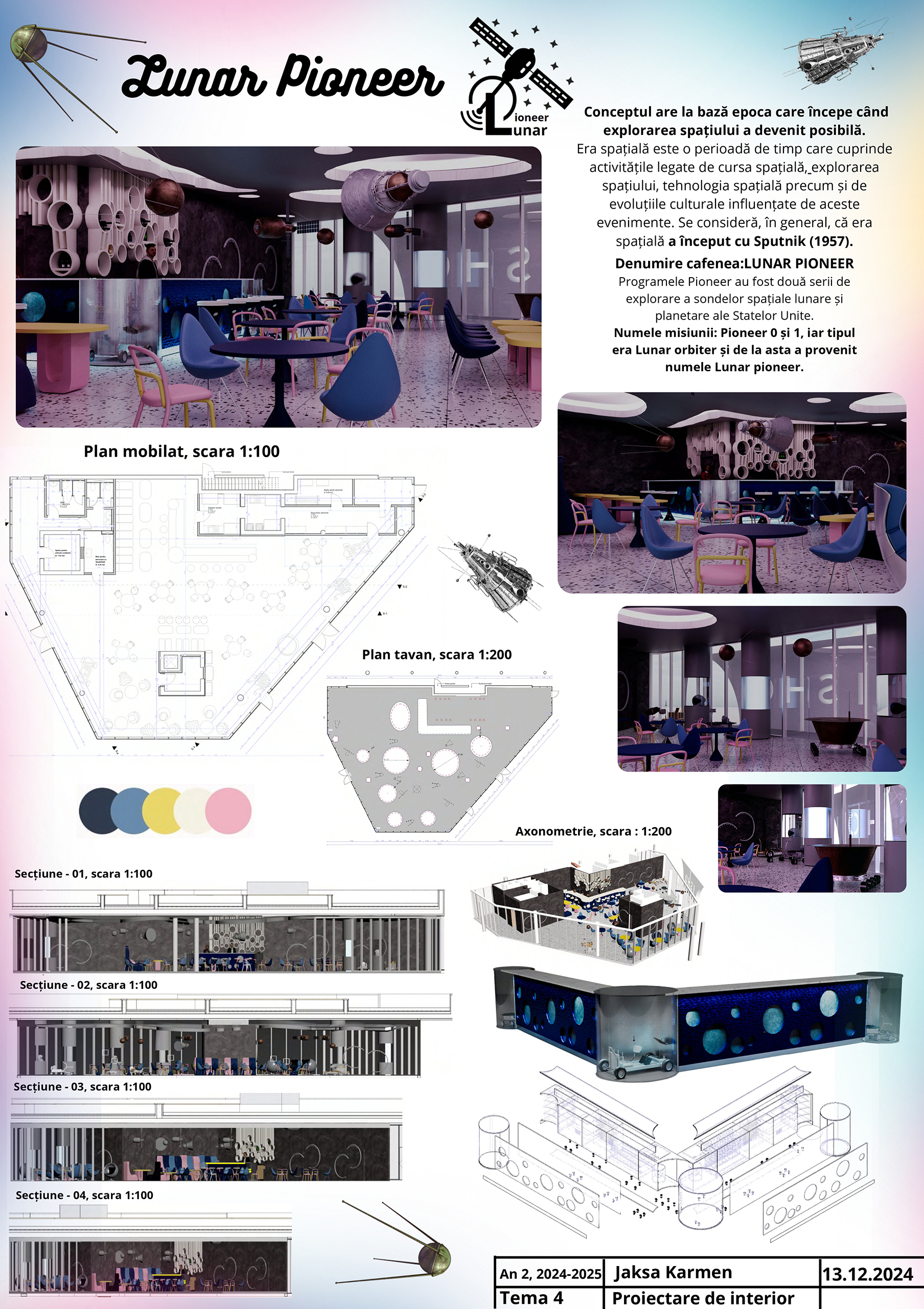
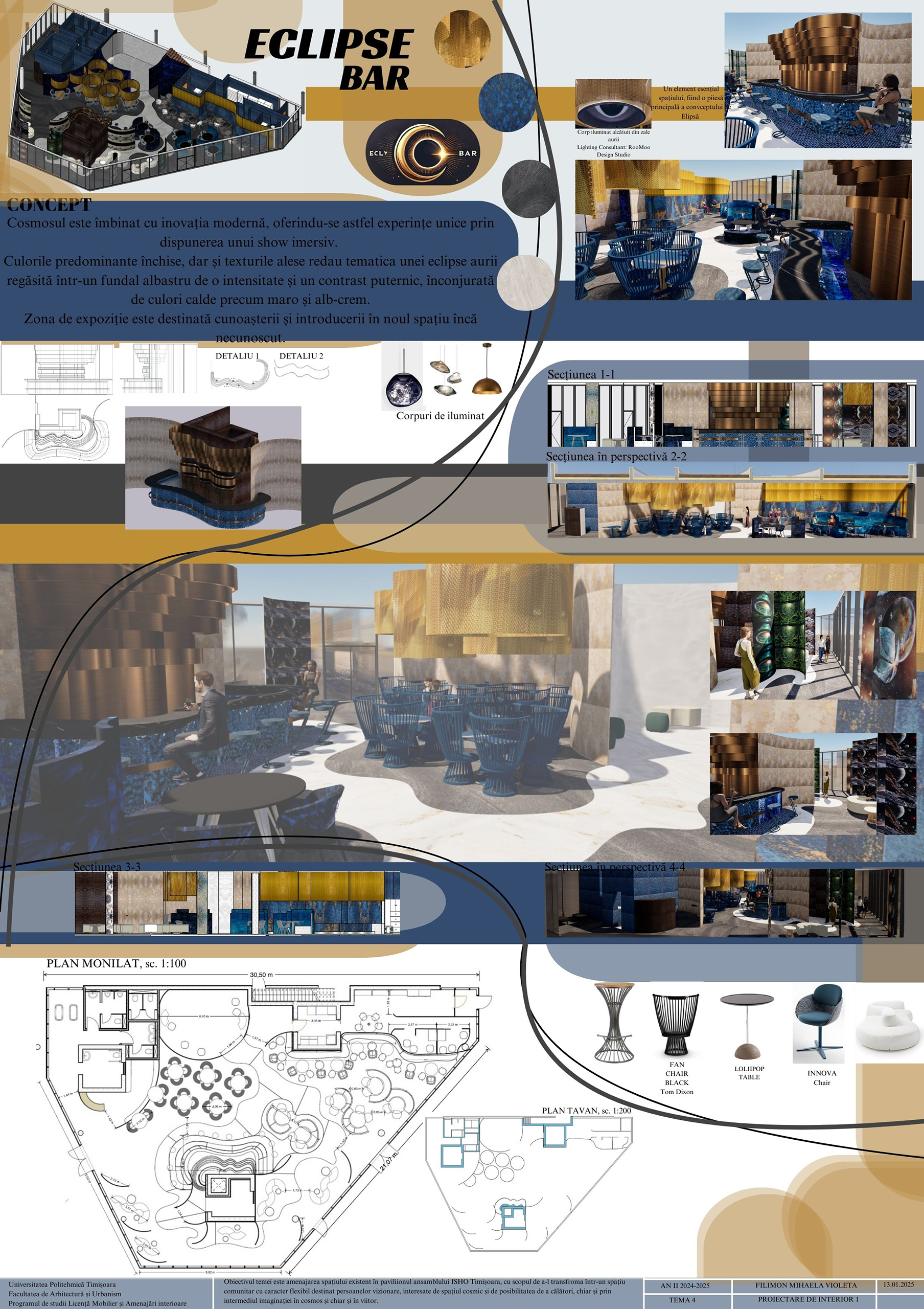
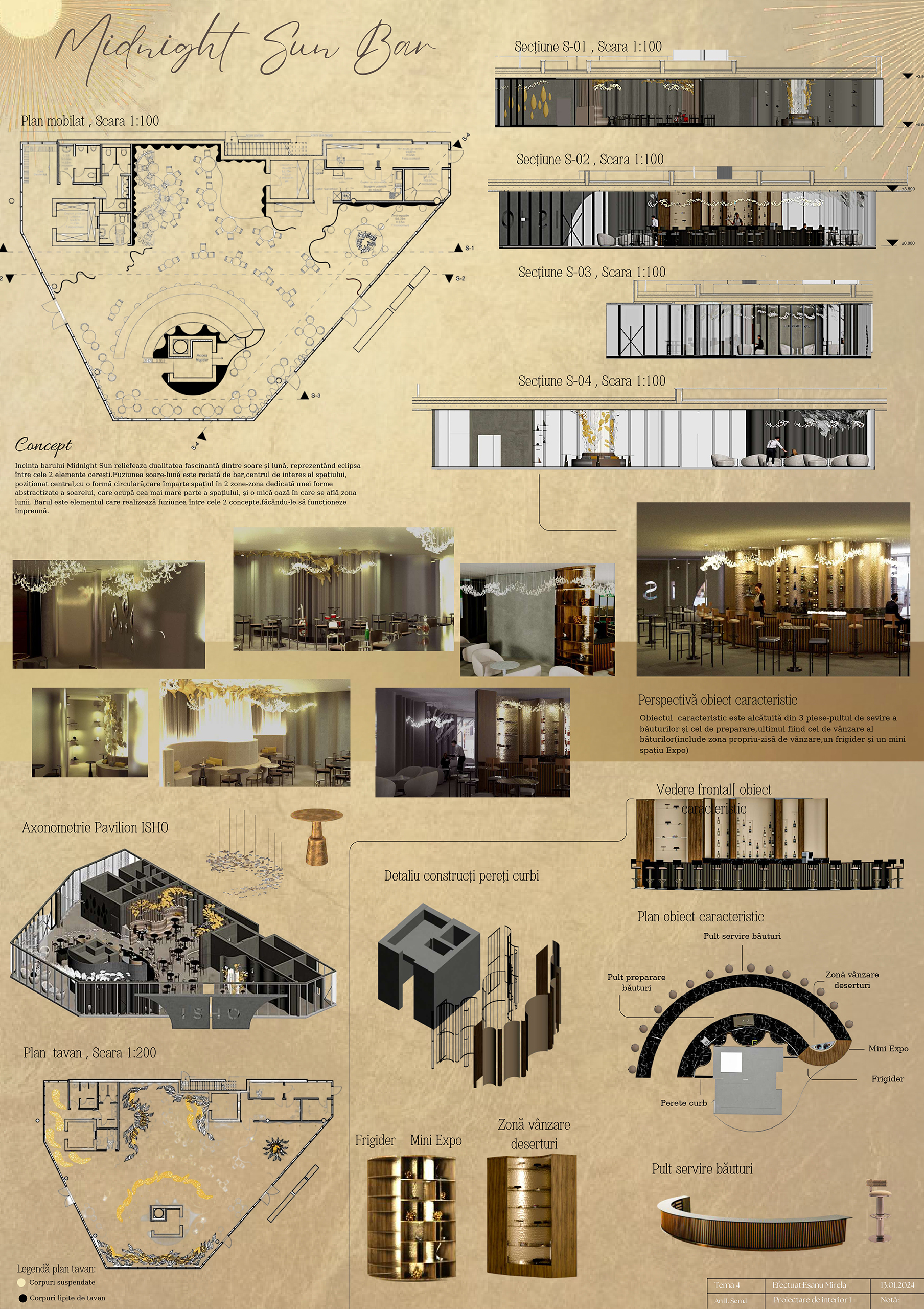
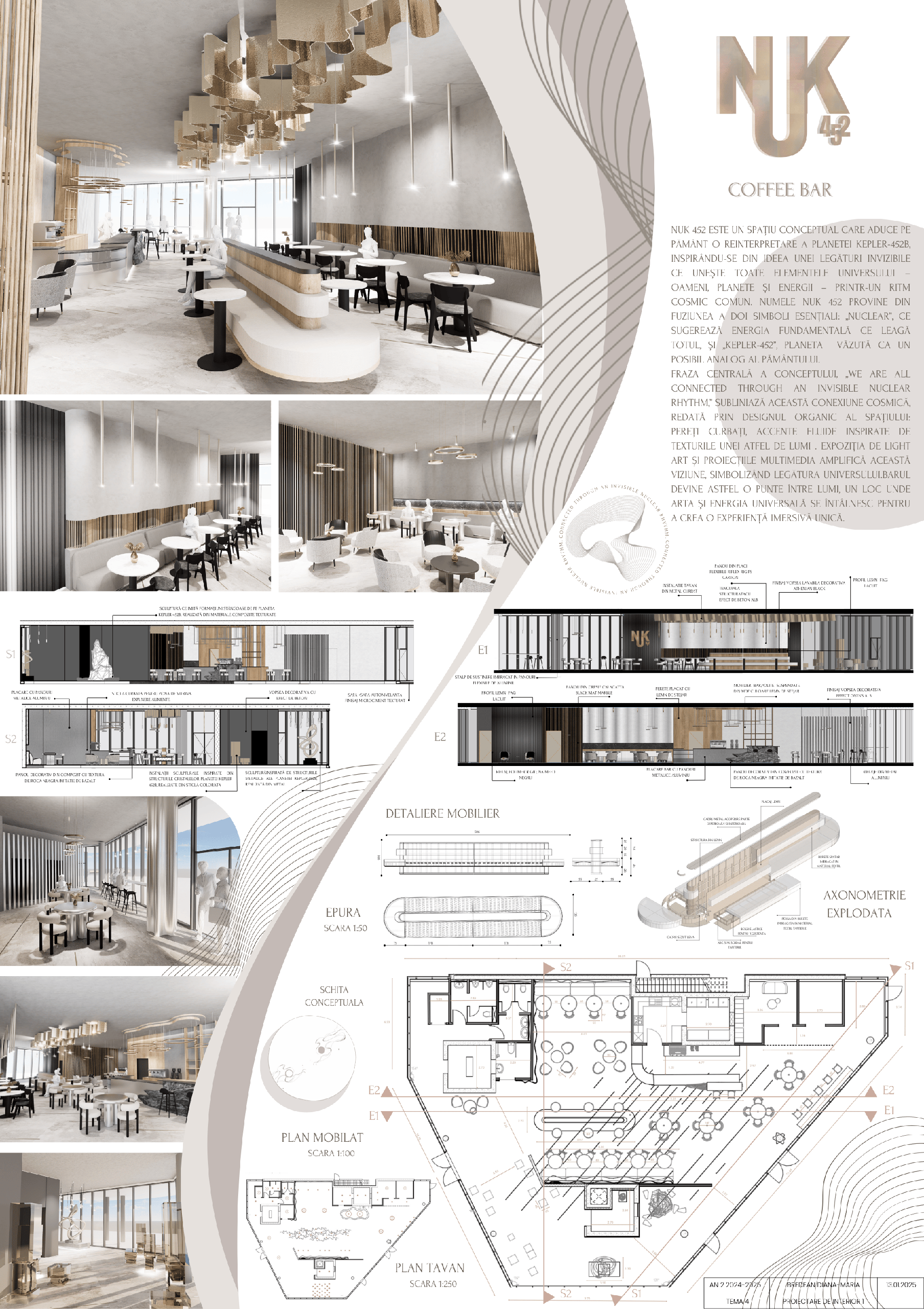
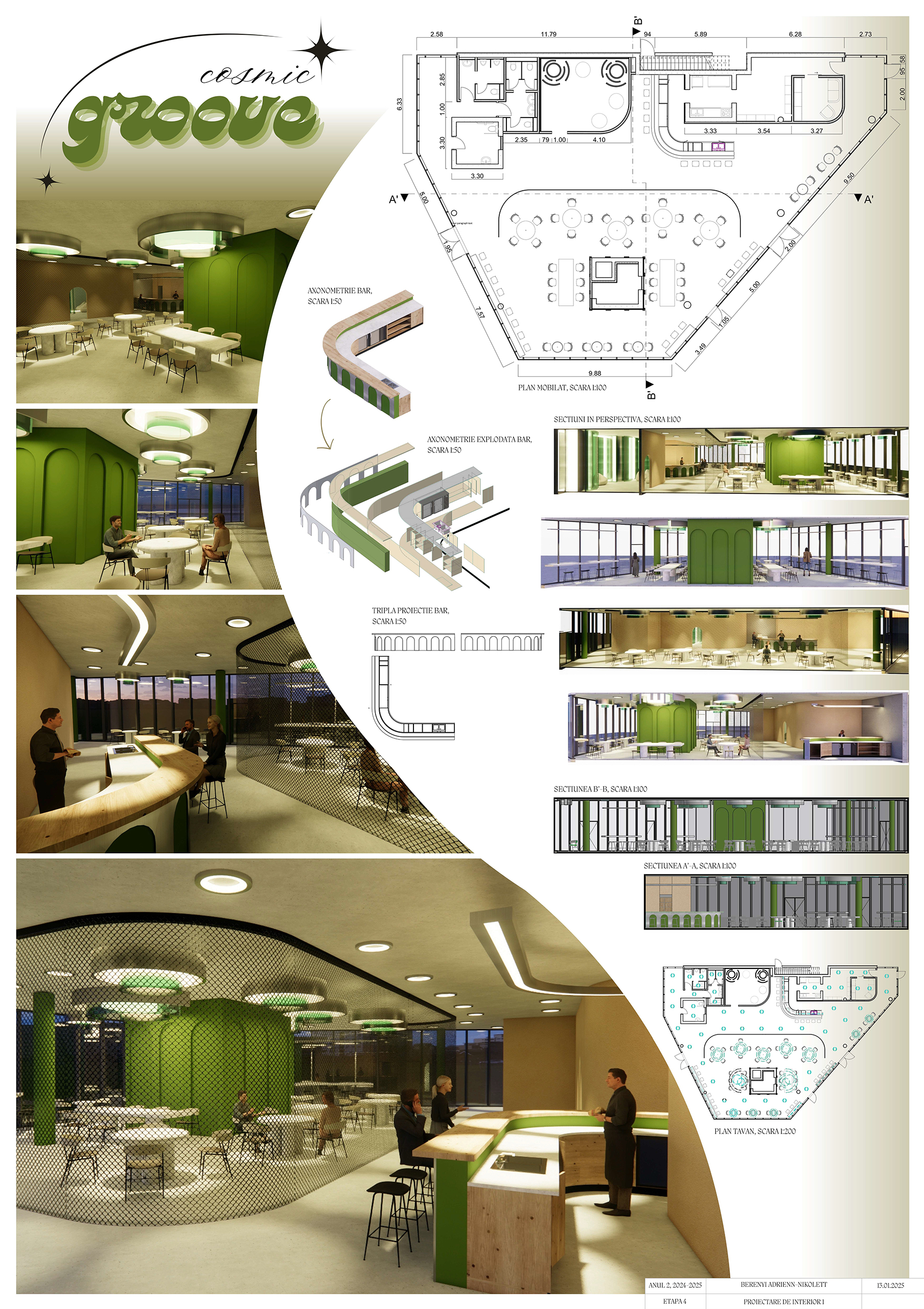
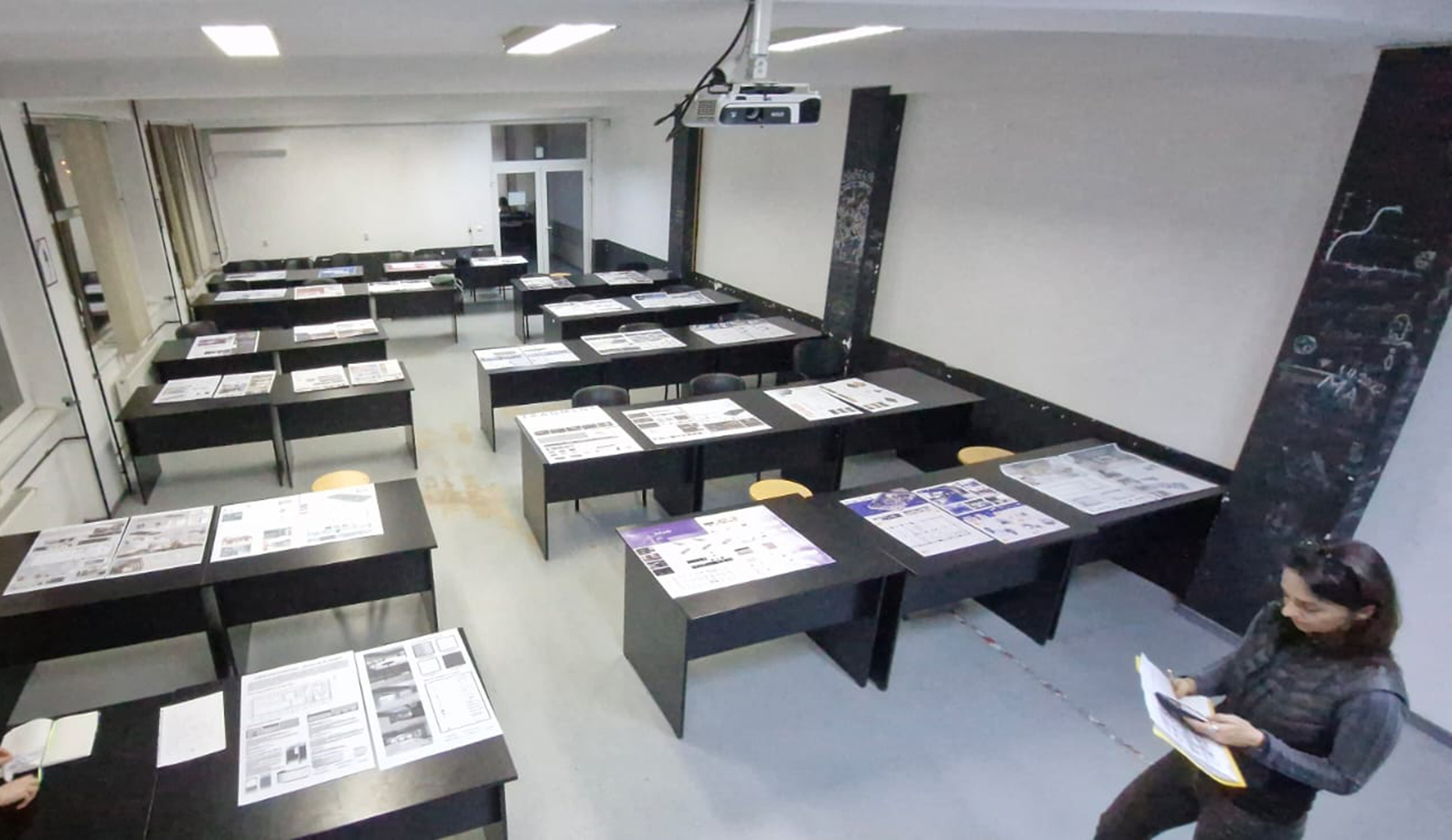
Proiectare de interior 1 (anul II, licență) este un curs aplicat ce urmărește consolidarea abilităților de a realiza o amenajare interioară. Tema semestrială vizează transformarea unui pavilion din ansamblul ISHO Timișoara într-un spațiu comunitar cu bar și zonă interactivă, inspirată de imaginarul cosmic.
Studenții dezvoltă un proiect coerent din punct de vedere funcțional, tehnic și estetic, respectând cerințe de ergonomie, accesibilitate, materialitate și iluminat. Proiectul parcurge patru etape obligatorii, cu corecturi și livrabile detaliate.
Evaluarea se bazează pe originalitate, claritate, funcționalitate și corectitudine tehnică. Cursul contribuie la formarea unei gândiri integrate, esențială în designul interior contemporan.
For the full pictures please click on the pages of the brochure below.
EN
Interior Design Studio 1 (2nd year, Bachelor’s level) is a practice-based course aimed at strengthening interior design skills. The semester project involves transforming a pavilion within the ISHO Timișoara complex into a community space with a bar and interactive zone, inspired by cosmic imagination and futuristic exploration.
Students are required to develop a coherent design proposal from a functional, technical, and aesthetic perspective, addressing ergonomics, accessibility, material selection, and lighting integration. The project unfolds in four mandatory stages, each involving specific deliverables and scheduled reviews.
Assessment focuses on originality, clarity, functionality, and technical accuracy. The course supports the development of an integrated design mindset, essential for contemporary interior design practice.
2025 | DESIGN 1| M01
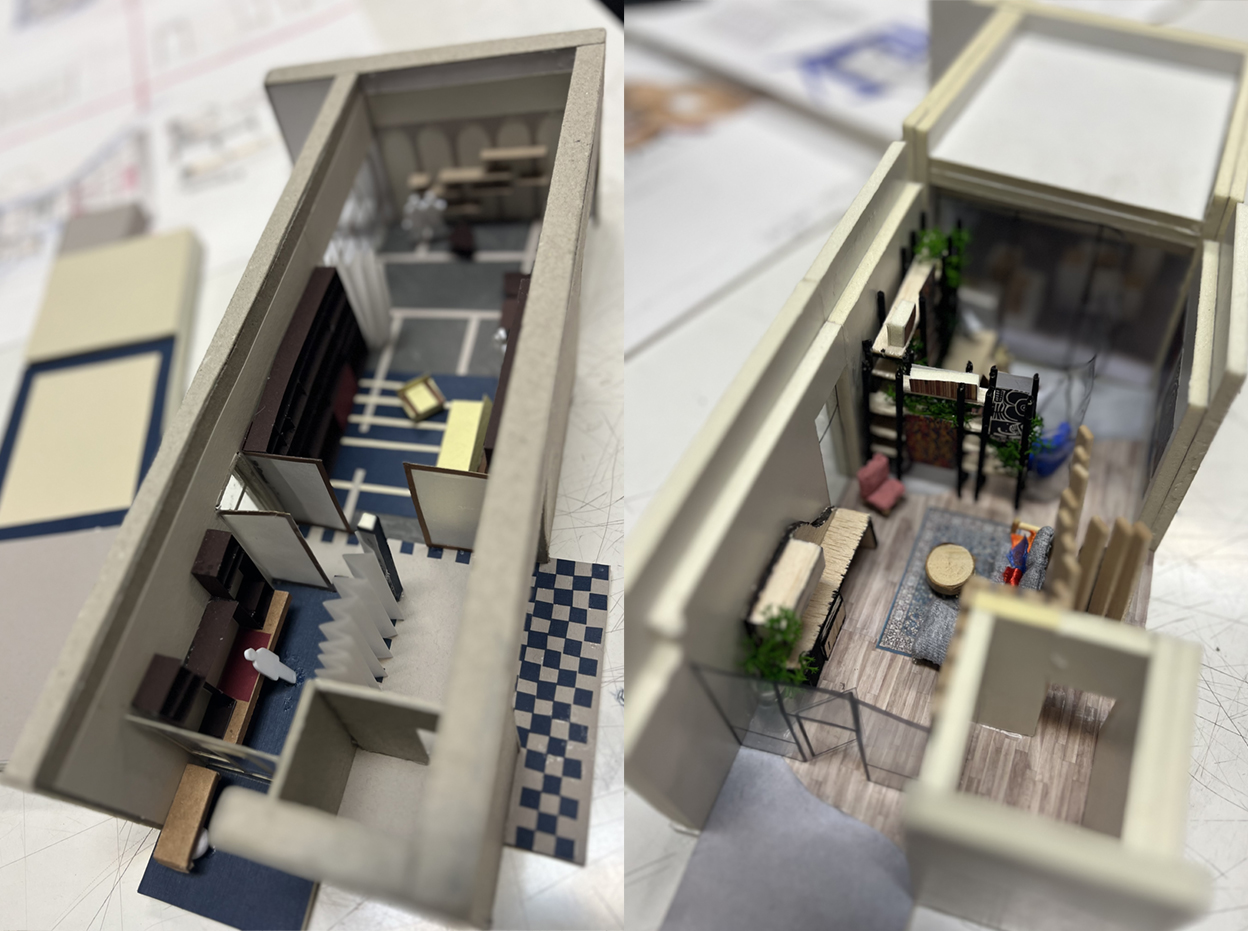
RO: Tema proiectului din primul semestru de studiu de la Specializarea Mobilier și Amenajări Interioare urmărește dezvoltarea capacității creative a proaspătului student și aplicarea noțiunilor dobândite în cadrul materiile conexe precum Compoziție, Istoria Artelor Decorative, Reprezentare prin Desen1, etc.
AMENAJARE UNITATE DE LOCUIT, a fost un exercițiu care în prima etapă constă în amenajarea unui spațiu dat, destinat unui artist plastic. În etapa a doua exercițiul se extinde spre un spațiu mai mare unde se dorește amenajarea unor zone de studiu/lucru, living cu zona de bar și o bibliotecă pentru familie. Dacă la prima etapă profilul artistului a fost la alegerea fiecărui student, în etapa următoare profilul cuplului a fost definit prin temă. Etaja finala a constat in integrarea in amenajarea anterioara a unei piese de mobilier sculpturale si multifunctionale, folosind ca exercitiu final si scanarea prin tehnica Photogrametriei.
Provocarea principală este dată de către prima temă, care în încăperea dată se dorește amplasarea unei zone de relaxare/ expozitie/ creatie specifica unui artist plastic (sculptor, pictor, grafician etc) și un ansamblu de 5- 7 locuri de șezut modulare, astfel încât să rezulte o compoziție spațială cu 1 sau 2 centre de interes, închisă sau deschisă, statică sau dinamică sau orice combinație între aceste caracteristici. La definirea centrului sau centrelor de interes vor conlucra atât piesele mobile (obiecte emblematice sau necesare+ locurile de șezut) cât și planul pardoselii, planul tavanului și planul peretelui ‚orb”, prin desenele și texturile acestora.
EN: The first-semester project in the Furniture and Interior Design specialization aims to develop students’ creative abilities and apply the knowledge acquired in related disciplines such as Composition, History of Decorative Arts, and Drawing Representation.
The Living Unit Design project was structured in three stages. The first stage involved designing a given space intended for an artist. In the second stage, the project expanded to a larger space, incorporating study/working areas, a living room with a bar, and a family library. While students individually defined the artist’s profile in the first stage, the couple’s profile was predetermined in the second. The final stage integrated a sculptural, multifunctional furniture piece and included photogrammetry scanning as a final exercise.
The primary challenge lay in the first stage, where the assigned space required a relaxation, exhibition, or creation area tailored to an artist (sculptor, painter, graphic designer, etc.), along with a set of five to seven modular seating elements. These were arranged to form a spatial composition with one or two focal points, either enclosed or open, static or dynamic, or any combination of these characteristics. The definition of the focal points was achieved through the interplay of mobile elements (key objects and seating), as well as the floor, ceiling, and blind wall planes, enhanced through drawings and textures.
2025 | PROIECTARE DE INTERIOR 3 | M03
RO
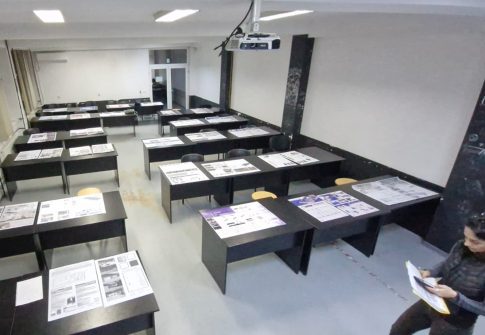
Proiectul din semestrul 1 al anului 3, desfășurat pe durata a 14 saptamani, propune amenajarea unui spatiu existent cu suprafata de aproximativ 200 mp. Temele sunt variate, implicand rezolvarea unei functiuni ce presupune acces public si care are un grad mai mare de complexitate.
Pe parcurs exista mai multe etape ce presupun predari intermediare, cuprinzand faza de analiza, rezolvare functionala, proiect tehnic, ajungand pana la faza de proiectare si detaliere a unor elemente reprezentative ale amenajarii si a unor piese de mobilier. In etapa finala se realizeaza un poster de prezentare al proiectului.
EN
The Semester 1 project of the third year, conducted over 14 weeks, focuses on designing an interior layout for an existing space of approximately 200 sqm. The project themes vary, requiring the resolution of a public-access function with a higher level of complexity.
Throughout the process, several stages involve intermediate submissions, including analysis, functional layout, technical project development, and progressing to the detailed design of key interior elements and furniture pieces. In the final stage, a presentation poster of the project is created.Conditii de lucru.
2024 | DIPLOMA | YEAR III
The completion of the three-year program requires the development of a comprehensive interior design project, covering all stages of the design process. Both the site and the function are chosen by the student, provided that the relevance and opportunity of the proposed intervention are clearly justified.
The main objective is to define a strong spatial identity, shaped both by the qualities of the selected context and by the specific characteristics of the proposed function. Throughout the phased development of the project, theoretical and technical approaches are pursued in order to formulate spatial and formal solutions that enhance the chosen space.
This process represents a valuable exercise in preparation for professional practice, addressing adaptive reuse, the creation of an aesthetic aligned with the proposed concept, the coordination of constructive elements (finishes, furnishings, installations), the resolution of execution details for custom-designed furniture, cost anticipation, and overall budget management.
Project Development Phases
Phase I involves understanding existing conditions and defining the requirements of the proposed theme. This includes studying comparable examples of similar scale and function, as well as analyzing the site’s specific characteristics, qualities, dysfunctions, and atmosphere.
Phase II focuses on developing a general intervention concept, generating two preliminary design proposals, and further detailing one selected option.
Phase III consists of producing the technical project documentation, detailing the solution developed in the previous phase at a technical design level.
Phase IV represents the execution detailing stage. The final phase includes preparing detailed drawings for at least three key design elements (such as custom furniture pieces or constructive details), finalizing finishes and materials, and documenting them within the written report, cost estimate, and material palette.
For the full texts please click on the pages of the brochure below.
Diploma Projects
Student: Bârle Maria-Francesca-Simina
Coordinating Professor: S.l. Dr. Arch. Maja Bâldea
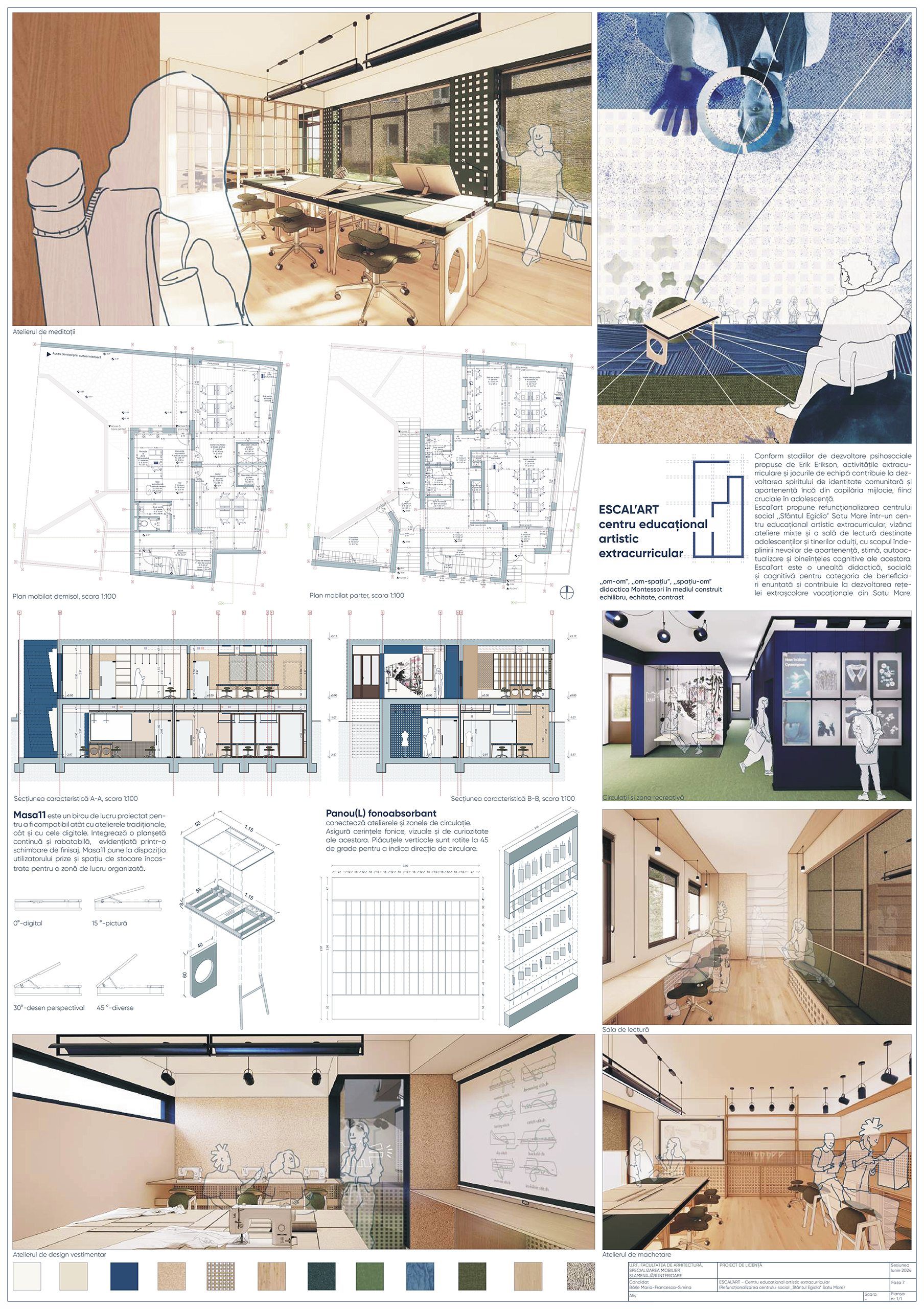
According to the stages of psychosocial development proposed by Erik Erikson (Childhood and Society, W. W. Norton & Co., Chicago, 1950), extracurricular activities and team-based games contribute to the development of community identity and a sense of belonging as early as middle childhood and become particularly crucial during adolescence. The recent volunteer activity carried out at the social centre “Saint Egidio” in Satu Mare, together with the theoretical framework mentioned above, generated the core hypothesis of the Escal’art project:
What is the role and position of vocational extracurricular activities in adolescents’ daily schedules in terms of their social and cognitive development?
How would adolescents and young people in Satu Mare benefit from expanding the local extracurricular network with a centre that offers guided training in contemporary vocational skills, which are often pursued individually due to limited or difficult access to assisted instruction?
In what ways could Montessori pedagogy innovate the vocational education process for adolescents, and what attributes position it advantageously compared to other methodologies?
Escal’art therefore proposes the adaptive reuse of the “Saint Egidio” Social Centre in Satu Mare into an extracurricular arts education centre. The project introduces mixed workshops, including tutoring in architecture and interior design, graphic design, fashion design, model making, as well as a study room for teenagers and young adults. The aim is to address their needs for belonging, esteem, and self-actualization.
From the perspective of the human–environment–space relationship, the impact of the Escal’art centre lies in its objective to function as a didactic, social, and cognitive instrument for its target users, while also contributing to the development of the local vocational extracurricular network in Satu Mare by increasing its visibility and relevance.
The theoretical foundation directly informs the design aesthetics, reflecting a continuous interplay between intrinsic and extrinsic perception and interaction. The project materializes Montessori principles and the triple relationship “person–person,” “person–space,” and “space–person.” The design seeks to generate sensorially balanced environments in accordance with the functional and ergonomic requirements of each activity. Personalization and stylistic coherence balance the standards outlined above and foster a sense of belonging within a group that shares similar values, reinforcing the anthropocentric character of the project.
To establish an authentic connection with the intended users and beneficiaries, they were directly involved in the conceptualization of the interior design through a feedback questionnaire. This process provided essential insights into their relationship with the extracurricular activities in which they participate, their preferred didactic approaches, and the importance of the environment in cognitive processes and overall well-being.
In conclusion, Escal’art represents a case study that emphasizes both the influence of space on the conduct of educational activities and the human capacity to shape the surrounding atmosphere. At the same time, it supports the development of the local extracurricular education system in Satu Mare through a Montessori-based methodology adapted to adolescents’ needs, fostering socio-cultural advancement within the community and strengthening the bonds of trust between learners and educators.
Student: Cuciula Lucia-Maria
Coordinating Professor: S.l. Dr. Arch. Otilia Tudoran
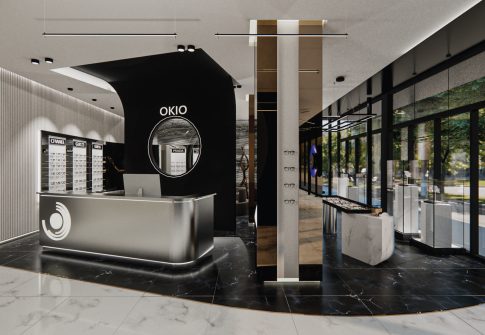
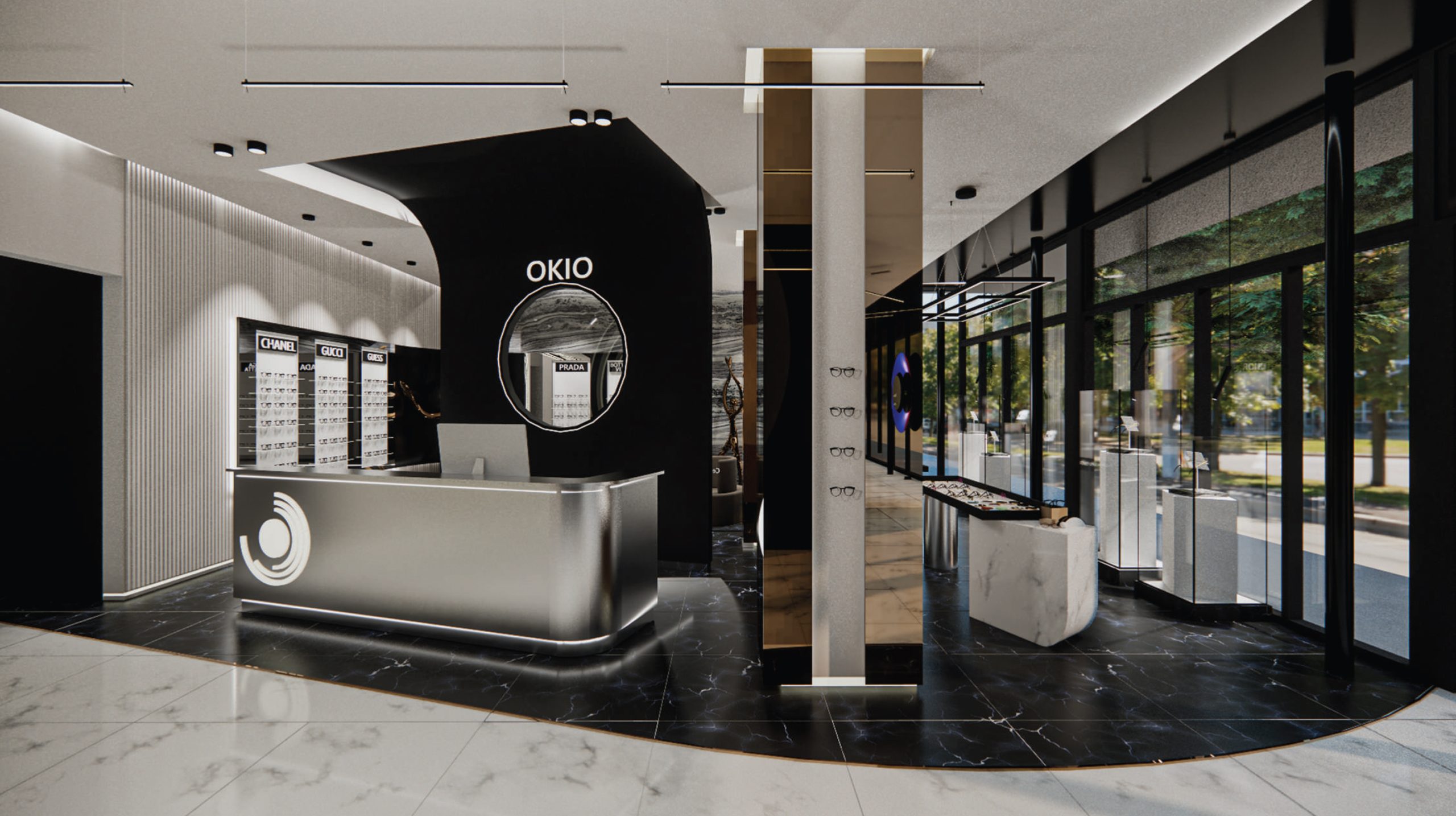
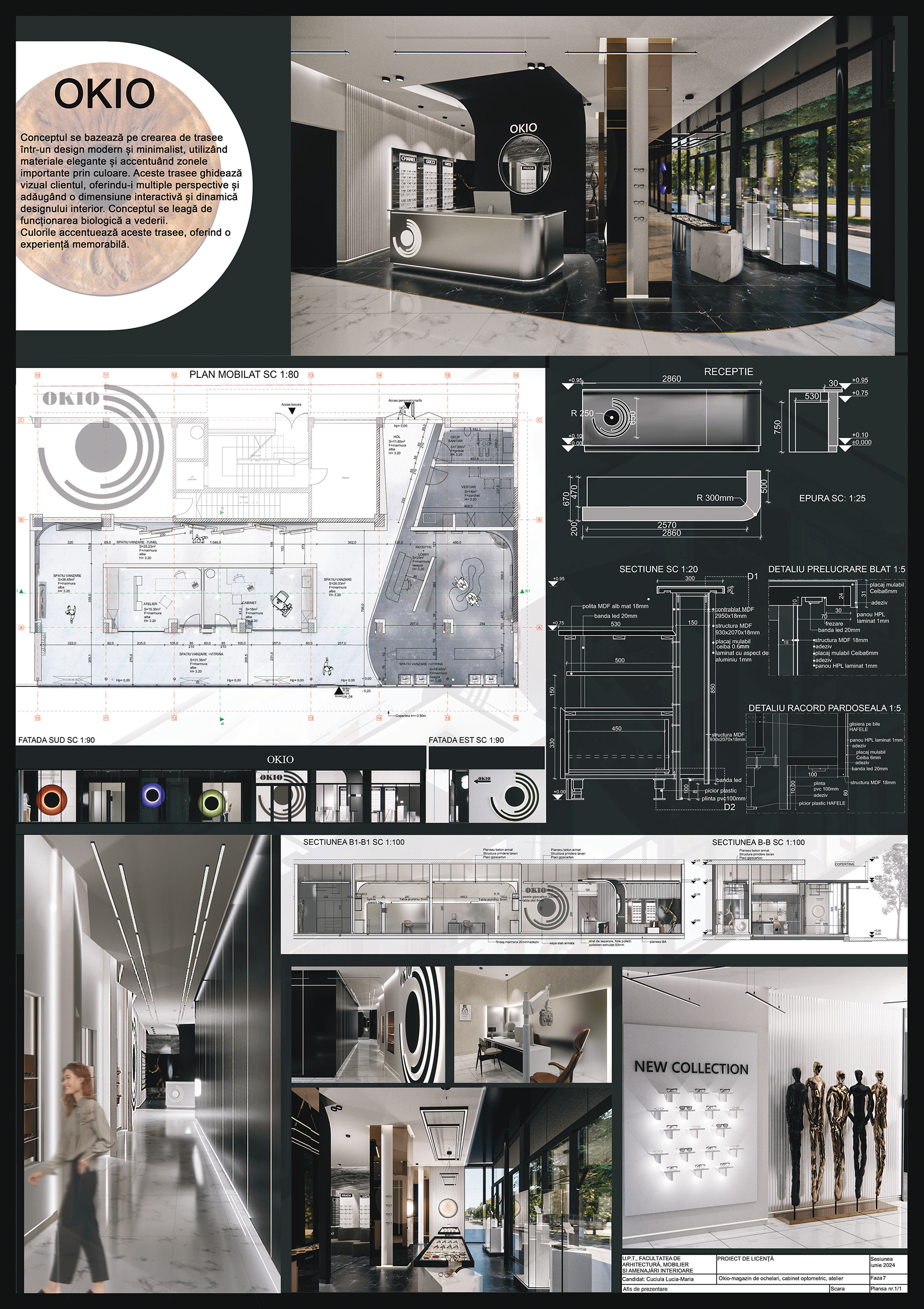
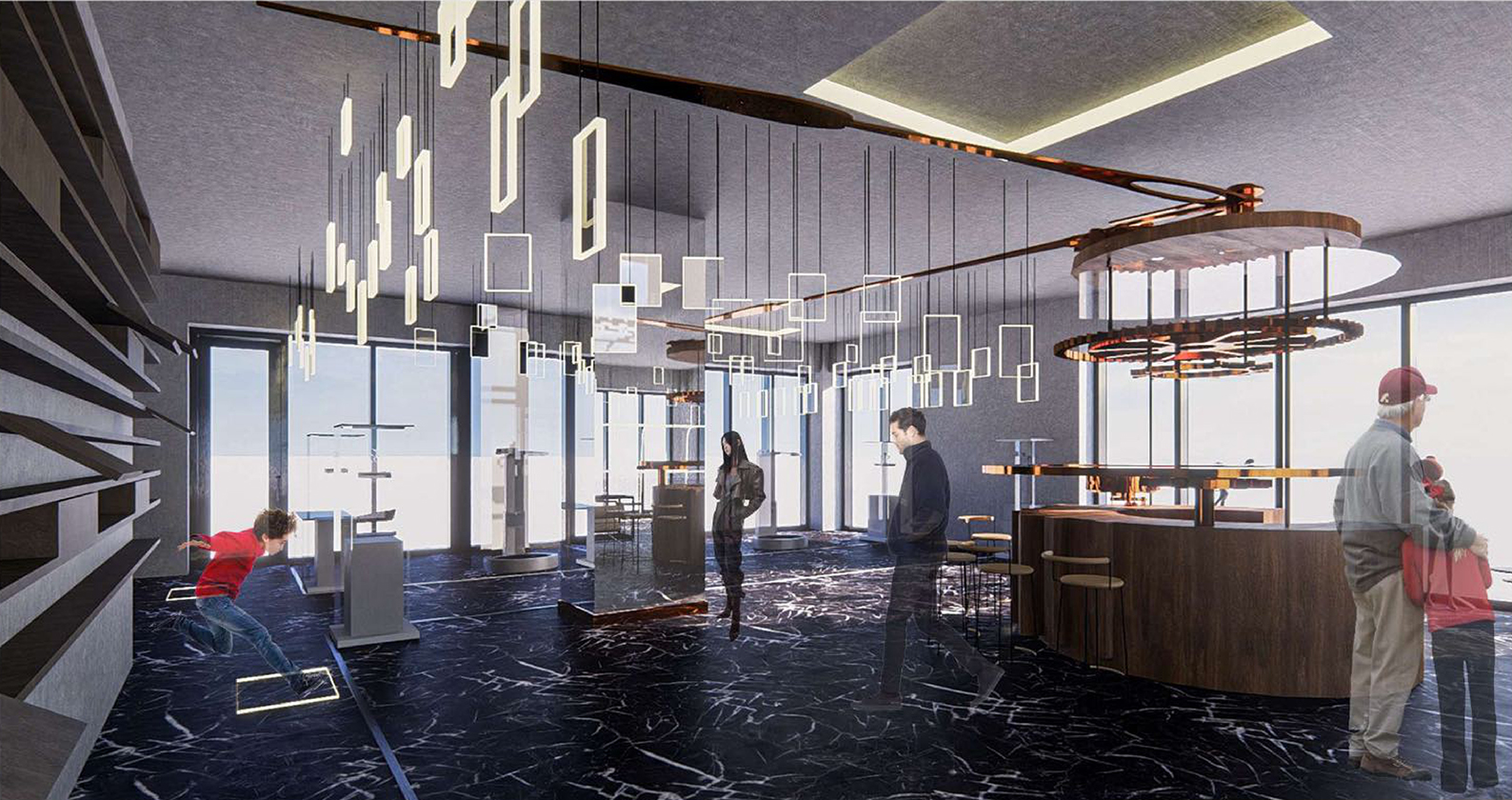
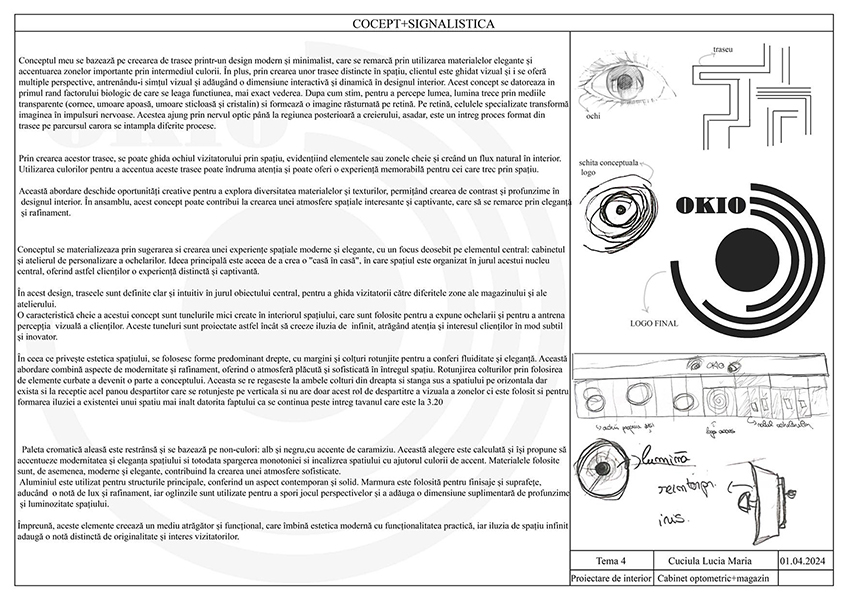
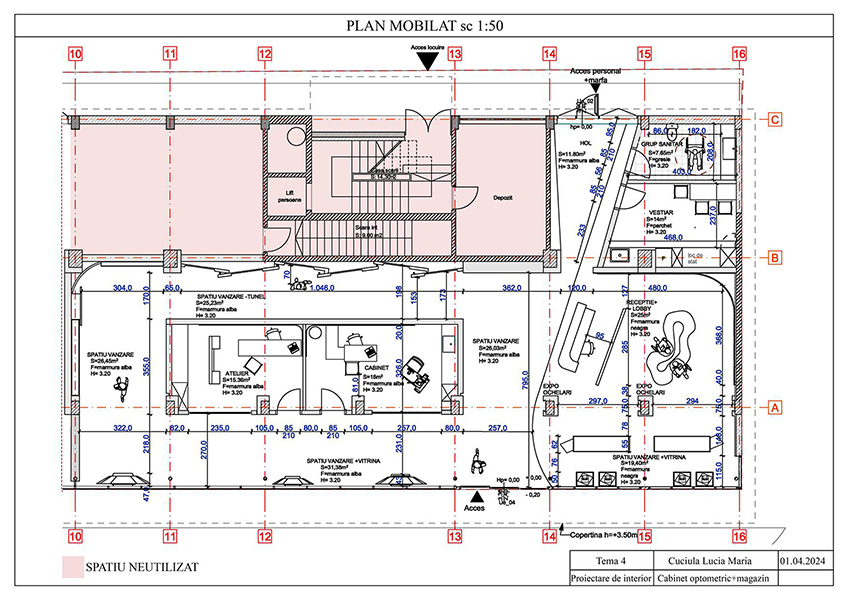
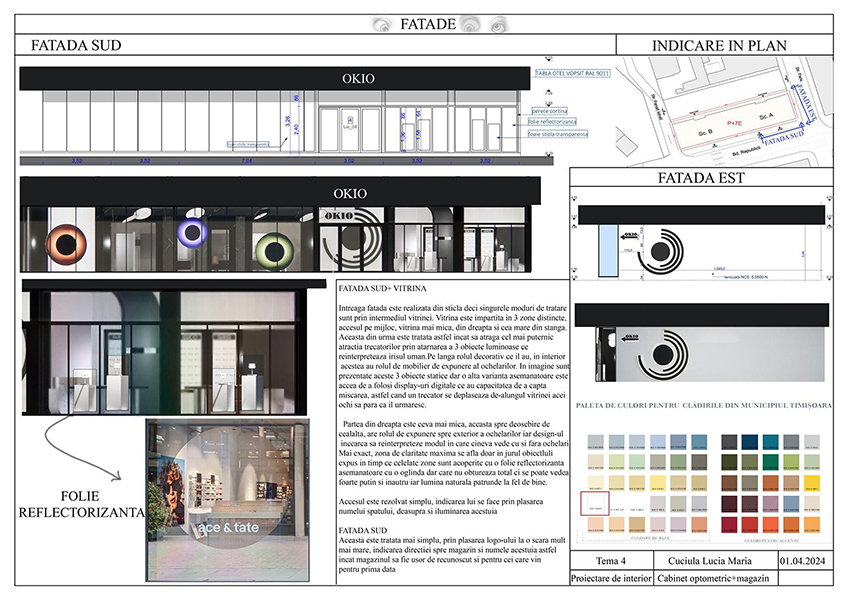
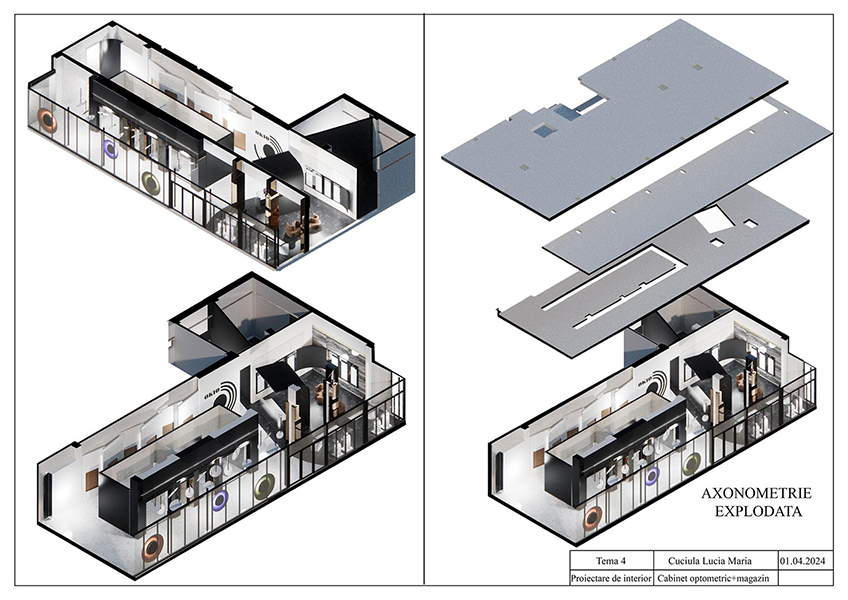
This project originated from the idea of creating a contemporary optometric practice to complement the central area of Timișoara. Over time, the concept evolved into OKIO—a multifunctional space that extends beyond the conventional notion of a clinic.
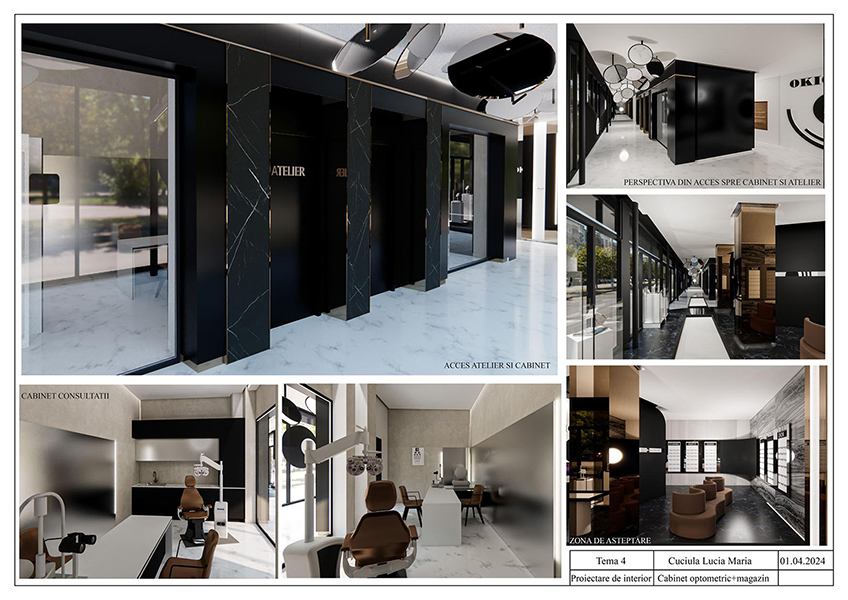
In addition to providing specialized optometric services, OKIO operates as a retail space offering a curated selection of renowned eyewear brands, including both prescription frames and sunglasses. The centre also incorporates an on-site workshop staffed by qualified professionals who assist clients in selecting frames suited to their facial features.
Beyond standard services, OKIO integrates customization options such as engraving and 3D printing of frames. Furthermore, the space offers a unique experiential component: the photographic capture of clients’ irises, transformed into personalized artistic prints, creating memorable and individualized keepsakes.
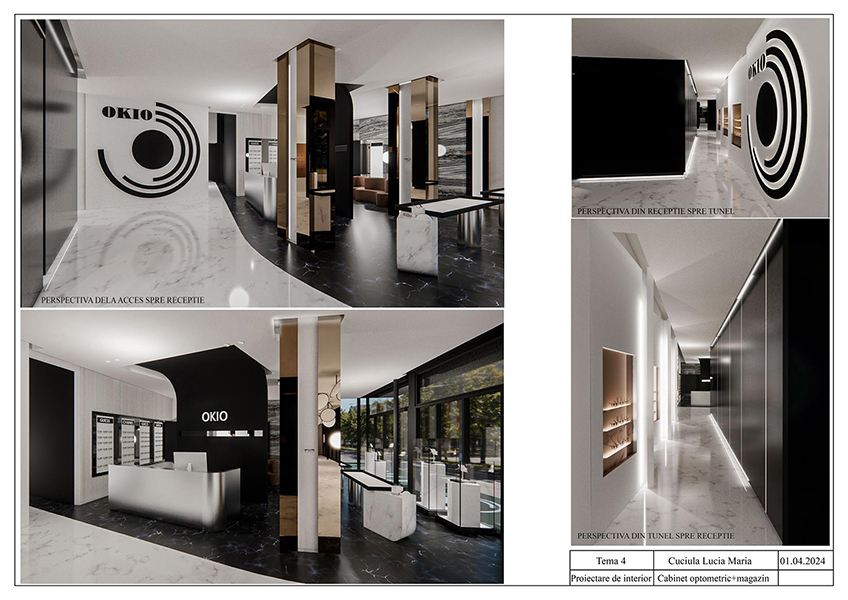
Given the range of services and the central urban location, the spatial concept was envisioned as modern and refined. This intention is reflected in the material palette—marble, metal, colored mirror surfaces—and in the inclusion of sculptural design objects that evoke the atmosphere of a gallery or museum rather than a conventional retail environment.
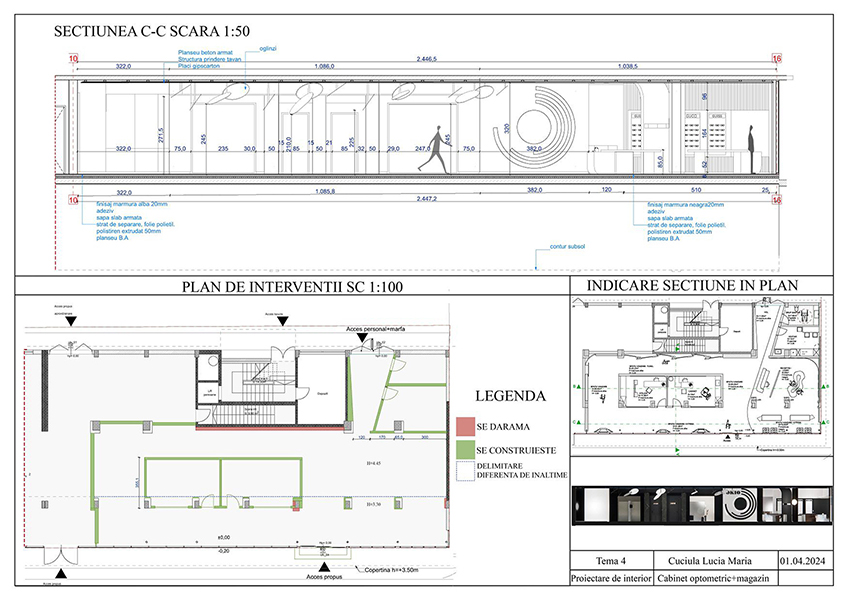
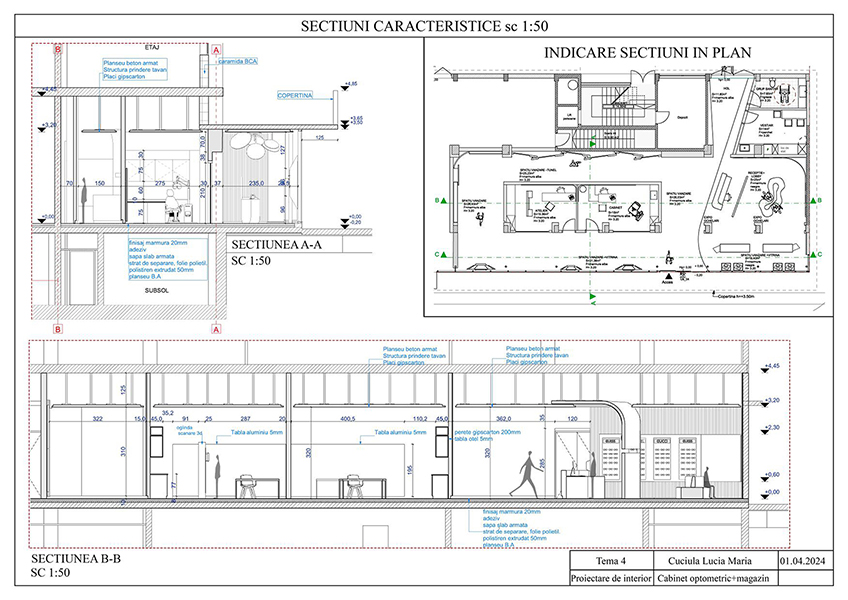
The interior is conceived as a visual composition that engages the human eye. Circulation is organized along a clearly defined route structured around a central focal element. The fluidity of movement is emphasized through rounded corners and continuous spatial transitions, guiding visitors intuitively throughout the space.
Situated in the heart of Timișoara and defined by a fully glazed façade, the storefront was designed to capture the attention of passersby. The display features oversized eye installations aligned along the window, generating curiosity while offering only partial visual access to the interior. The eyewear display area remains visible from the street, while the remainder of the space is deliberately concealed, enhancing intrigue and reinforcing the conceptual narrative.
Students: Tímea Mihály
Coordinating Professor: Specialist in Furniture and Interior Design Carmen Elena Săndescu
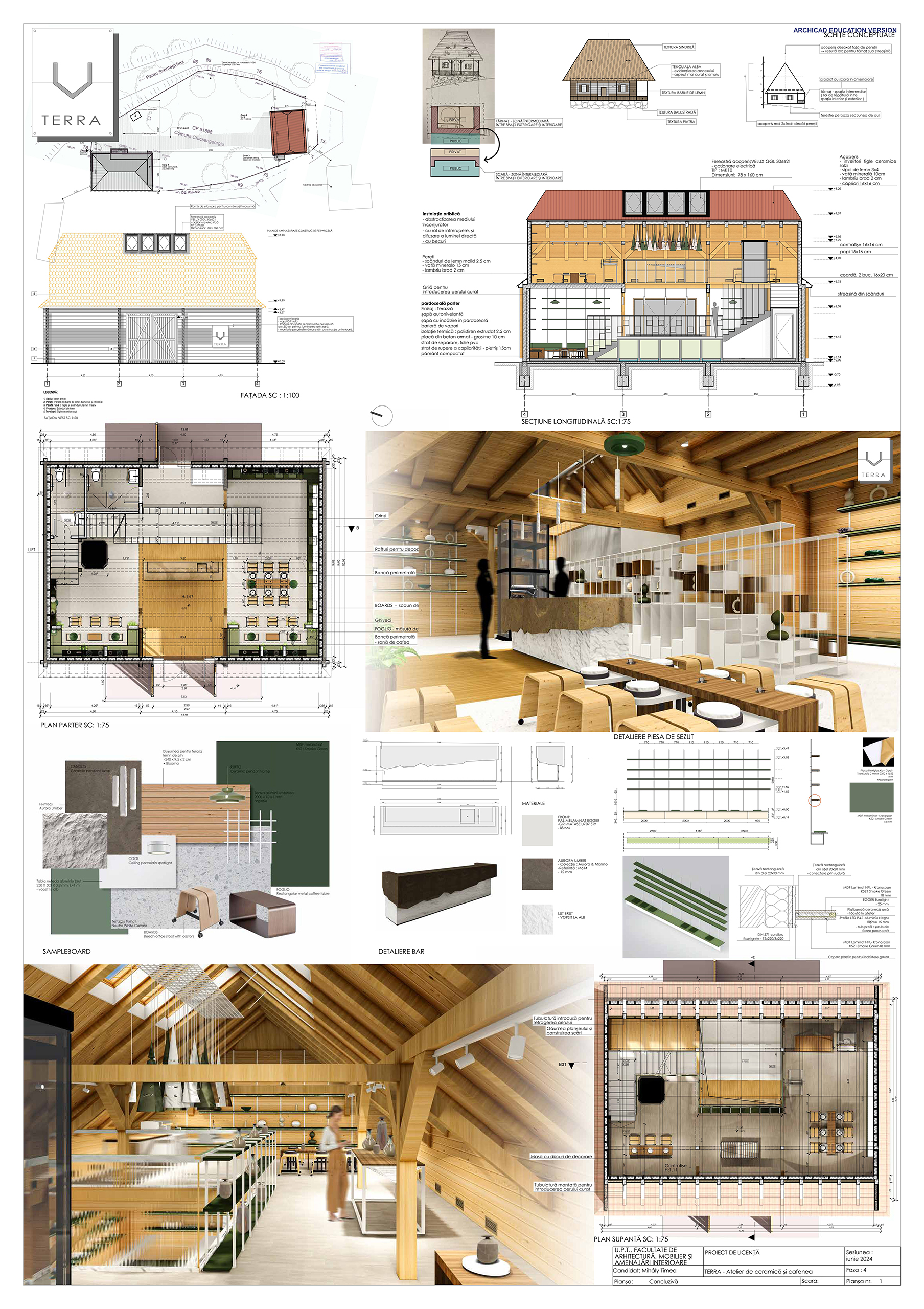
Integration within the built environment remains an ongoing subject of debate in architectural discourse and represents a fundamental aspect of the design process. While it is essential to preserve the character and atmosphere of a place, it is neither possible nor appropriate to replicate historical elements directly. Instead, meaningful integration can be achieved through the study of proportions, the abstraction of local symbols, textures and ornaments, the simplification of forms, and the use of related or locally sourced materials. Given the specific configuration of the surrounding context, this project seeks to reinterpret these principles in a contemporary and abstracted manner.
The building was conceived as a communal hub intended to host the social activities of the village. Its generous and flexible interior spaces are designed to accommodate a variety of functions, supported by adaptable furniture systems. The village regularly organizes creative activities for both younger and older generations, and the building provides an appropriate spatial framework for such events. However, as these activities are not permanent, the building was designed to ensure functional and economic sustainability. For this reason, it incorporates a ceramics workshop and a café area, both intended to operate on a continuous basis.
Conceptually, the interior design draws upon the proportions and rhythms characteristic of local architecture. The composition features simple geometric volumes and emphasizes the use of locally specific textured materials. The architectural language reflects adaptation to geographical conditions—high-pitched roofs, extended eaves, and a porch mediating between interior and exterior spaces. In this context, human habitation maintains a constant relationship with the natural surroundings: walls do not isolate inhabitants from their environment but rather offer protection while preserving connection. The proposed design seeks to reinterpret and embody this architectural ethos in a contemporary expression.
Student: Smerea Alexia
Coordinating Professor: Conf. Dr. Arch. Camil Milincu
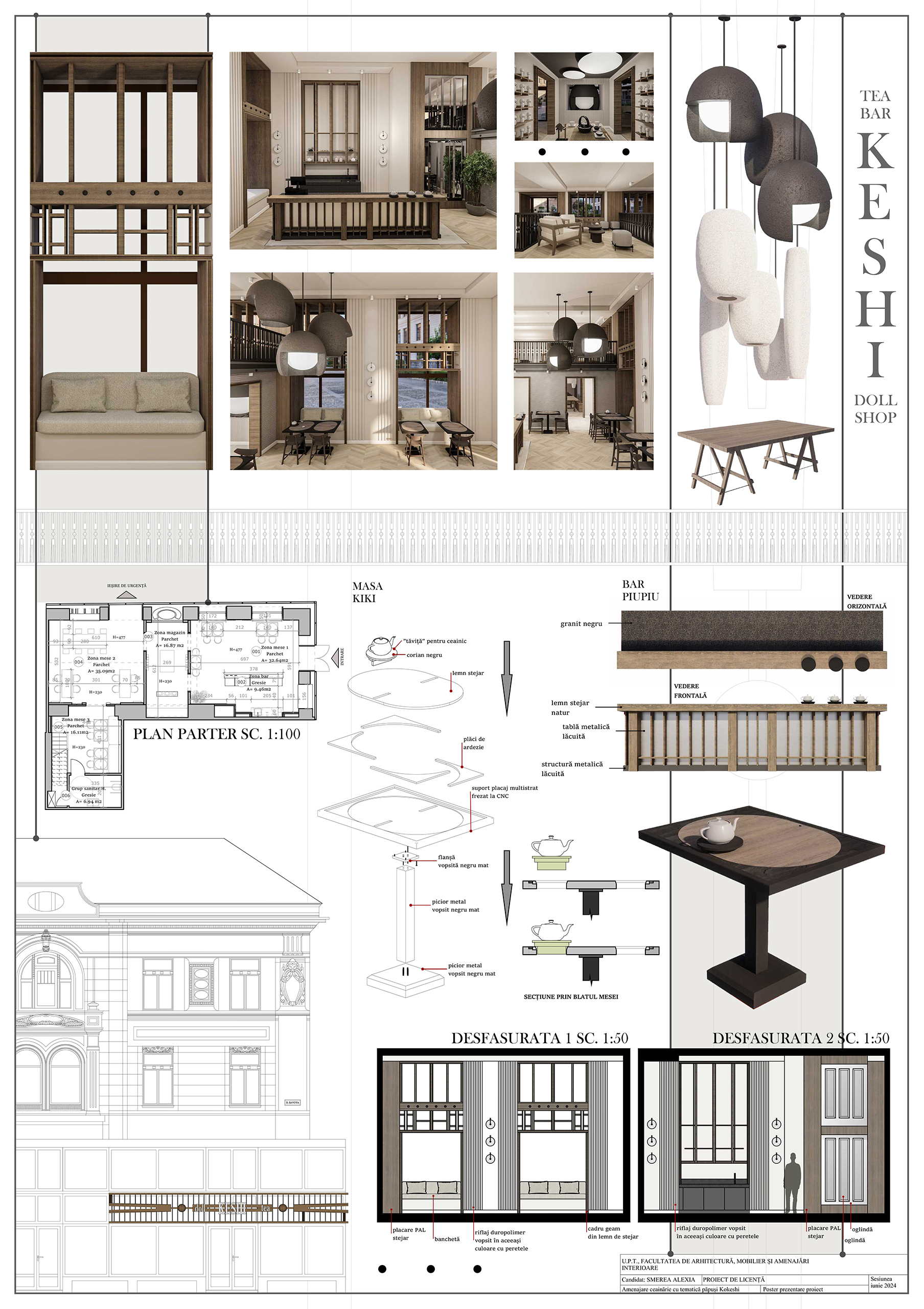
The theme of the Bachelor’s degree project consists of the adaptive reuse of an existing ground-floor café space, transforming it into a teahouse combined with a kokeshi doll shop.
The central concept of the interior design is union, referring to the creation of new connections rooted in childhood memories, with play serving as the primary thematic framework of the space. The proposed design merges Japanese elements with the Classicist Secession features present on the building’s façade. Japanese influences are introduced through the use of characteristic materials and colors—such as wood, cast iron, and ceramics—as well as through the adoption of clean, linear geometries. The Classicist Secession style is reinterpreted in the interior by incorporating geometric details inspired by the façade, including fluted column motifs, hemispherical forms, and oval shapes.
The kokeshi doll serves as the defining design motif of the teahouse. It is analyzed from a geometric perspective and abstracted into various spatial and decorative elements throughout the interior. Its role extends beyond aesthetic and commercial purposes, contributing to the expression of the overarching concept of union. Within this framework, the traditional tea ceremony is reimagined as a playful tea gathering—an experience that can be shared by visitors and, symbolically, by kokeshi dolls, evoking the imaginative rituals of childhood.
Student: Török-Darvas Eszter
Coordinating Professor: Conf. Dr. Arch. Diana Giurea
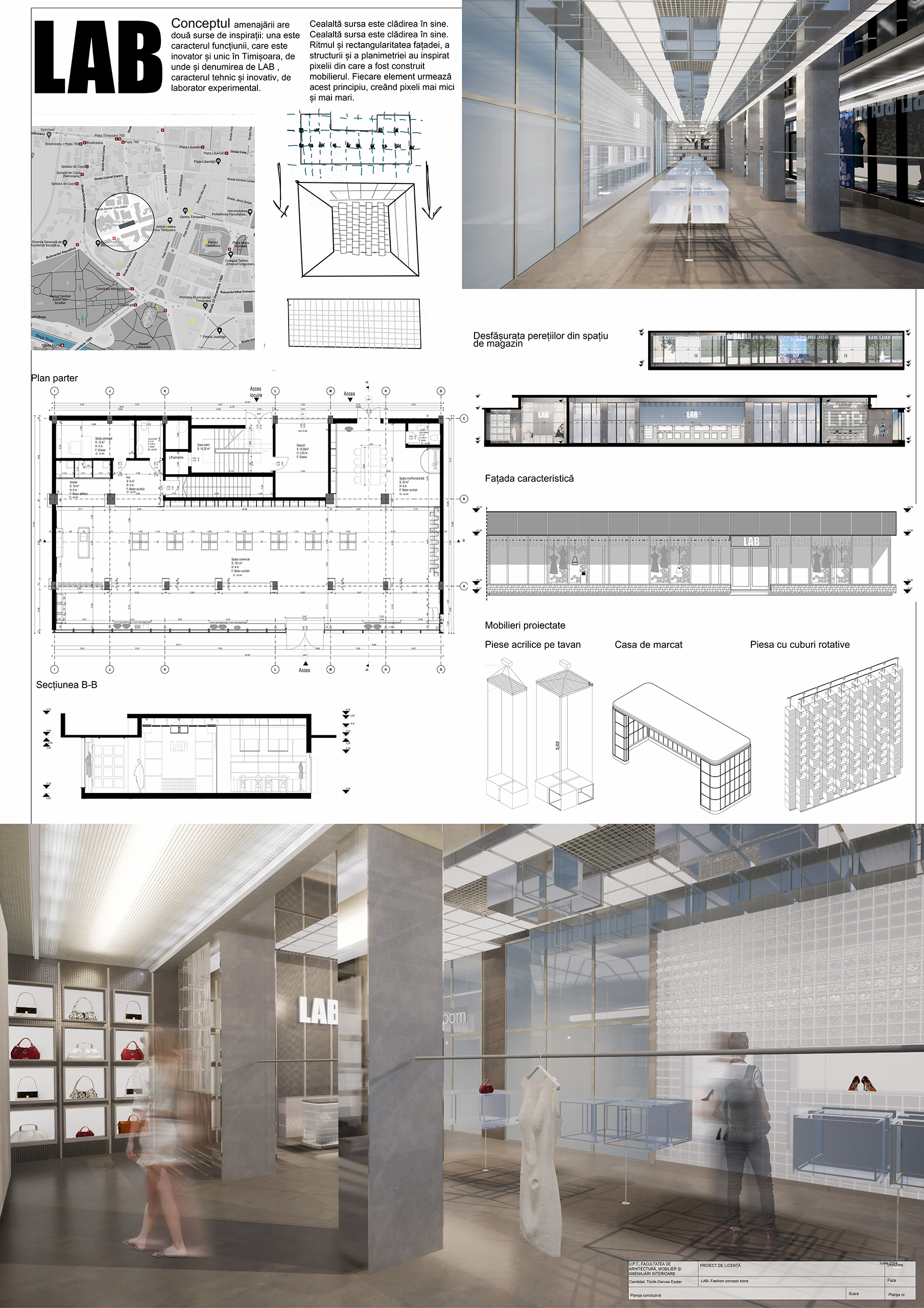
As part of the project, I designed a retail space dedicated to clothing and accessories. However, it is conceived not as a conventional store, but as a concept store, offering an expanded program that goes beyond retail. The space is adaptable and can function as a venue for fashion shows, product launches, and specialized workshops. It operates as a collaborative platform, bringing together multiple designers and providing an environment for emerging creatives seeking a physical location to showcase and sell their work.
The theme was approached as a laboratory. Fashion design is a dynamic and continuously evolving field, shaped by ongoing research, experimentation, and innovation. The space was therefore designed to accommodate designers working across various disciplines, including apparel, footwear, bags, and jewelry. The furniture is predominantly custom-designed, characterized by simple forms, and integrated with mechanical and electrical systems that enhance flexibility and functionality.
An important source of inspiration was the architecture of the existing building. LAB is situated in the center of Timișoara, within a structure defined by rectangular volumes, strong rhythm, and symmetry. These characteristics shape the façade, spatial layout, and overall identity of the building, and were consciously reflected in the interior design. The concept was developed “pixel by pixel,” with the entire composition structured through cubic modules. Spatial organization follows a symmetrical logic, with square-based divisions reinforcing clarity and order.
At the same time, adaptability was a key principle: most elements are modular, reconfigurable, and easily adjustable to support different types of events and exhibitions. The chromatic palette is restrained, consisting primarily of shades of white, gray, and blue-green. Material contrasts play a significant role in defining the atmosphere—glossy, reflective, and transparent surfaces such as glass bricks, matte plexiglass, mirrors, and metallic elements interact with the raw texture of exposed concrete.
Overall, the project is defined by a clean, contemporary aesthetic, combining advanced technology with the refined atmosphere of a high-end fashion concept store.
Student: Soreanu Bianca-Ioana
Coordinating Professor: Asist. Dr. Arch. Ionuț Ciprian Mătieș
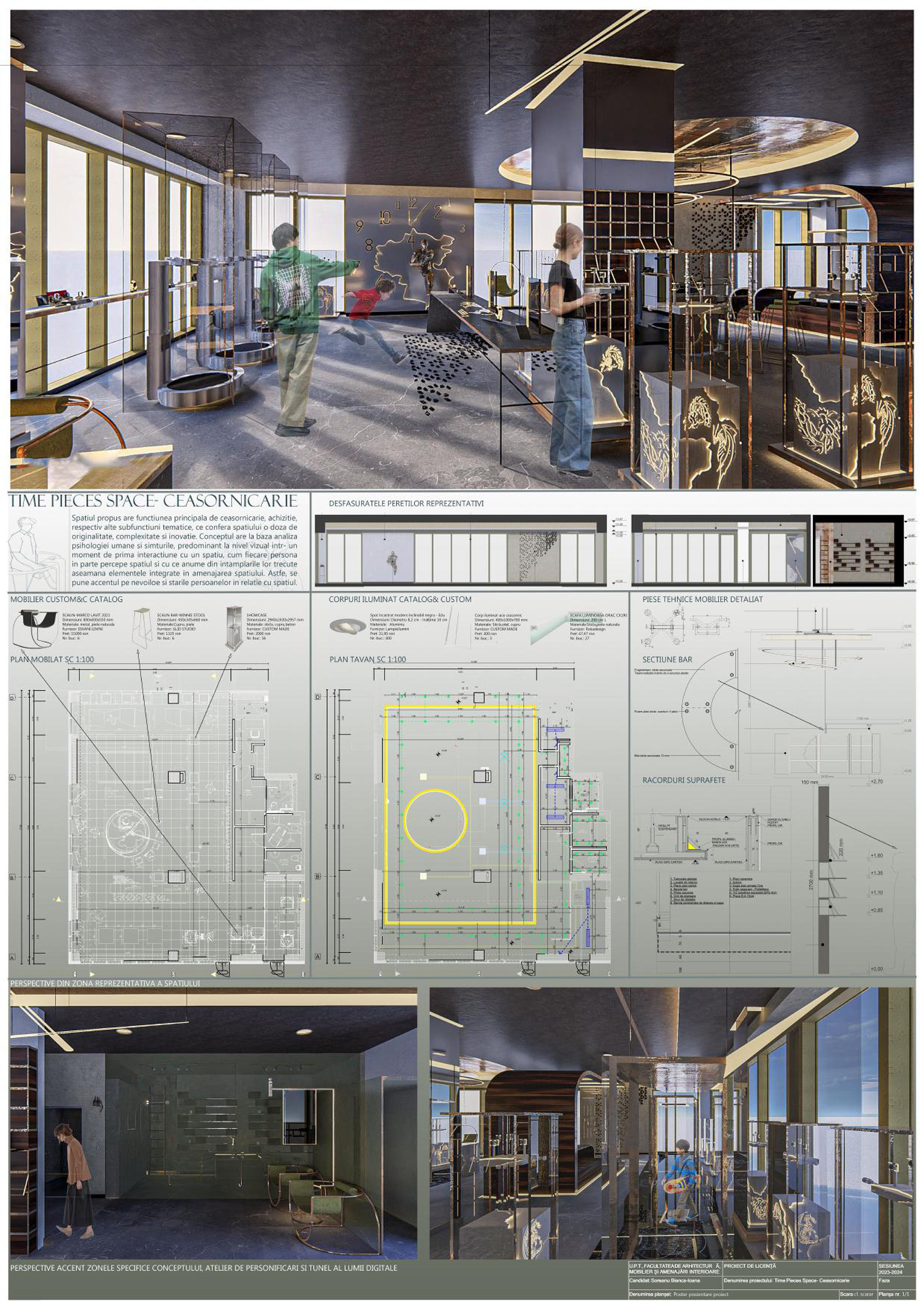
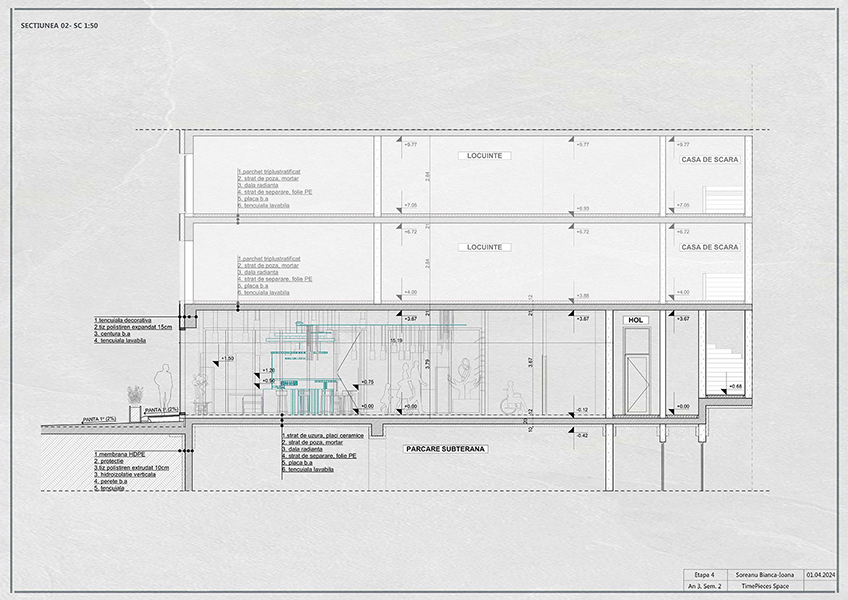
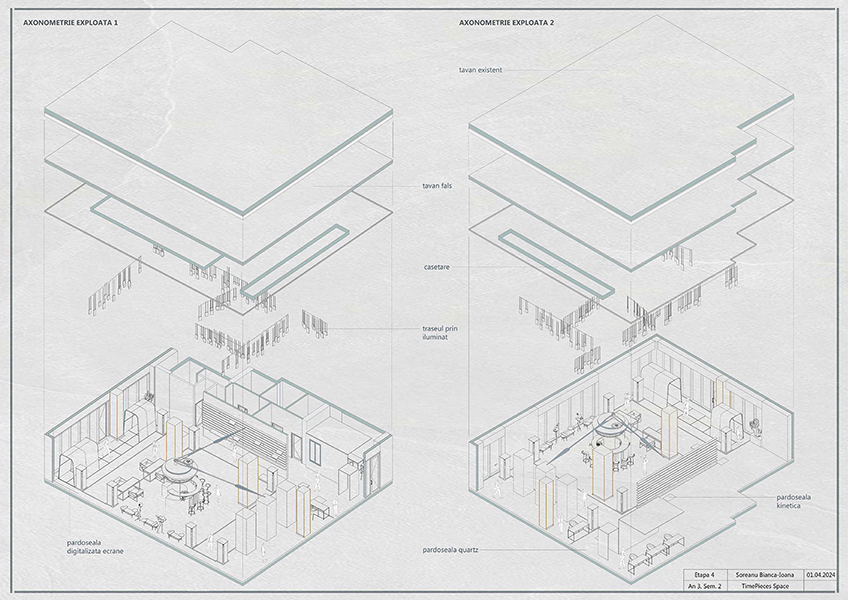
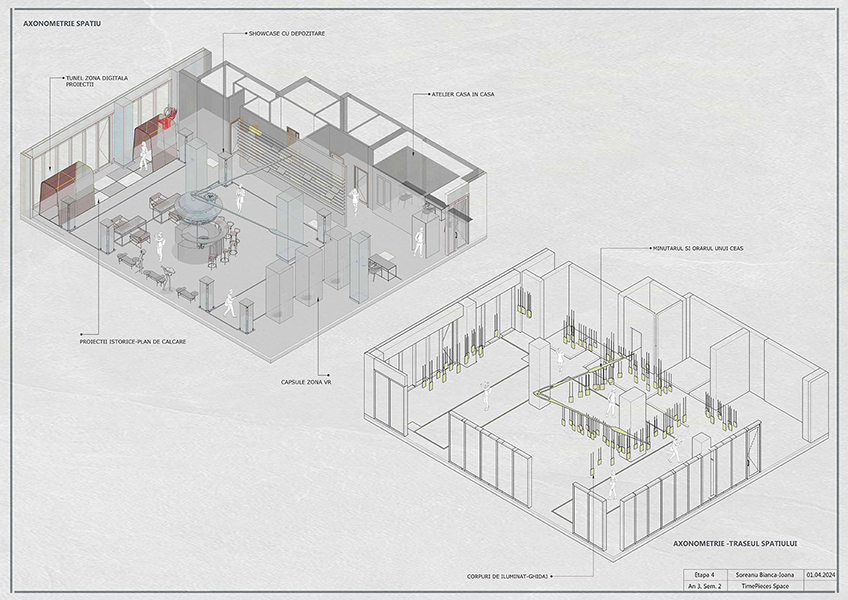
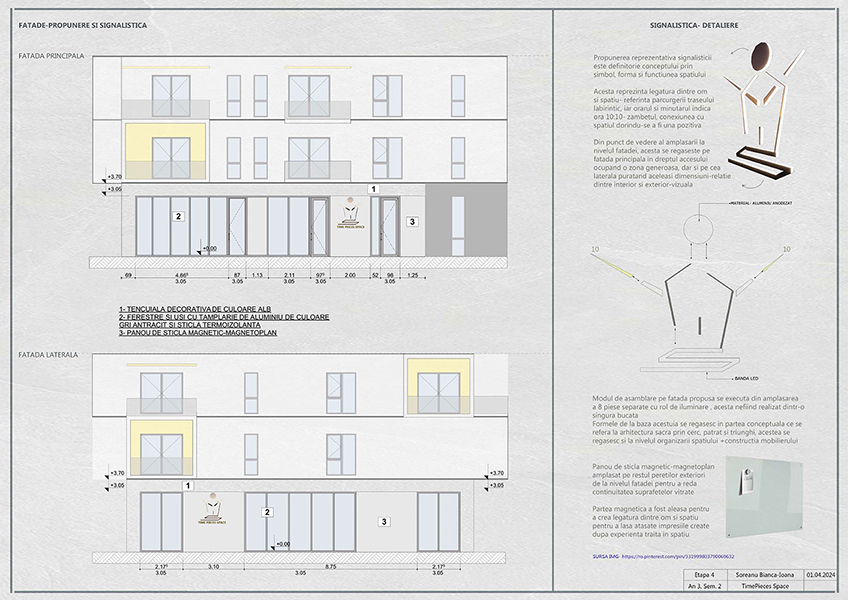
In this project, I designed a multifunctional watchmaker’s workshop—a space dedicated not only to horology enthusiasts but also to fostering interaction, whether between individuals or between the individual and the built environment. The concept envisions a setting that accommodates diverse personalities and experiences, structured around distinct zones that reference past, present, and future. Vintage watch models evoke a sense of history, while contemporary elements frame the present, and a forward-looking perspective—where “the sky is the limit”—symbolizes the possibility for each visitor to construct their own universe.
The spatial organization is articulated through custom-designed furniture and thematic elements that reinforce the narrative. The atmosphere varies according to the user’s perception, oscillating between warm and cool, intimate and dynamic, yet always interactive. Particular emphasis was placed on a contemporary, digitized area incorporating cyberpunk-inspired effects, intended to intensify the human–space relationship and to reflect the diversity of activities hosted within the workshop. This approach reinterprets the traditional watchmaking function within a modern framework capable of attracting multiple generations.
The project was developed progressively, from conceptual sketches to a highly detailed representation approximating real construction. Materials, textures, colors, and finishes were carefully selected to support the overarching theme and concept. Drawing upon case studies of similar functions as well as original design explorations and modeled elements, the result is an interactive, contemporary, and distinctive environment.
At its core, the project is grounded in the exploration of the human–space relationship, the psychological effects of the built environment, and references to principles of sacred architecture found across cultures, integrating these dimensions into a cohesive and experiential interior design proposal.
Student: Henț Iulia-Alexia
Coordinating Professor: Conf. Dr. Arch. Andreea Anghel
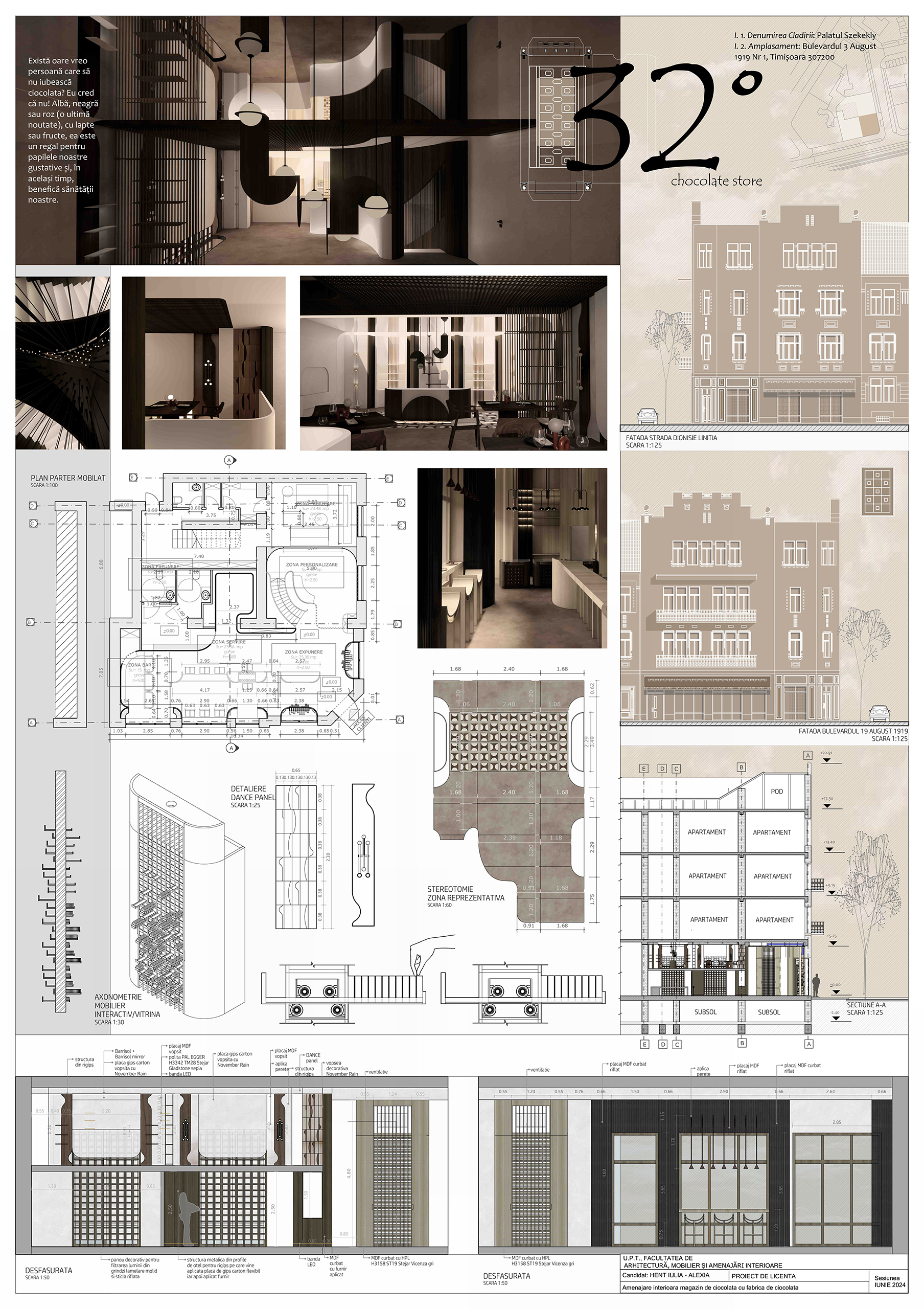
Located in the historic Fabric district of Timișoara, within the Szekely Palace, the selected site currently functions as a facility for the preparation of confectionery and pastry products. The proposed intervention redefines the space as a showroom-warehouse dedicated to the presentation of chocolate products, incorporating a small-scale chocolate factory. The Szekely Palace is distinguished by its architectural language, characterized by a restrained plastic expression devoid of excessive ornamentation, anticipating the modernist direction that would later shape international architecture.
The conceptual inspiration for the project stems from Timișoara’s historical connection to the Kandia chocolate factory—a brand that delighted generations of chocolate enthusiasts and left a lasting mark on the city’s identity for over a century, beginning in 1890. Drawing from this legacy, the proposal envisions the creation of a small confectionery workshop in Timișoara, symbolically reopening a space for passion and creativity in the field. The long-term vision imagines locally produced chocolates and chocolate bars gaining recognition beyond Romania, potentially throughout Europe.
The interior design concept is grounded in the transformation of chocolate from its liquid to its solid state. This metamorphosis is translated spatially through the use of organic, flowing geometries rendered in solid, substantial materials—forms that appear fluid yet embody mass and permanence, metaphorically suggesting the solidification process of chocolate.
The spatial narrative unfolds as a journey that simulates the organic stages of chocolate production. The design capitalizes on this manufacturing process by gradually transitioning materials and textures—from rough to refined surfaces—mirroring the cocoa bean’s transformation from harvesting to grinding and final refinement. Architectural curves guide movement through the space, evoking the tempering and molding stages of chocolate making. In this sense, the interior itself becomes a form of packaging that must be metaphorically “unwrapped” to be fully understood.
Existing architectural elements are carefully integrated into the proposal. Decorative motifs from the façade are reinterpreted as sources of inspiration and constructive elements, including forms suggestive of chocolate shapes. Materials present on both the façade and in the interior—such as green ceramics—are incorporated into the new design. The historical context of the site is also acknowledged: the previous use of the land as a timber warehouse informs the reintroduction of wood as a key material.
Color plays a significant role in shaping the atmosphere of the space. Warm tones dominate the interior, fostering a welcoming and comfortable ambiance often associated with nature and organic textures. Subtle shades of brown and green—derived from the natural hues of cocoa beans—form the core chromatic palette, reinforcing the conceptual and sensory narrative of the project.
2024 | PROIECTARE DE INTERIOR 2 | M02
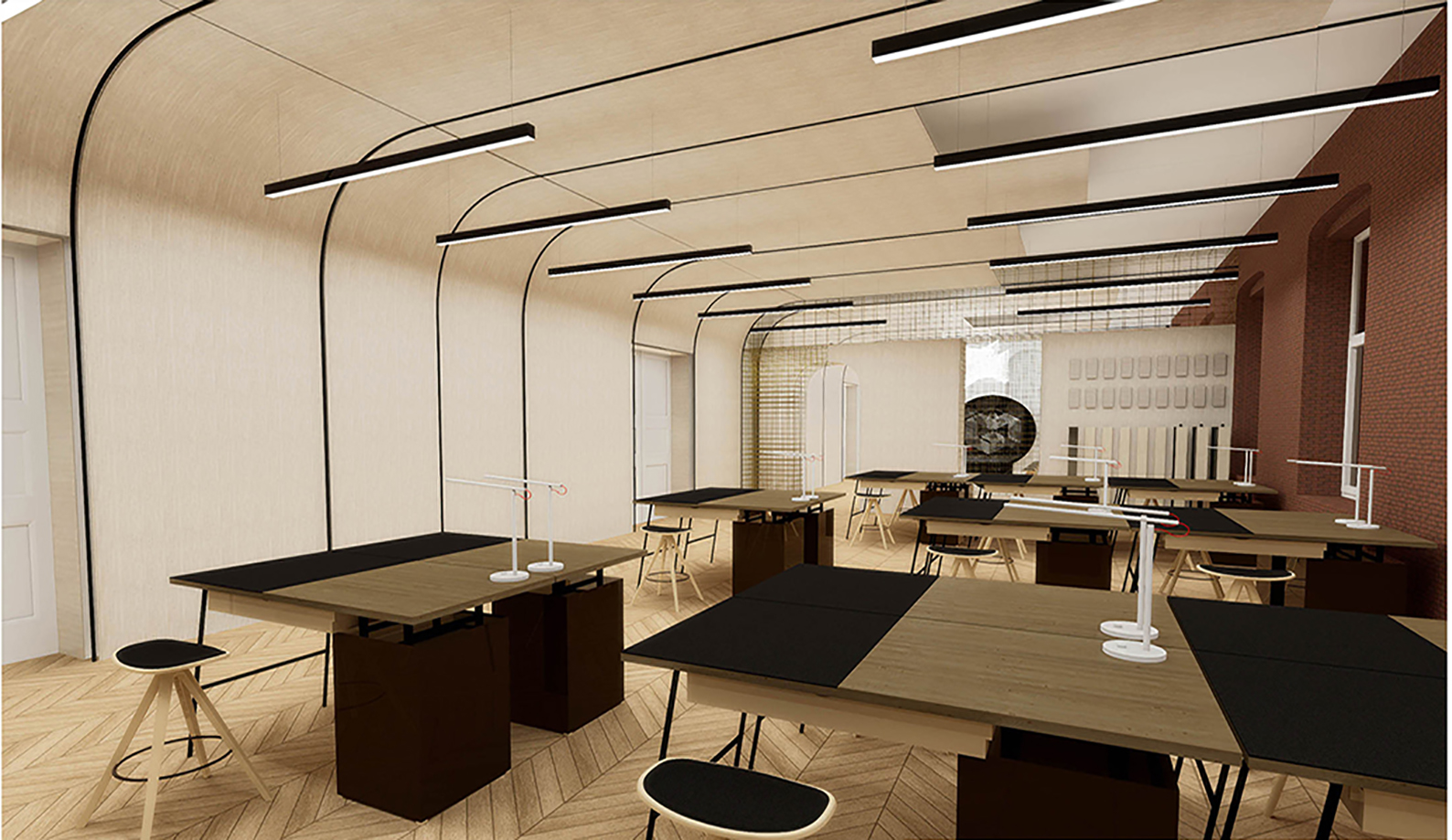
RO: Proiectul vizează reimaginarea unui spațiu din patrimoniul UPT, în scopul generării unui spațiu creativ de educație cu caracter flexibil, destinat învățării bazate pe colaborare multidisciplinară. Spațiul este intenționat să deservească studenții specializării, având funcția de bază de atelier de proiectare și oferind un suport flexibil pentru activități didactice și de socializare.
Structura proiectului vizează trei etape distincte, una bazată pe analiză și stabilirea principiilor generale ale demersului, una pe dezvoltarea principiilor generale de zonare, mobilare și moduri de operare și una de detaliere a anumitor operații în cadrul interior și a unor componente de mobilier particulare. Proiectul se încheie cu o etapă concluzivă care reia legătura dintre etapele disparate și reîntregește discursul proiectului.
For the full pictures please click on the pages of the brochure below.
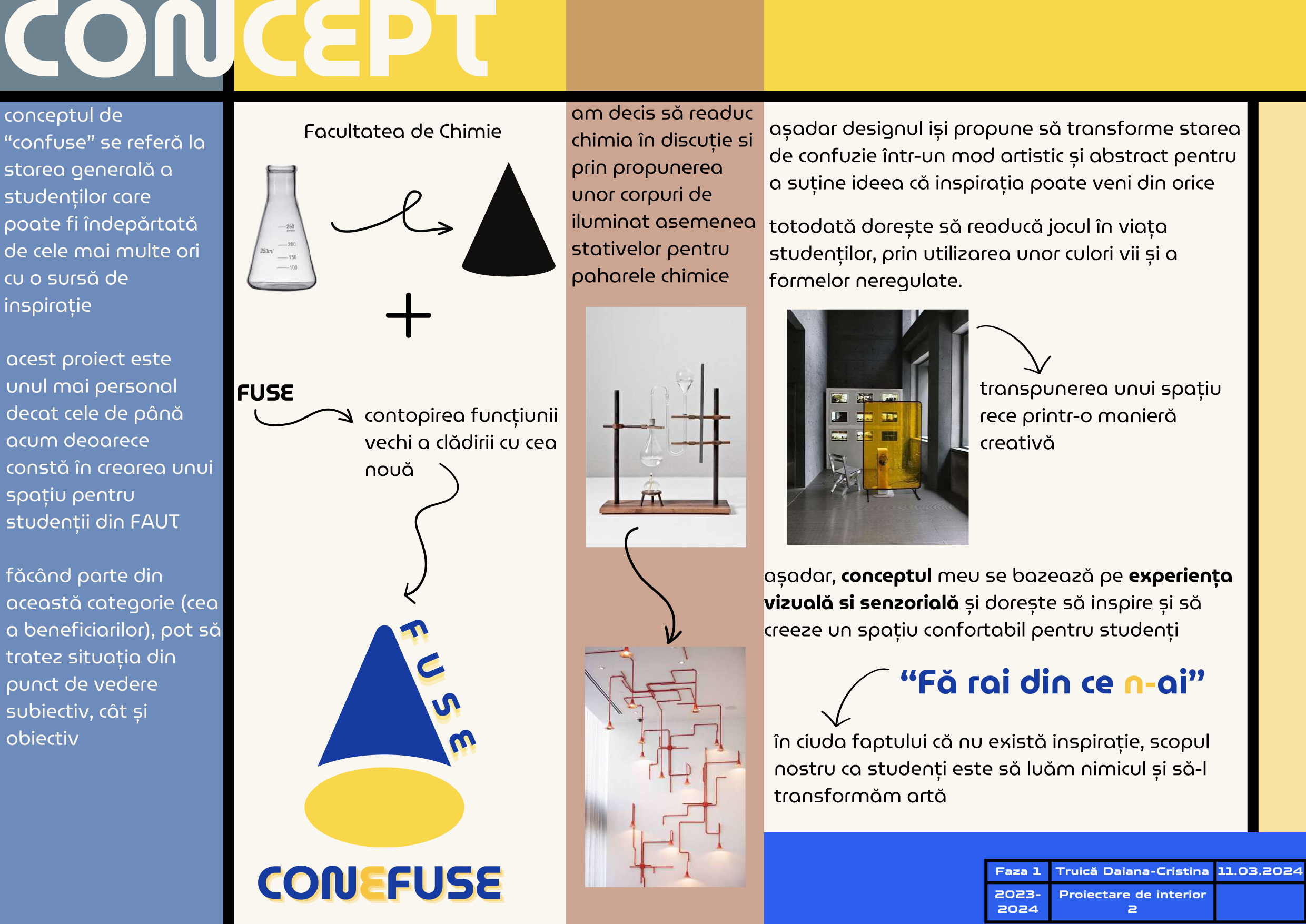
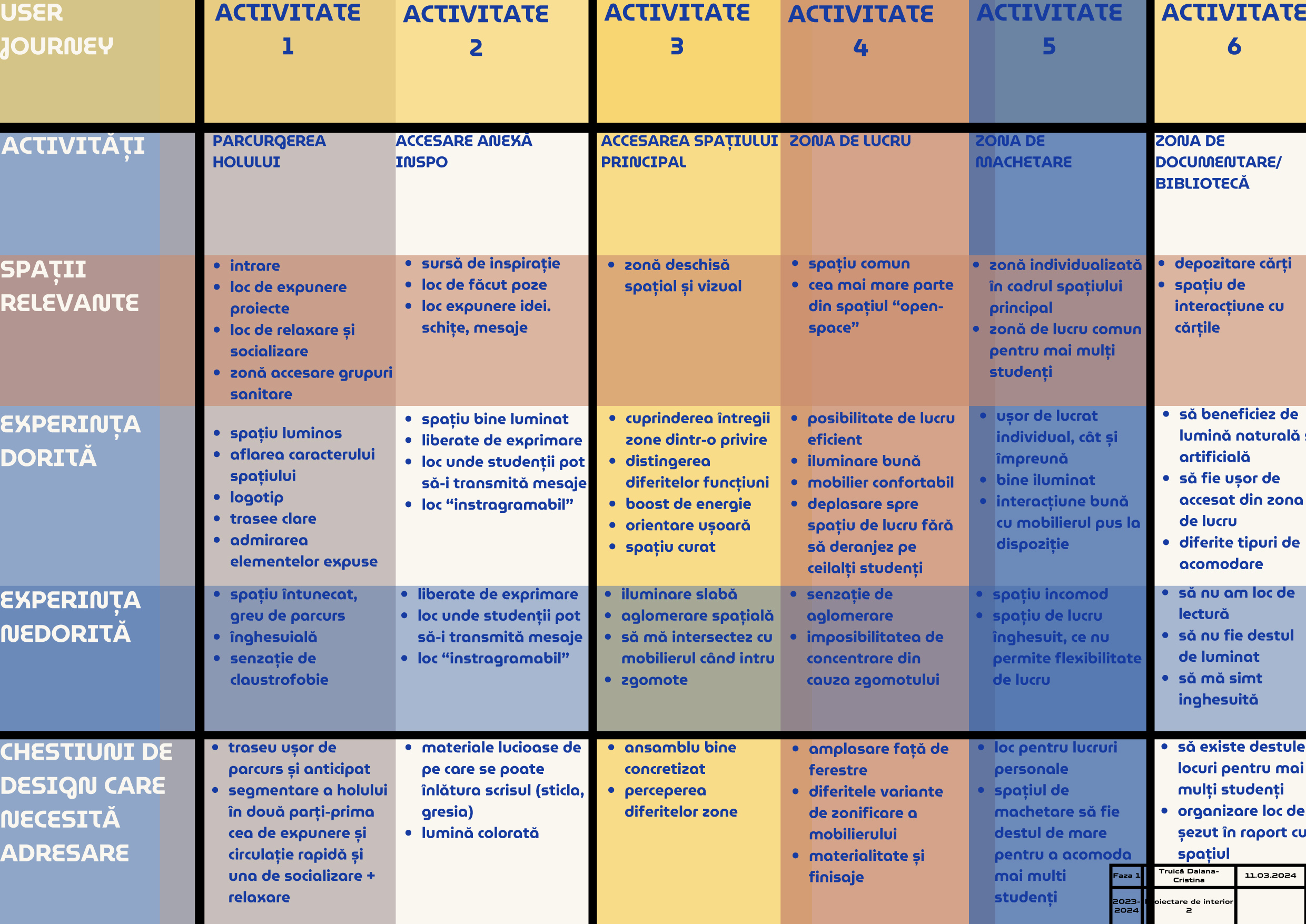
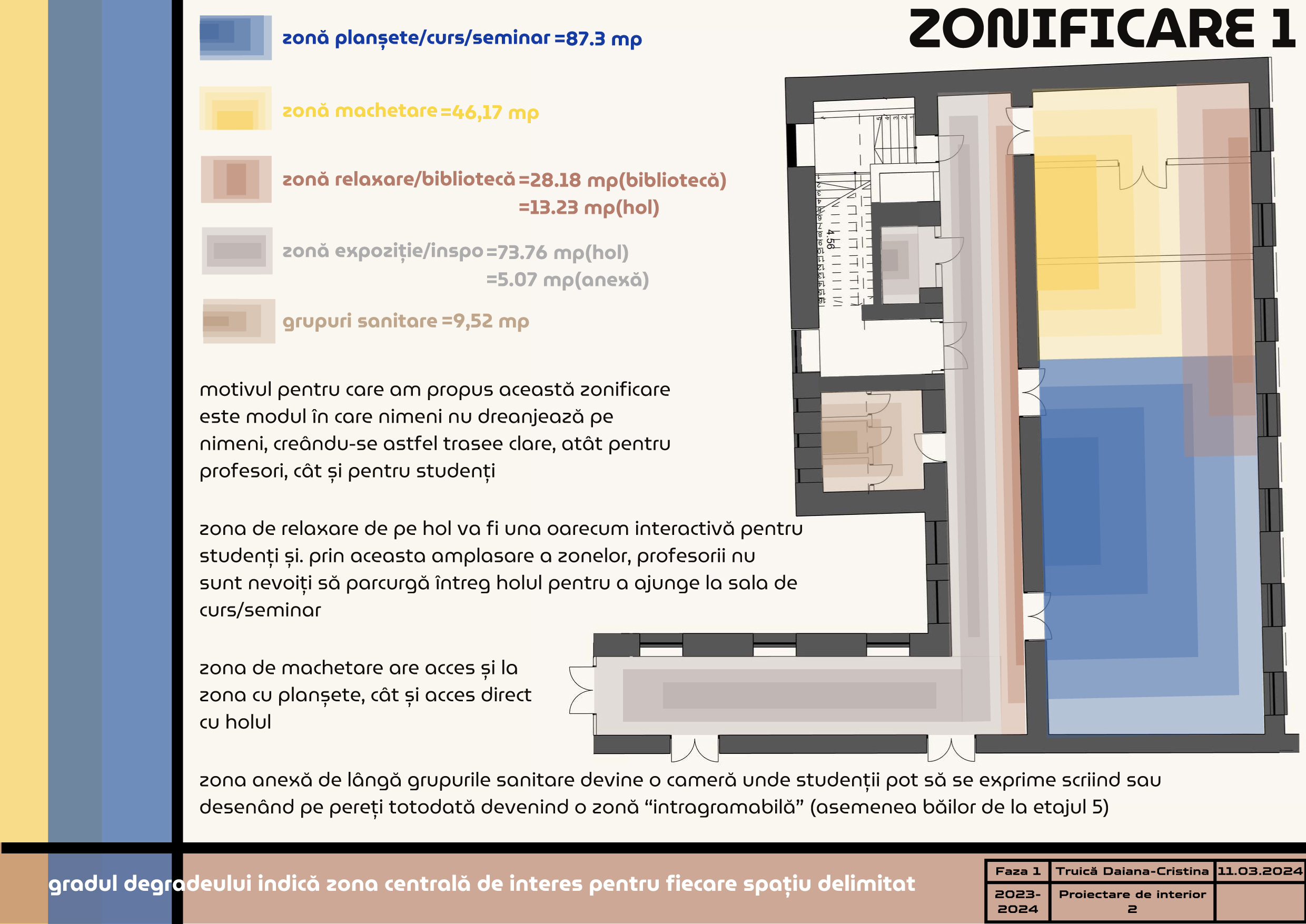
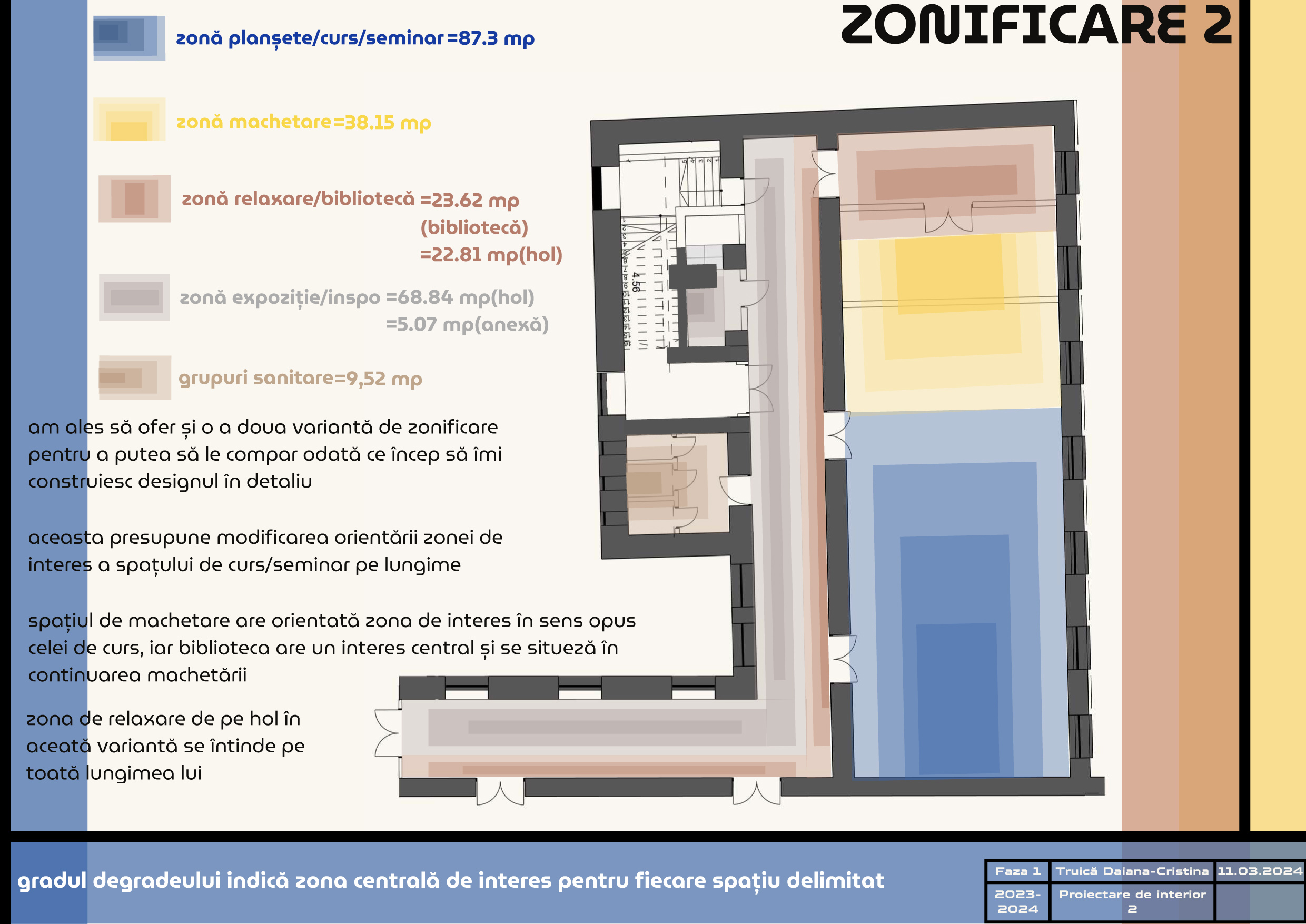
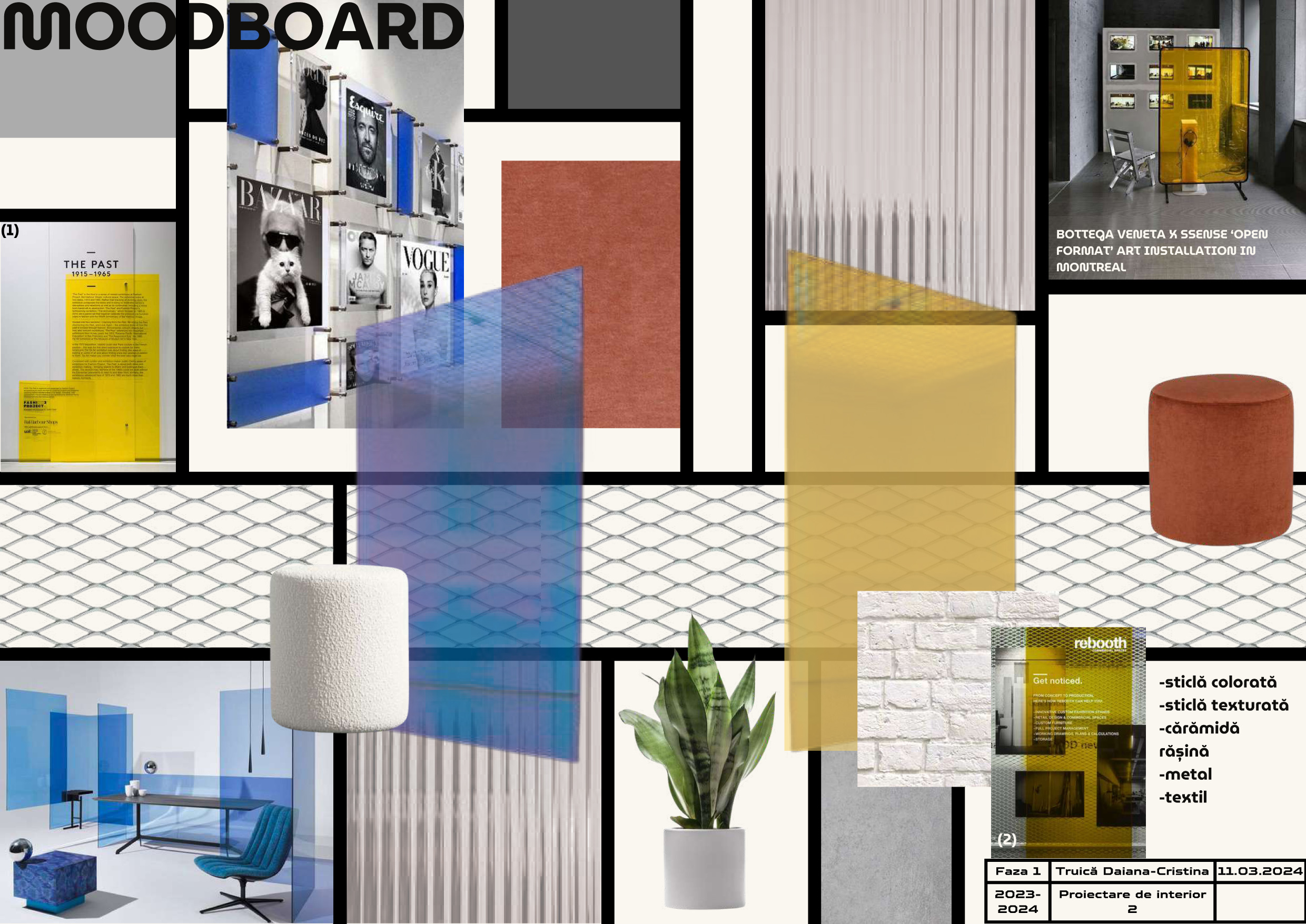
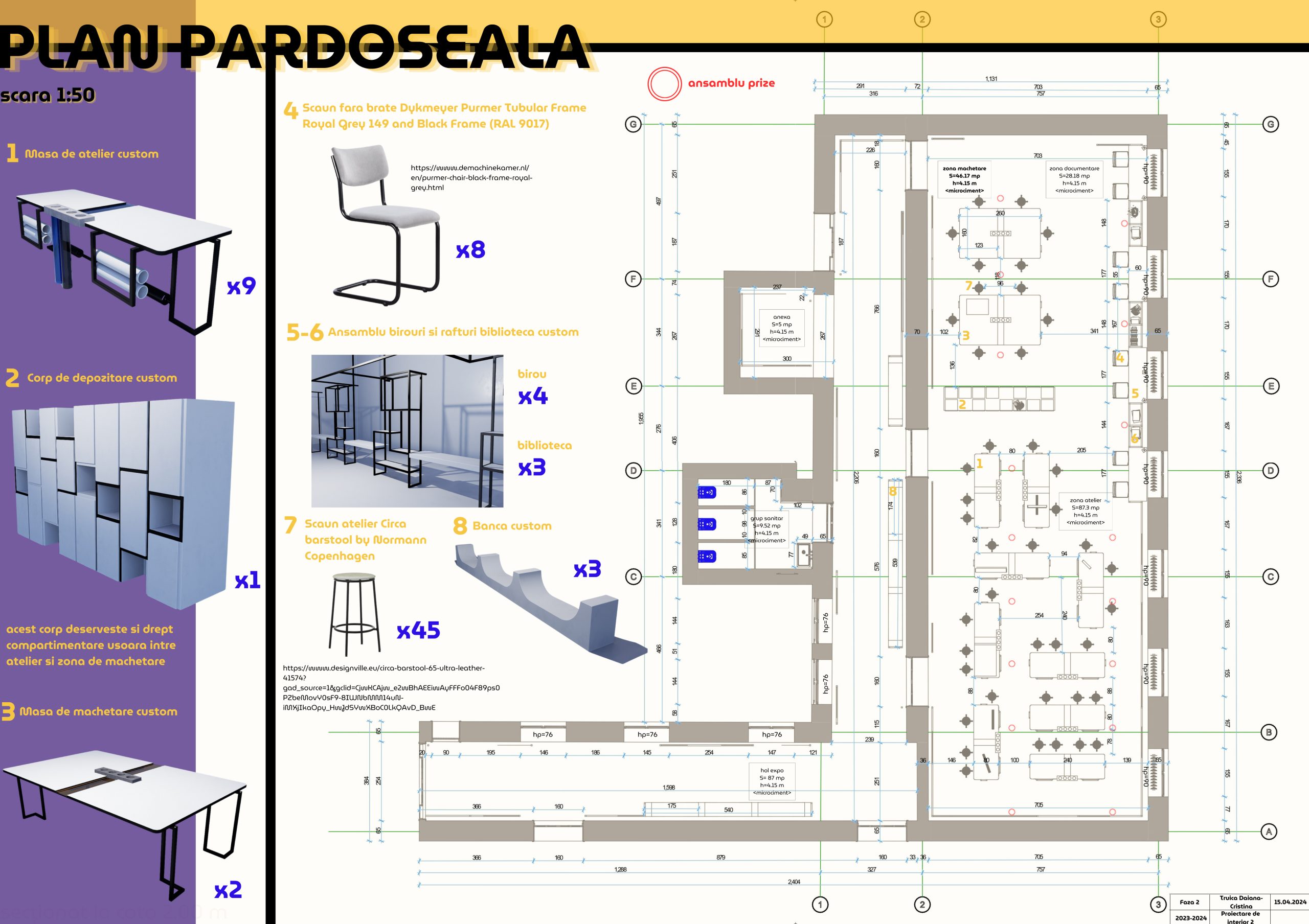
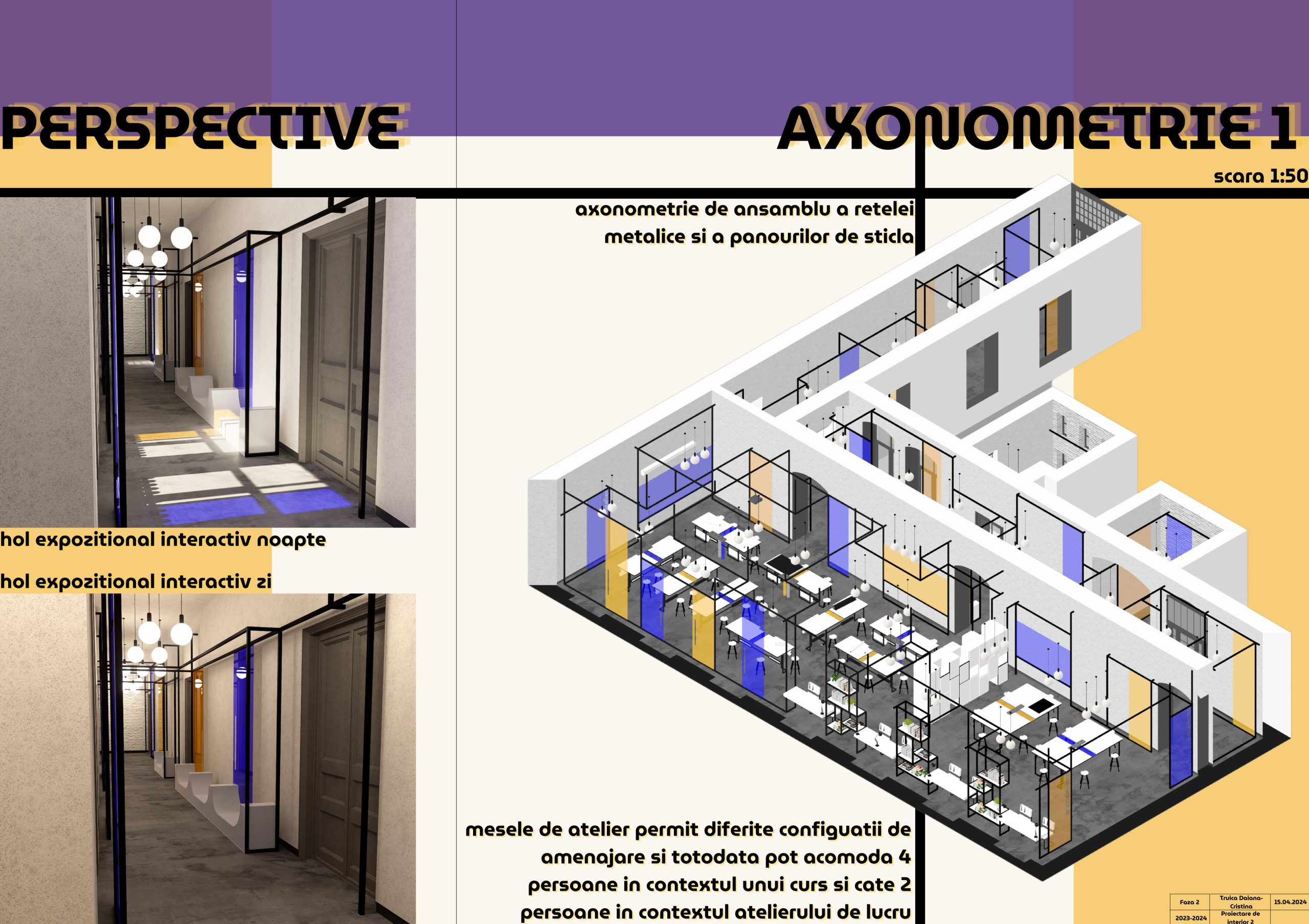
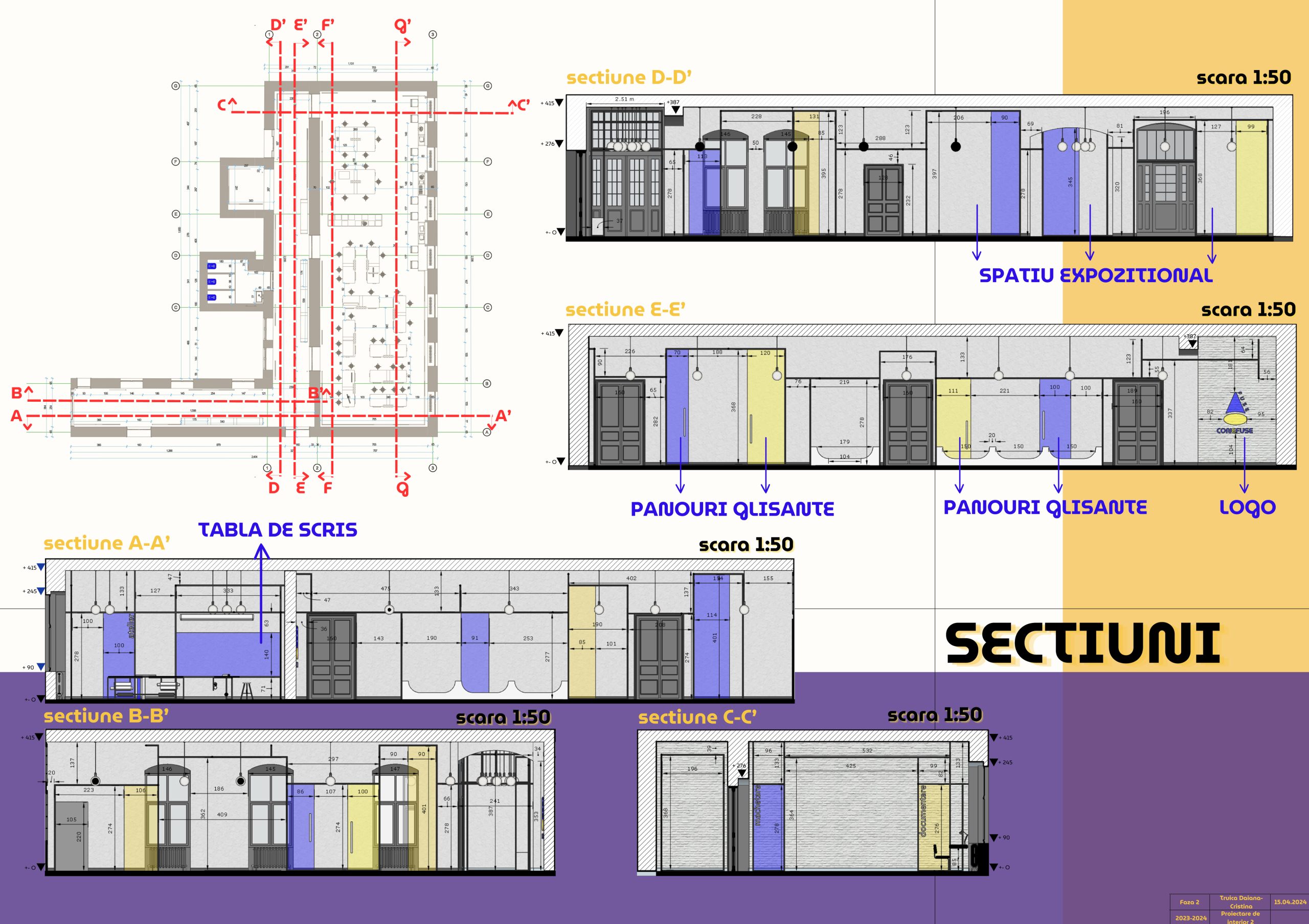
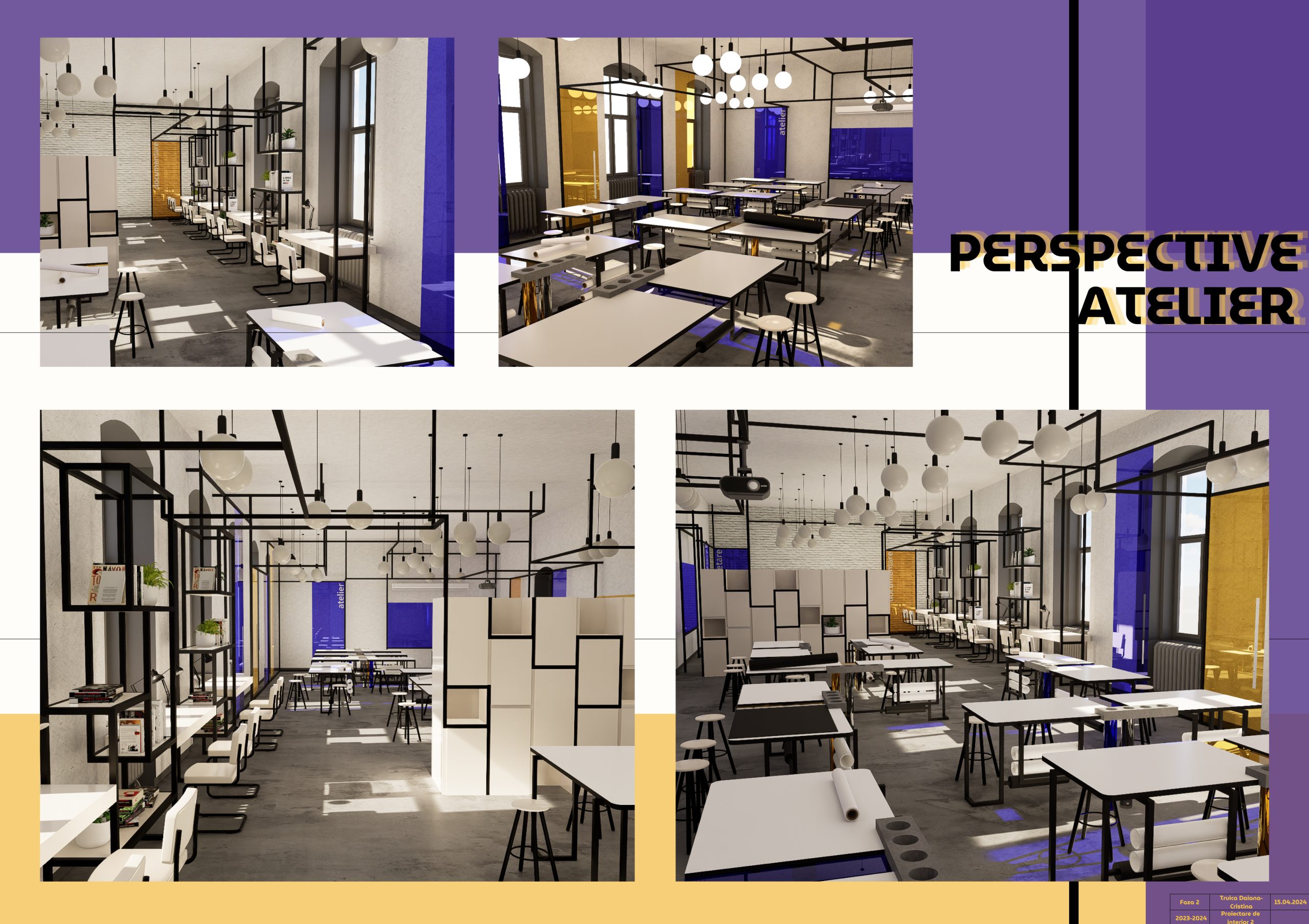
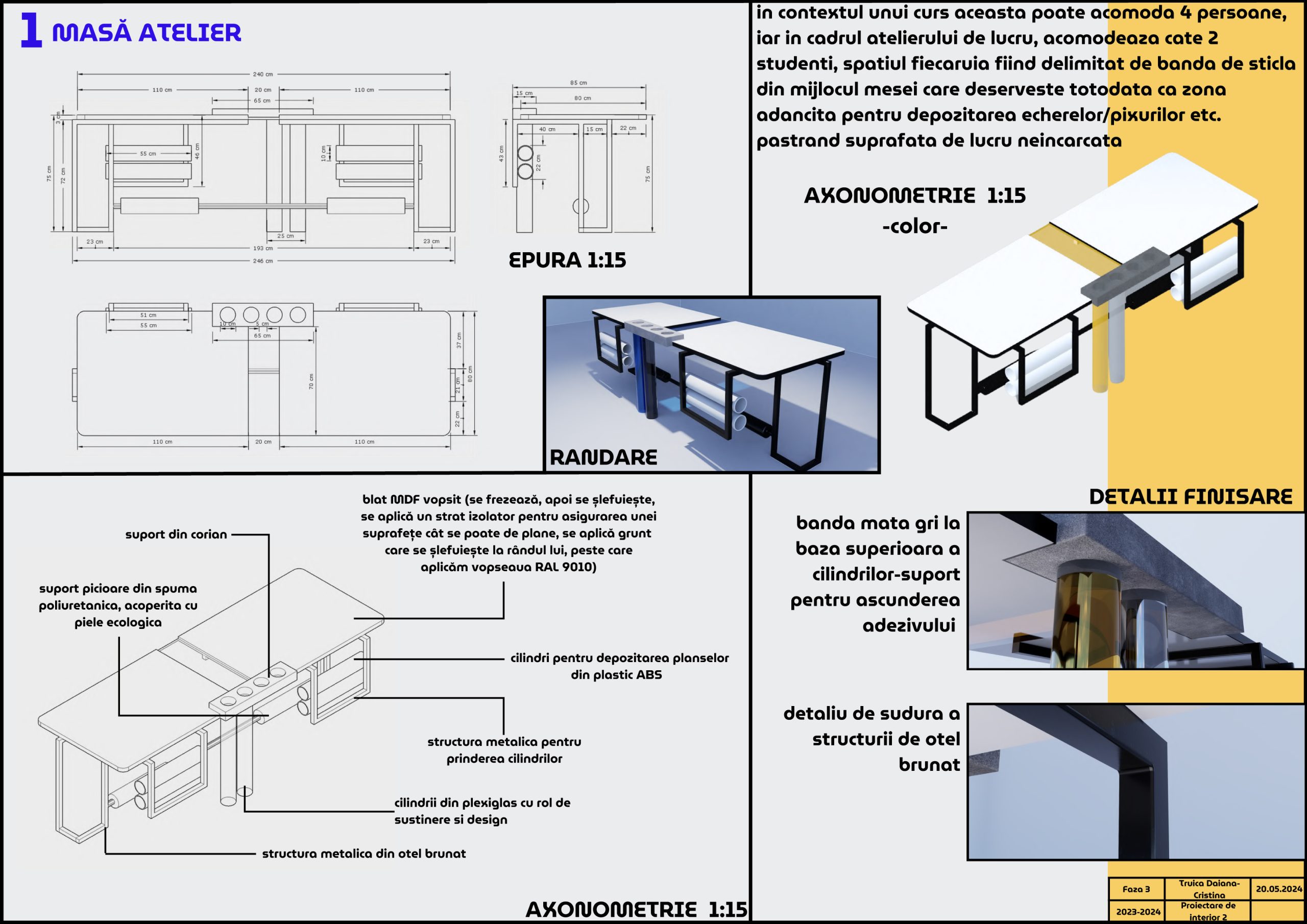
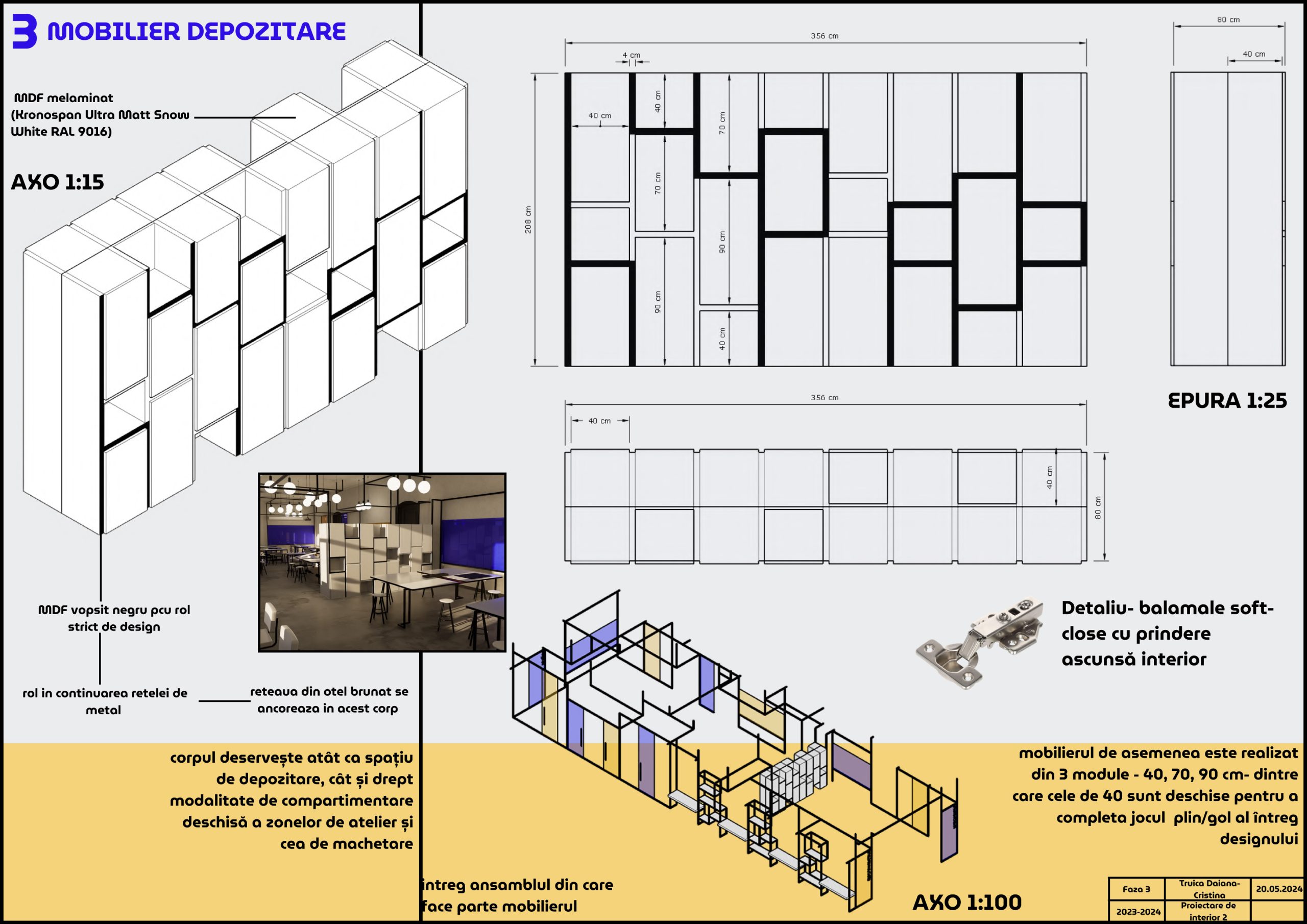
EN: The project aimes at reimagining a space within the portofolio of UPT, in order to generate a creative space for education with a flexible character, intended for multidisciplinary collaborative learning. The space is intended to serve the students of the specialisation, while its main function is that of a workshop space, while also offering a flexible support for teaching activities as well as socialising.
The structure of the project covers three distinct phases, one based on analysis and establishment of the general principles of the approach, one in which general principles of zoning, furnishing and modes of operation are developed and one based on the detailing of certain operations within the interior and furniture components. The project ends with a concluding poster that re-connects the disparate stages and re-weaves the discourse of the project.
2024 | PROIECTARE DE INTERIOR 4 | M03
RO
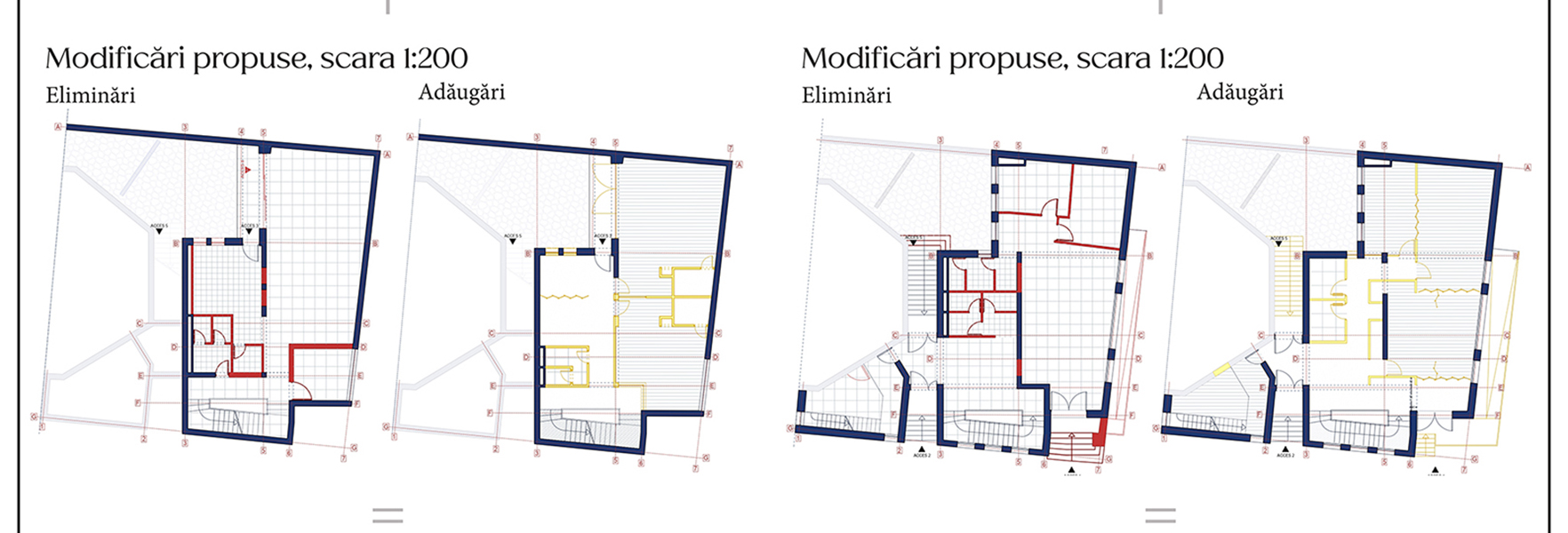
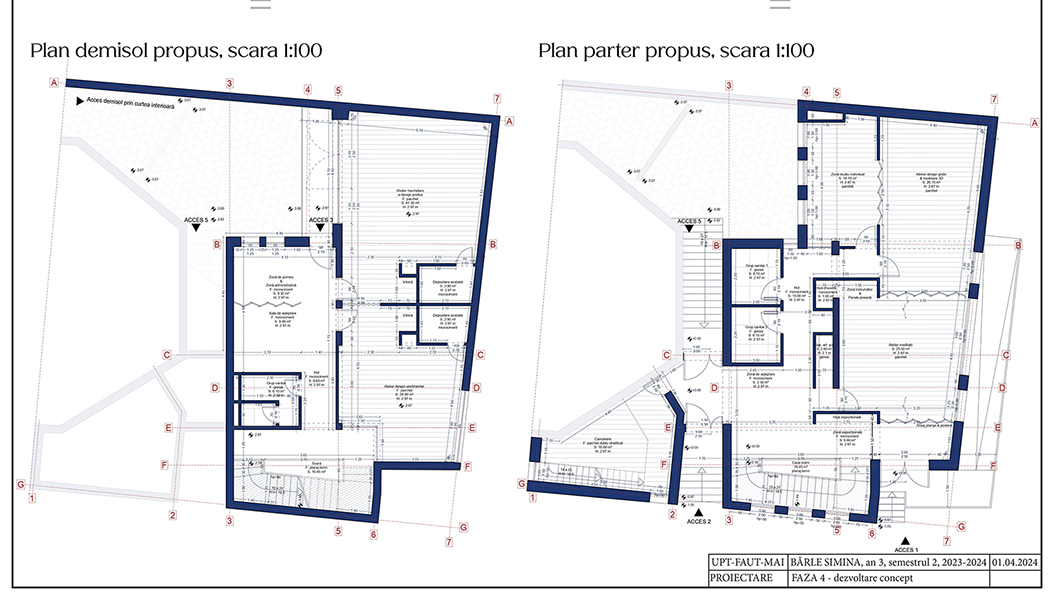
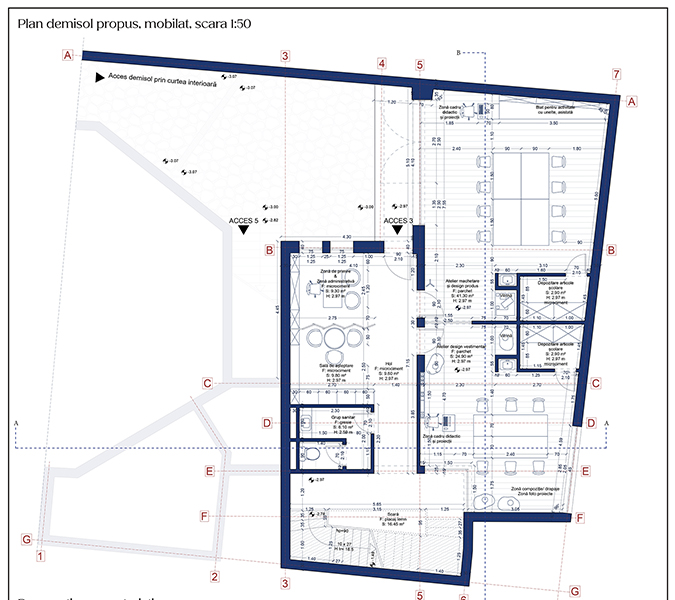
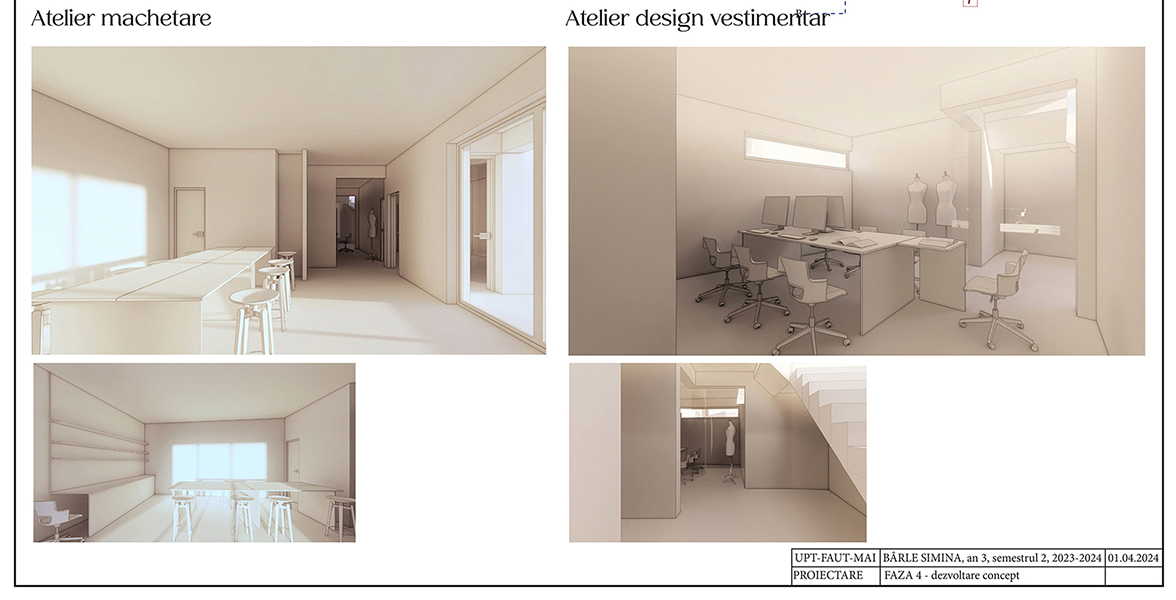
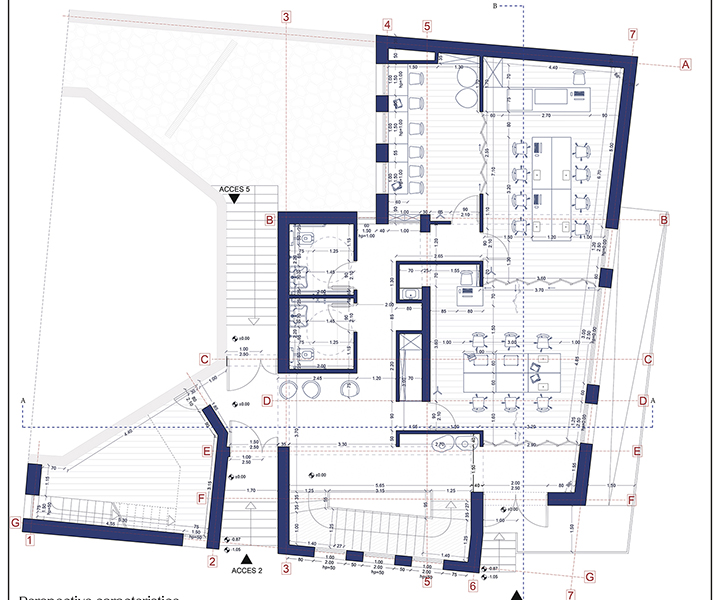
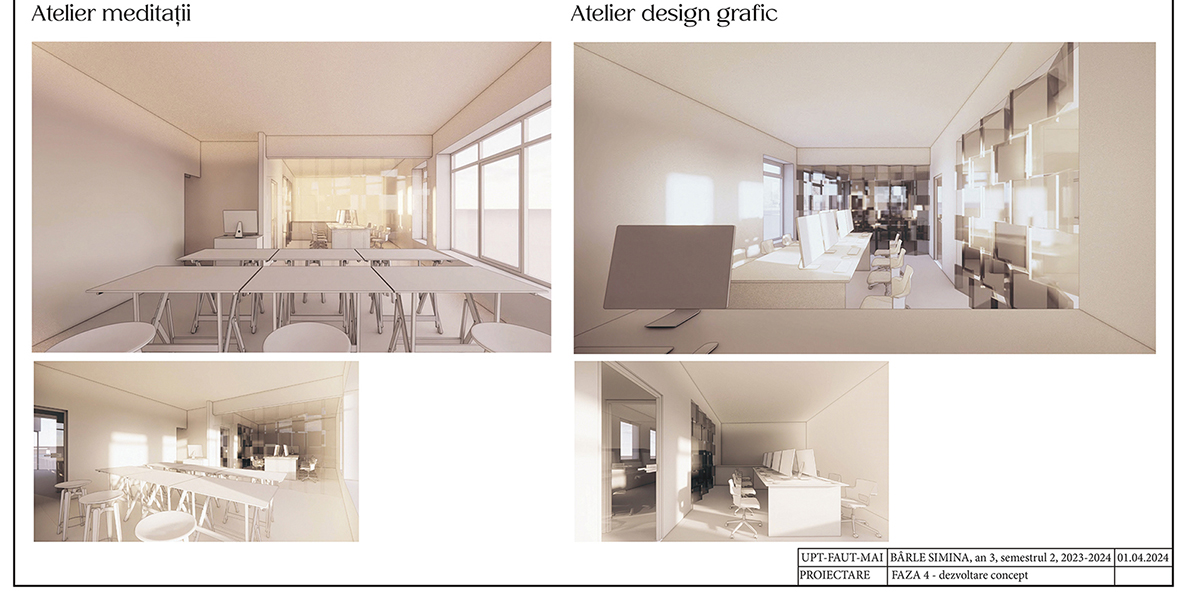
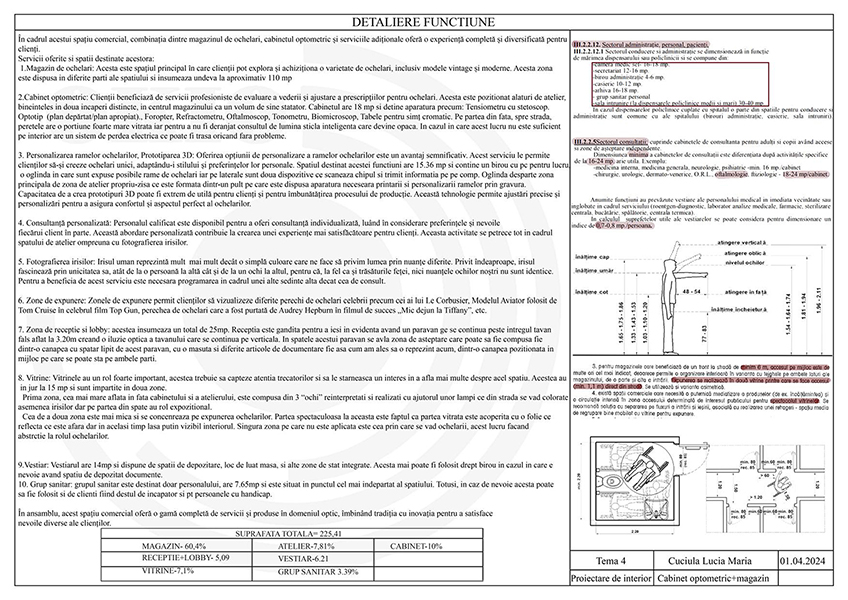
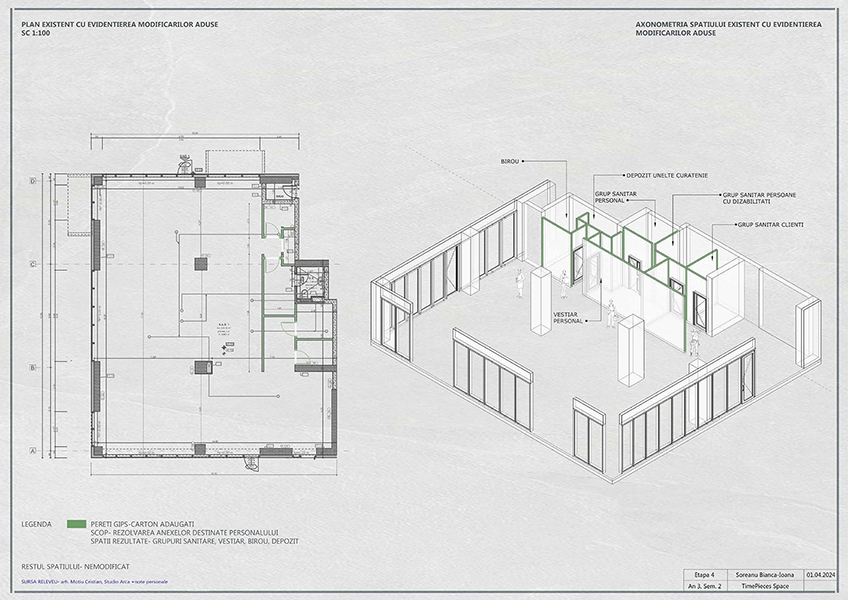
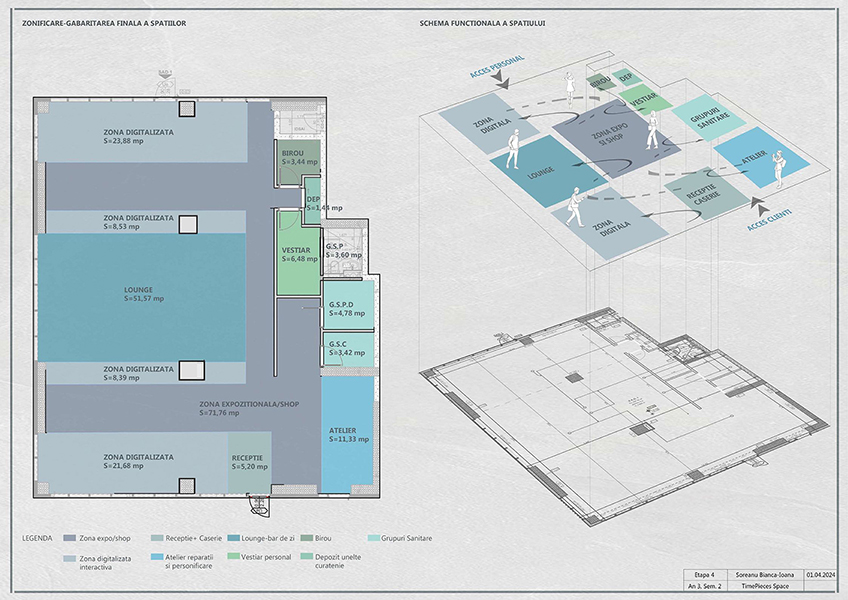
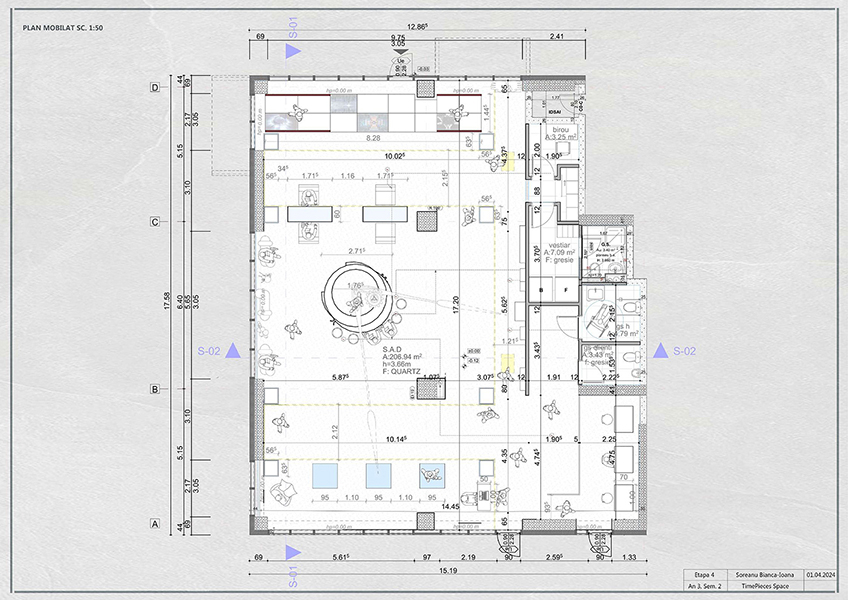
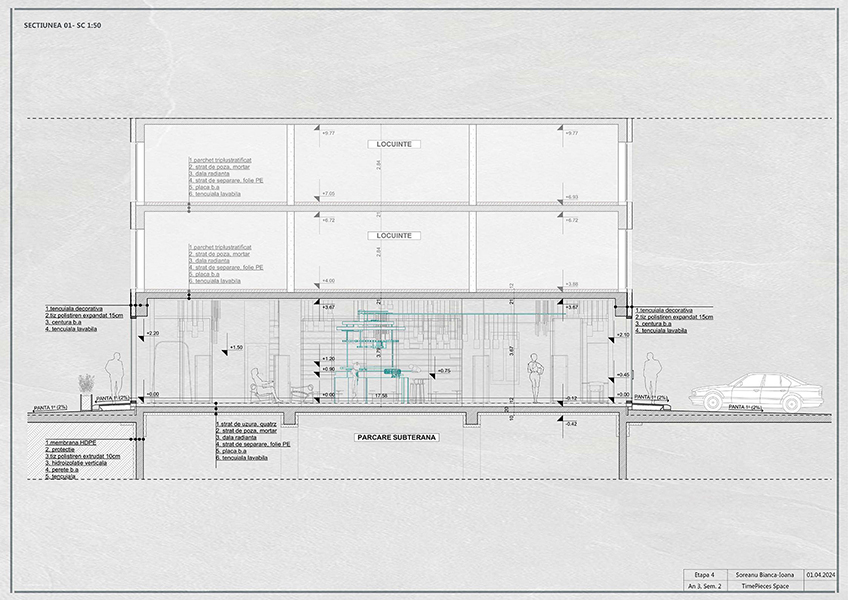
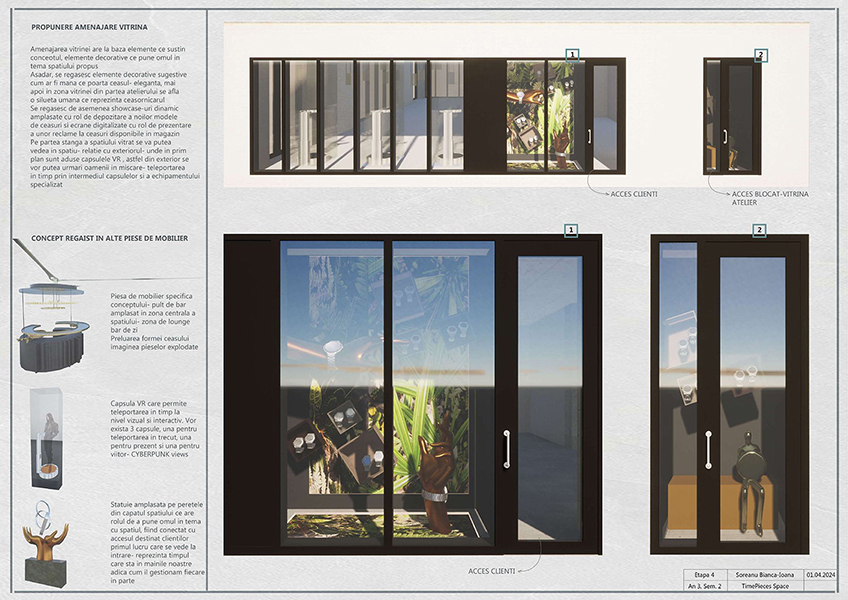
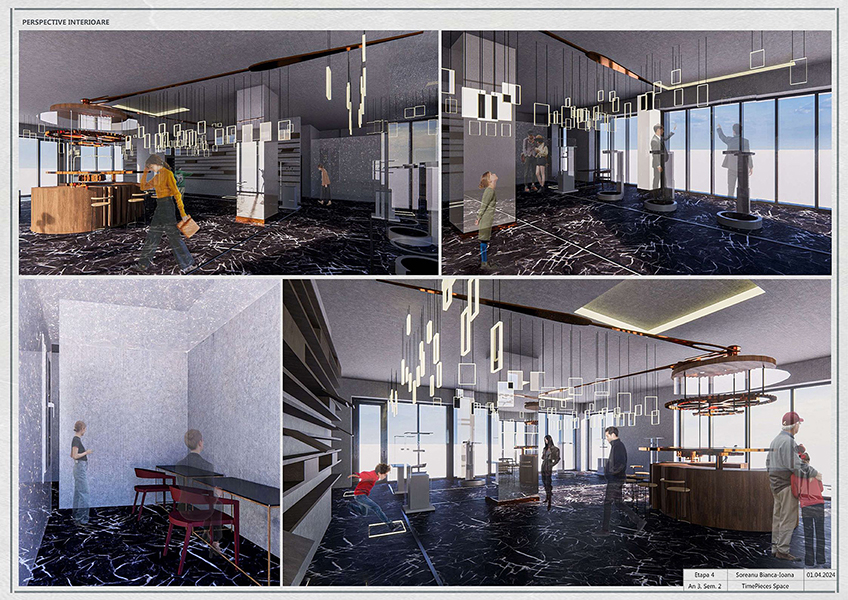
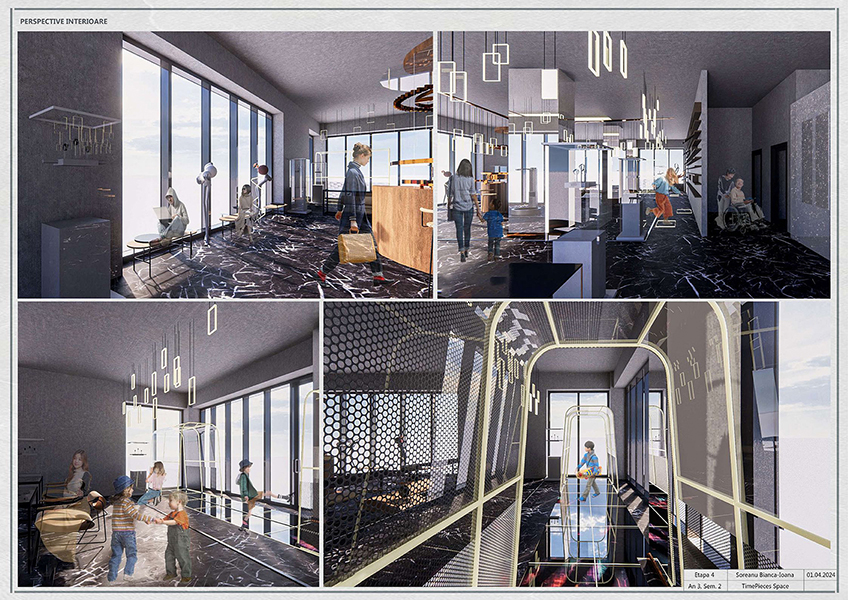
Proiectul din semestrul 2 , desfășurat pe durata a 7 săptămâni va constitui baza proiectului de licență , pe care studenții îl vor susține la sfârșitul celor 3 ani de studiu și își propune realizarea unui proiect complet de amenajare interioară și mobilier cu toate etapele ei de elaborare necesare.
Pentru a putea demara proiectul este obligatorie înțelegerea situației existente și definirea cerințelor impuse de tema program.
Spațiul existent și tema sunt la libera alegere a studentului, existând unele condiții de suprafață minimă și complexitate a programului ales. Acestea se vor discuta individual, în principiu suprafața studiată trebuie să fie de aproximativ 200 mp iar funcțiunea va presupune acces public.
For the full pictures please click on the pages of the brochure below.
EN
The Semester 2 project, carried out over a period of 7 weeks, will serve as the foundation for the Bachelor’s thesis, which students will present at the end of their three years of study. The project aims to develop a comprehensive interior design and furniture proposal, including all necessary stages of elaboration.
To initiate the project, it is essential to understand the existing situation and define the requirements set by the program brief.
The existing space and project theme are freely chosen by the student, with certain conditions regarding minimum area and program complexity. These aspects will be discussed individually. In principle, the studied space should be approximately 200 sqm, and the function must allow public access.
2022 | DESIGN 2 | M01
RO
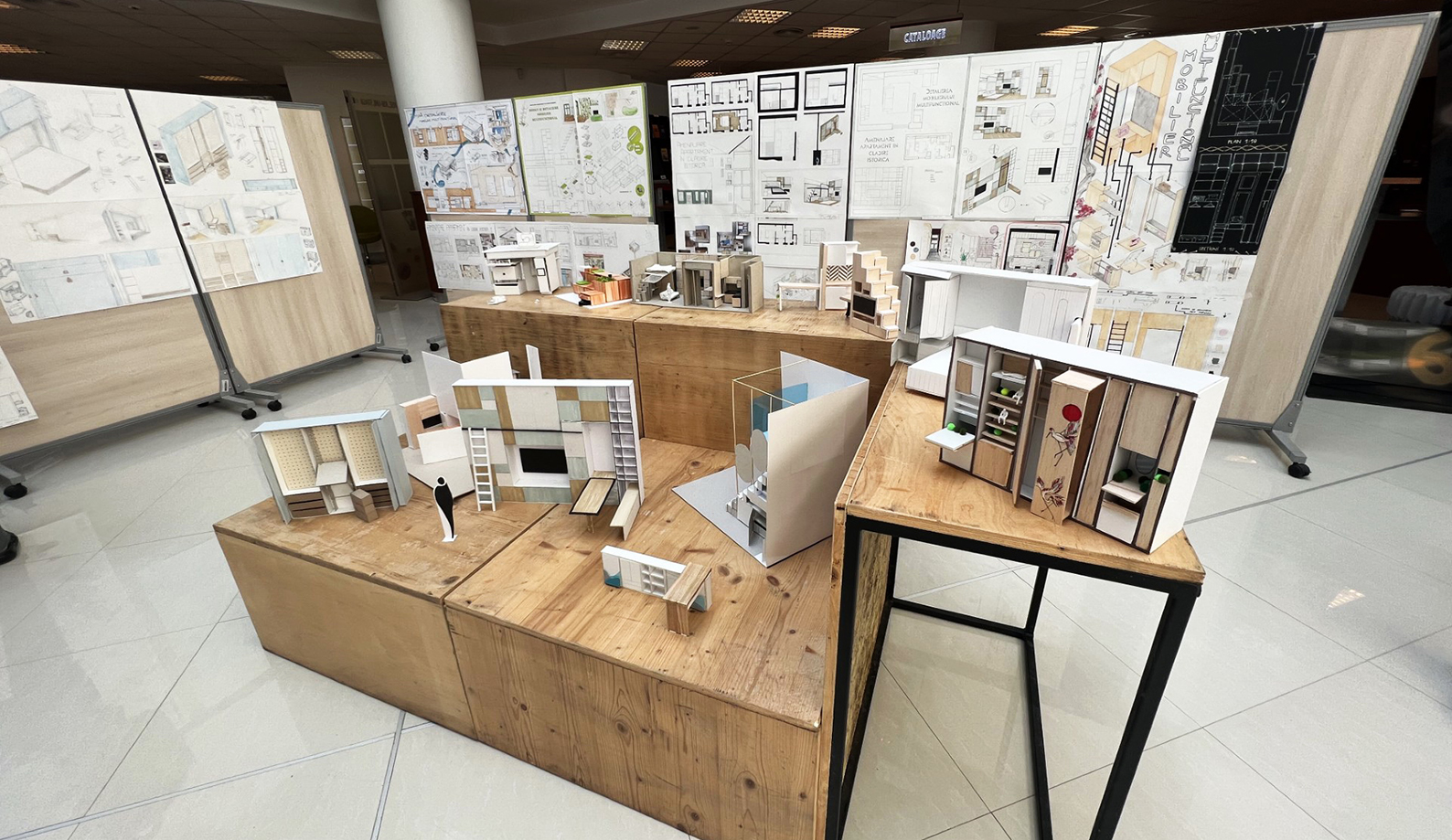
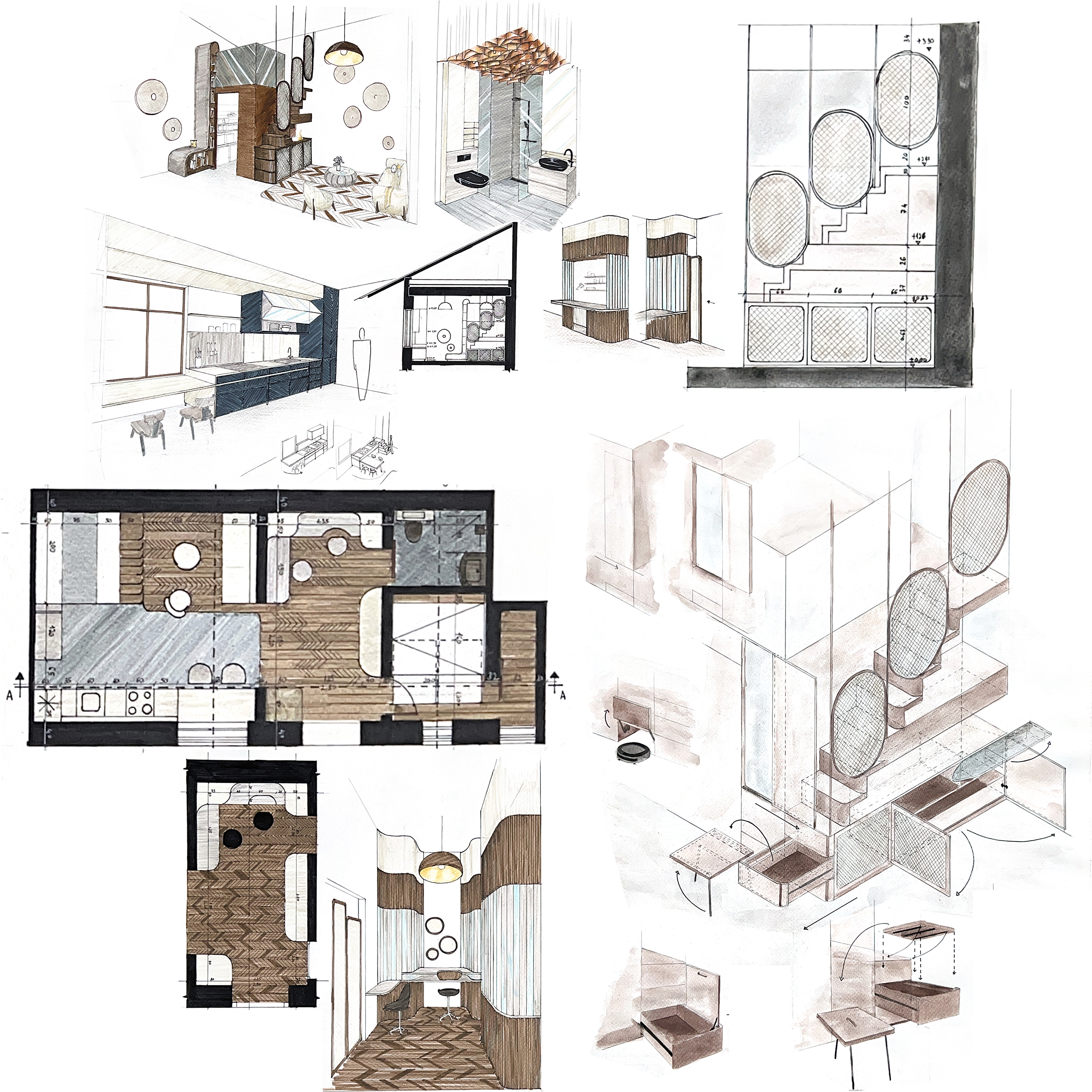
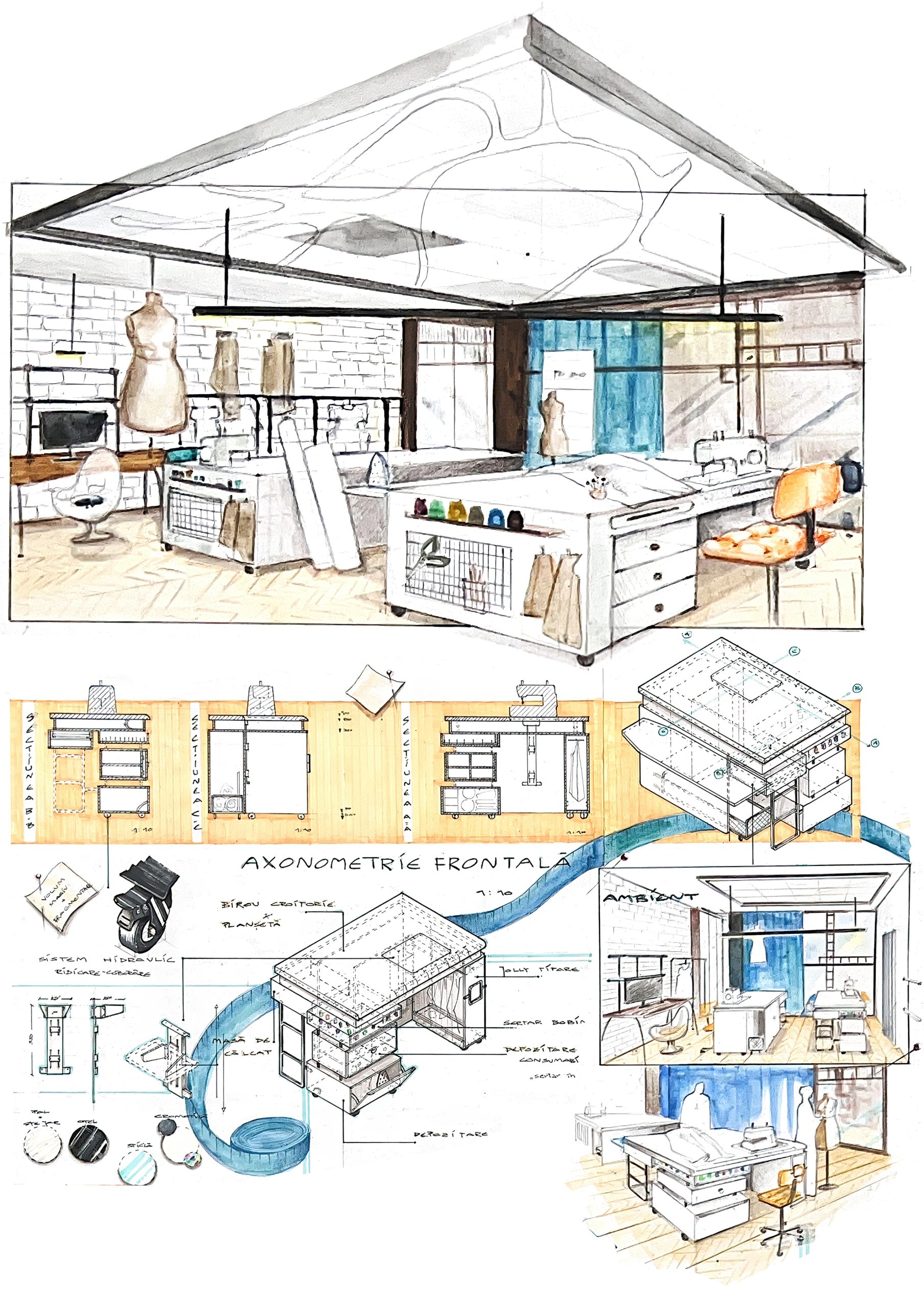
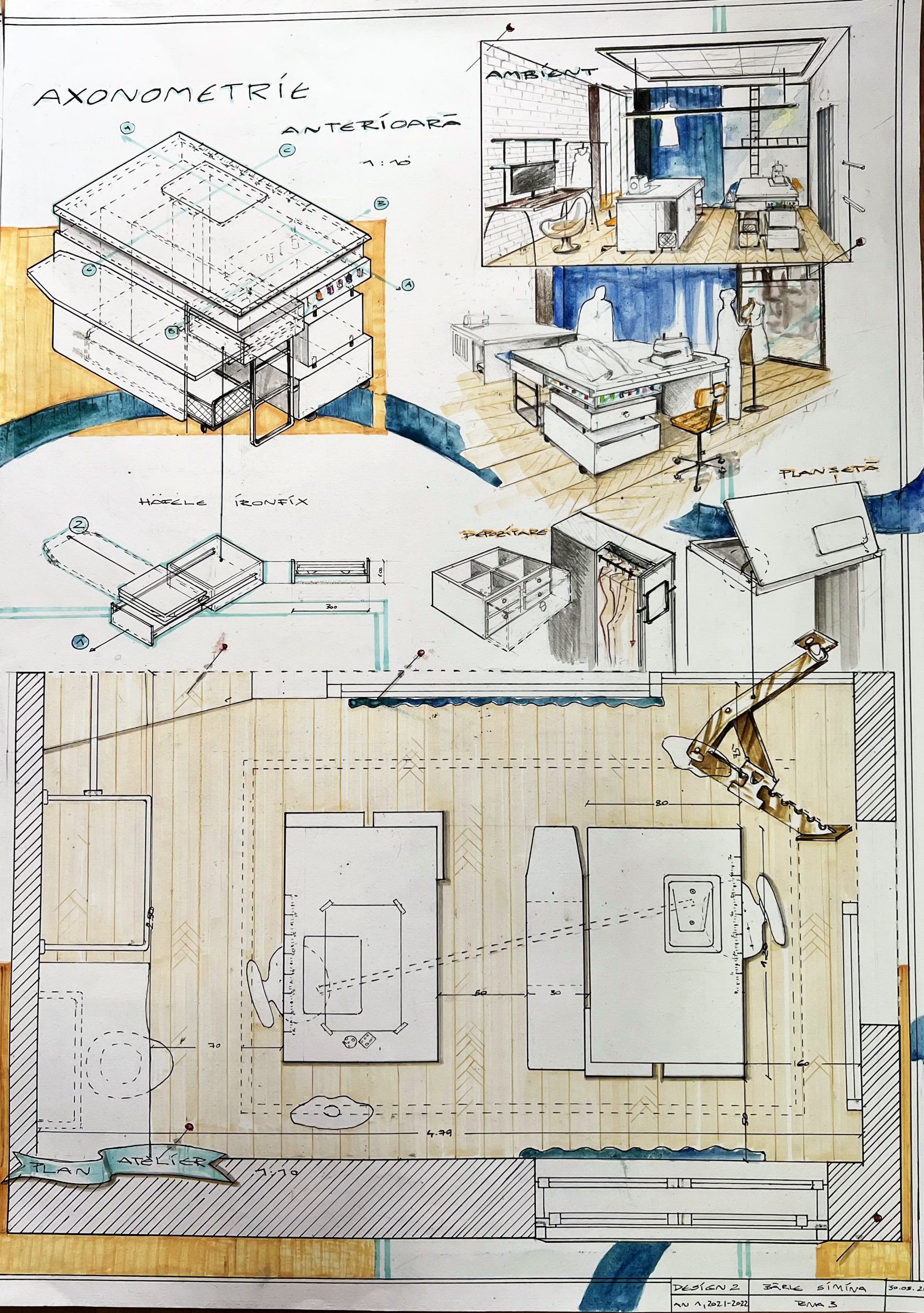
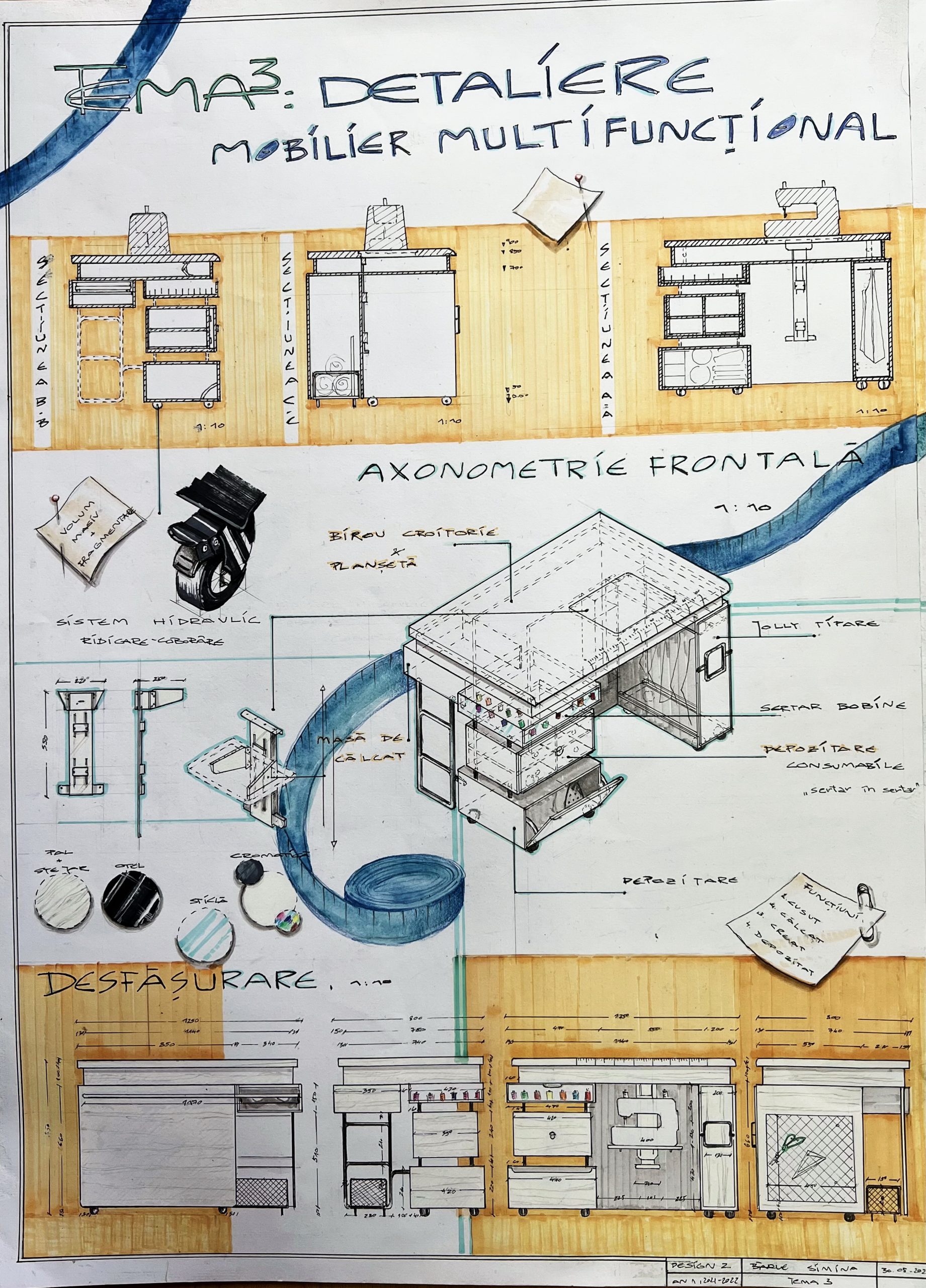
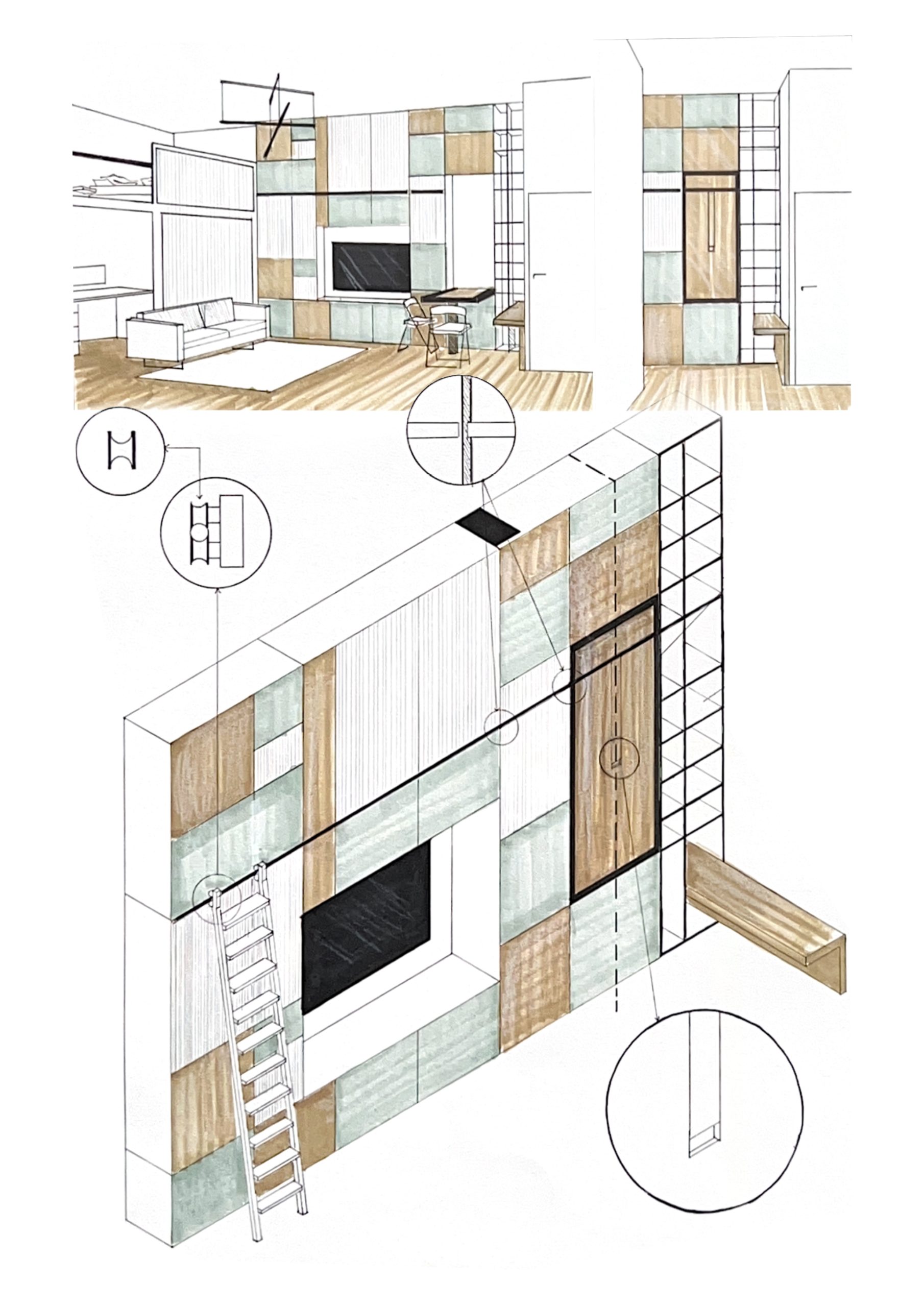
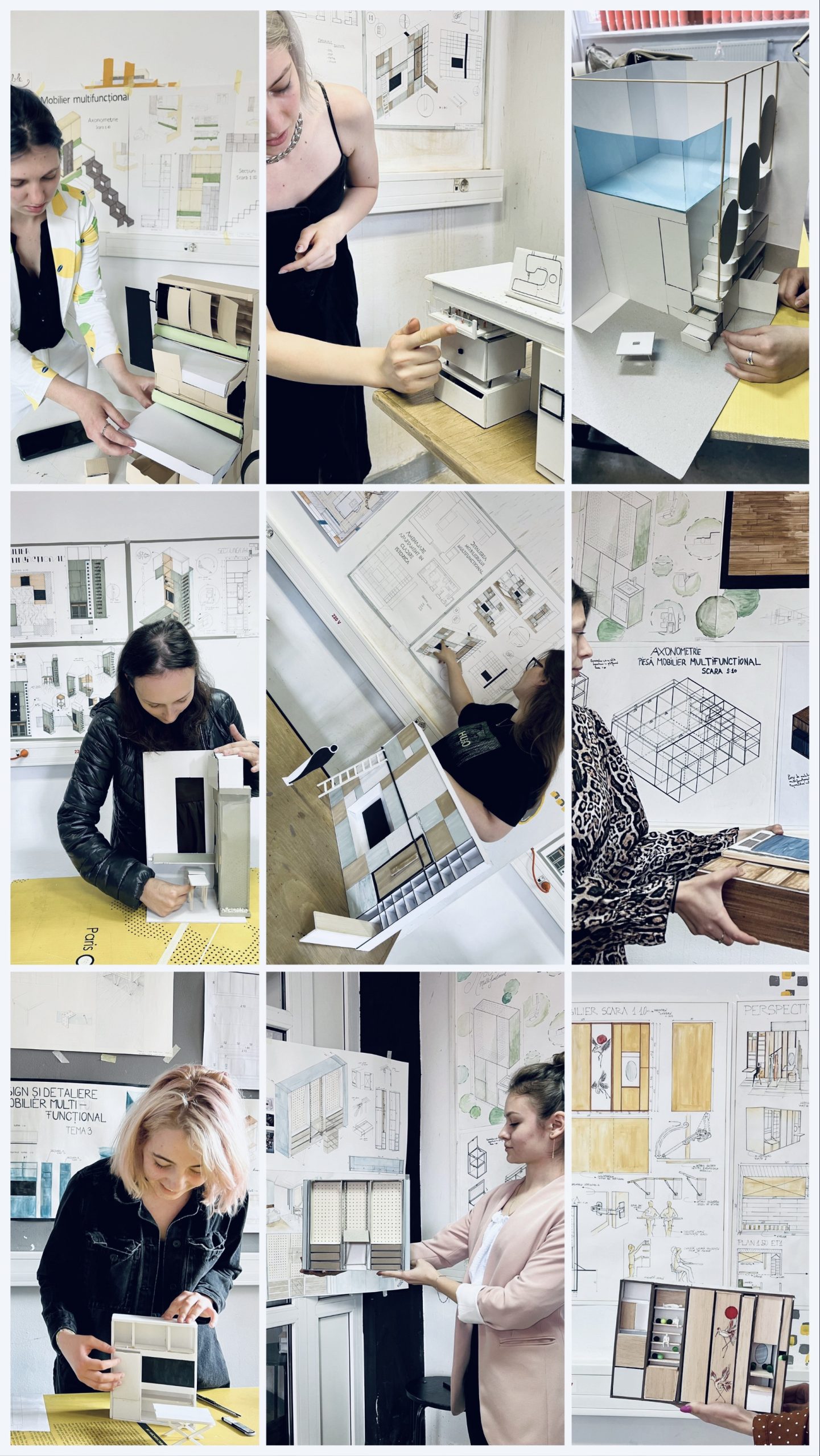
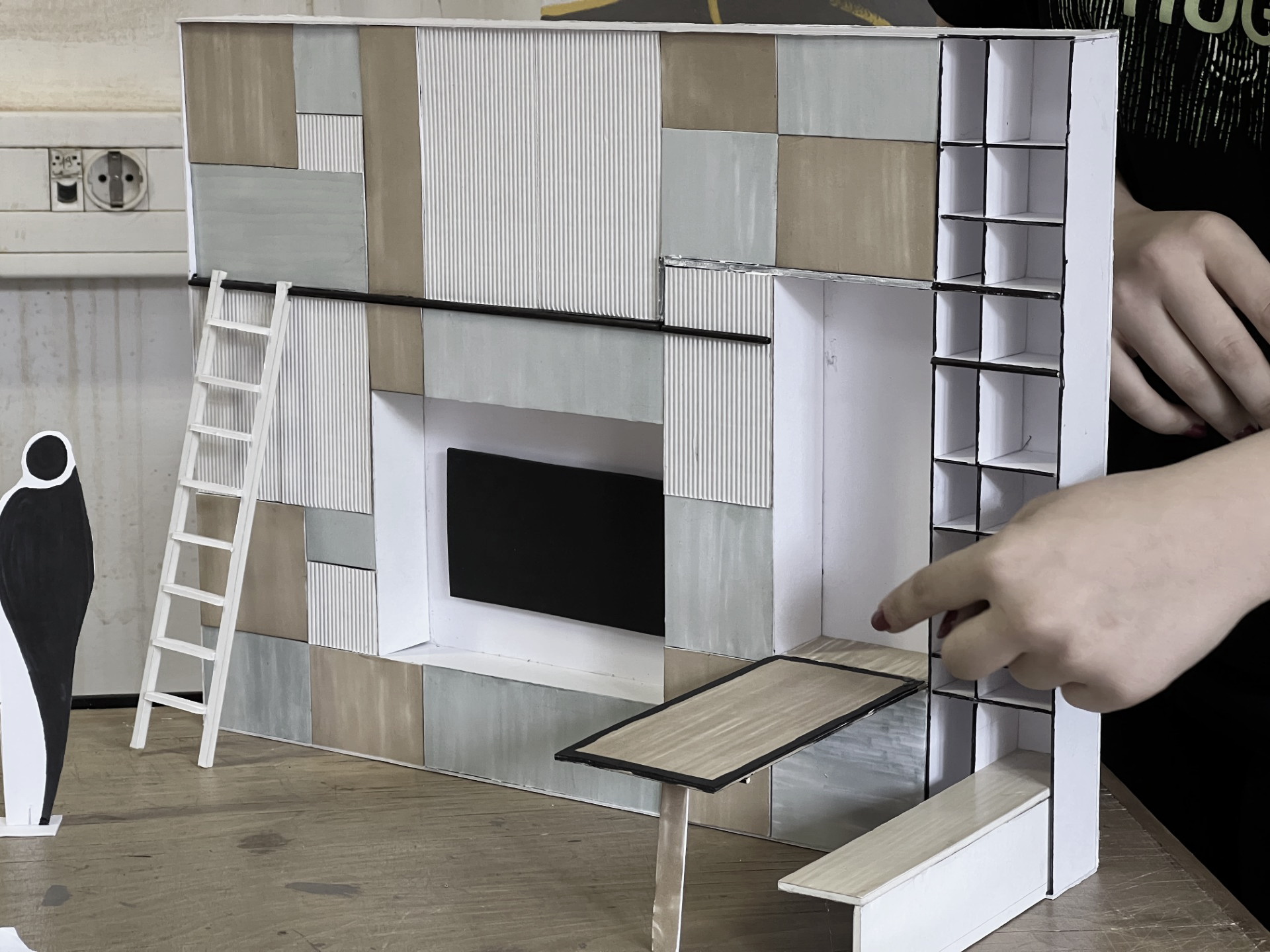
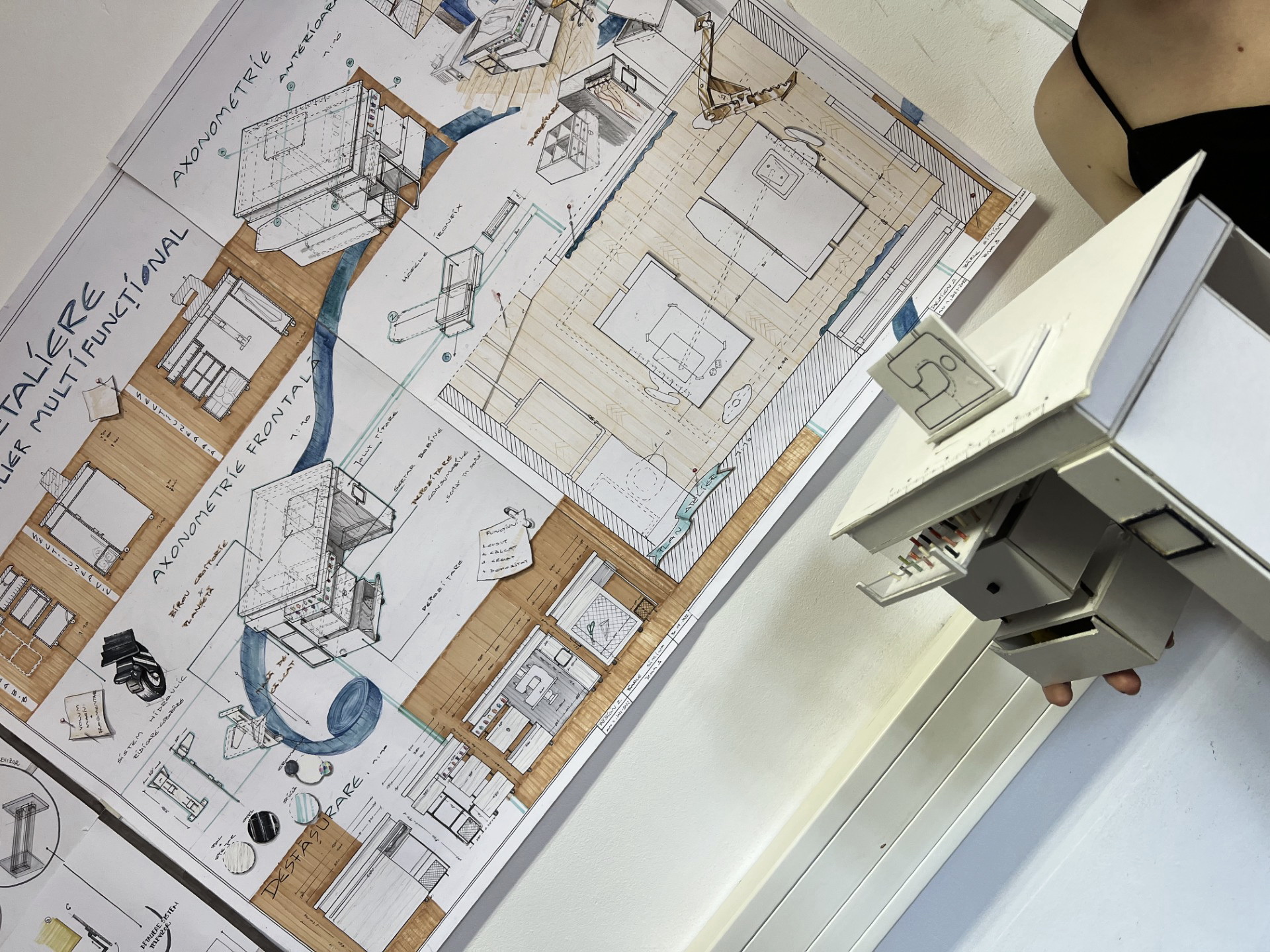
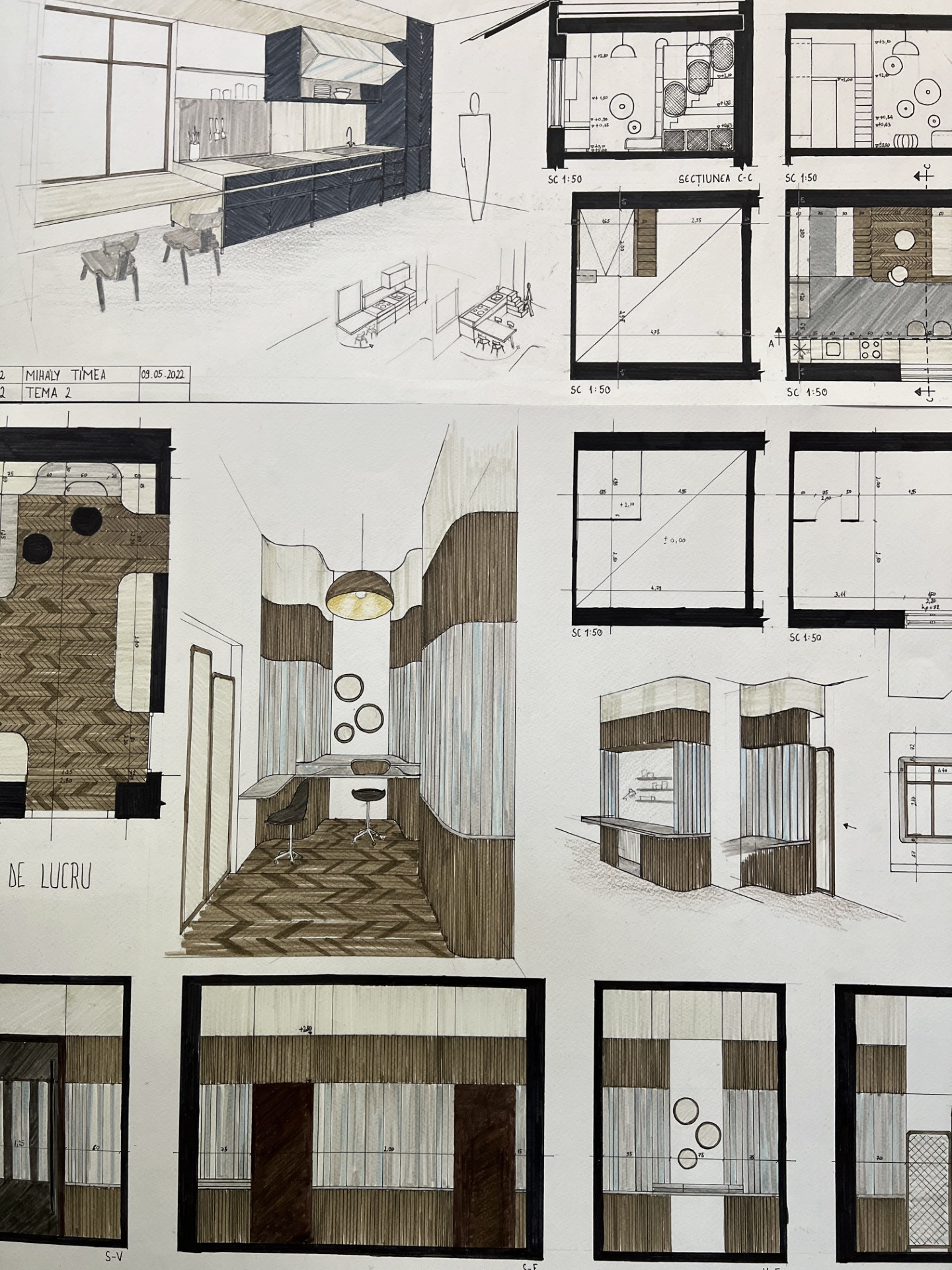
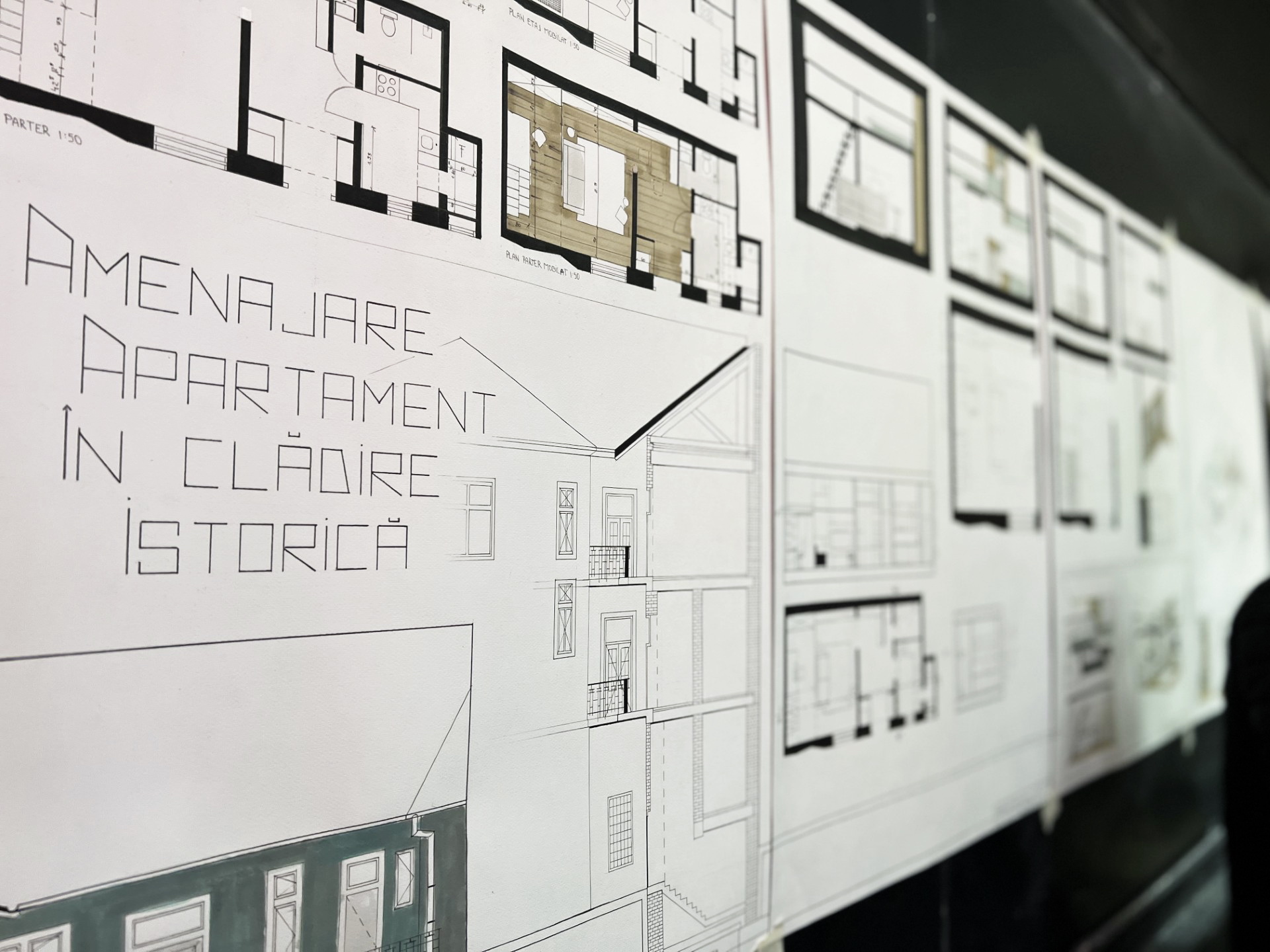
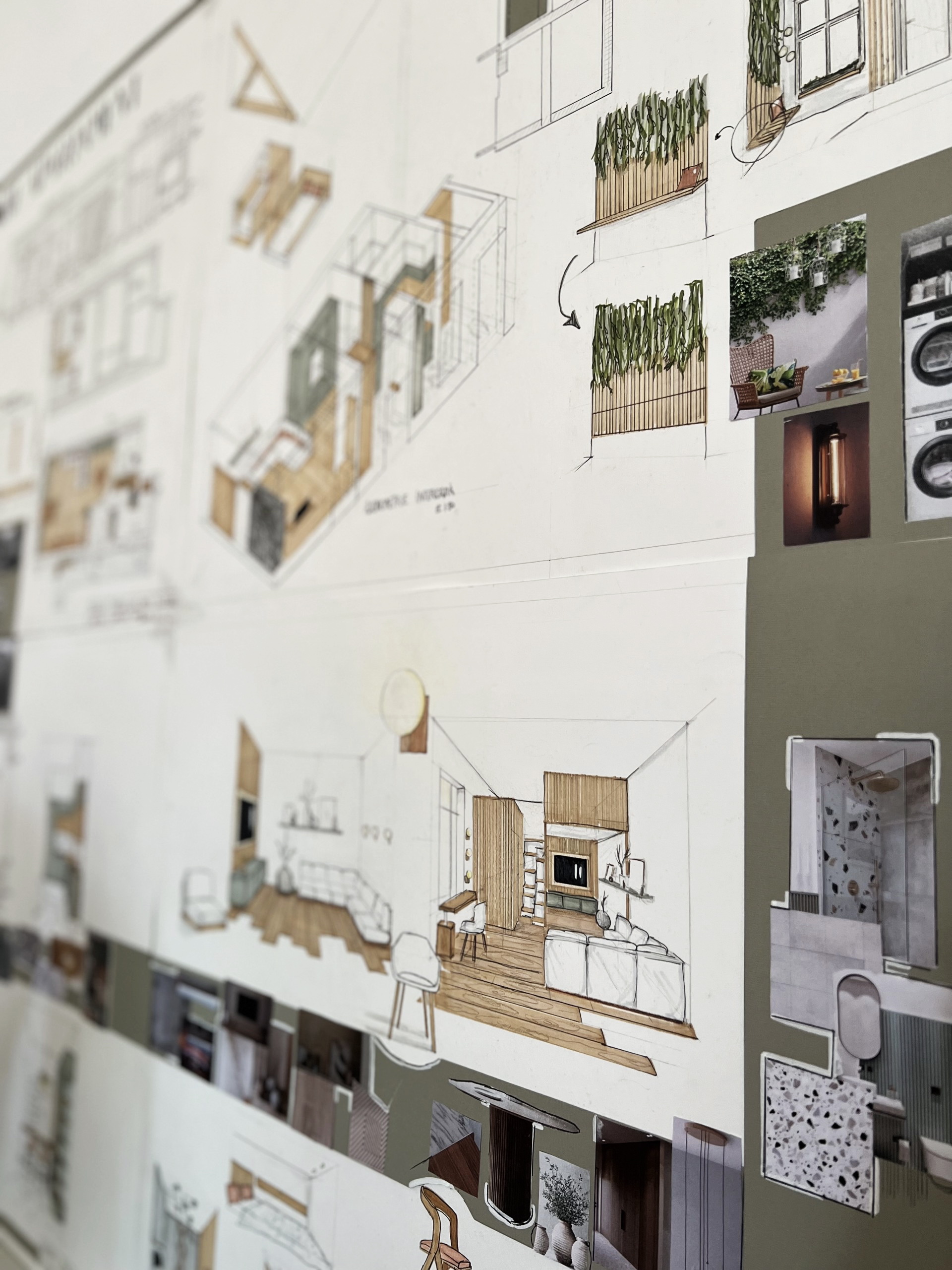
AMENAJAREA UNUI MICROAPARTAMENT ÎNTR-O CLĂDIRE ISTORICĂ a reprezentat un exercițiu aplicat, având ca obiectiv proiectarea unui spațiu de locuit de dimensiuni reduse, situat într-o clădire istorică din Timișoara. Profilul beneficiarilor și relația dintre aceștia (cuplu, prieteni, părinte-copil) au fost stabilite individual de fiecare student. Proiectul semestrial, structurat în trei etape, a inclus elaborarea schemelor funcționale și definirea conceptului general, urmate de amenajarea propriu-zisă, detalierea tehnică și proiectarea unei piese de mobilier multifuncționale.
Provocarea principală a constat în integrarea și suprapunerea funcțiunilor pentru maximizarea utilizării spațiului restrâns, cu accent pe îmbinarea diverselor funcțiuni într-o singură zonă, prin soluții inovatoare de mobilare și compartimentare multifuncțională.
For the full pictures please click on the pages of the brochure below.
EN
INTERIOR DESIGN OF A MICRO-APARTMENT IN A HISTORICAL BUILDING was a practical exercise focused on designing a small living space within a historical building in Timișoara. The beneficiaries’ profile and their relationship (couple, friends, parent-child) were individually determined by each student. The semester project, structured in three stages, included the development of functional diagrams and the definition of a general concept, followed by the actual interior design, technical detailing, and the design of a multifunctional furniture piece.
The primary challenge was integrating and overlapping functions to optimize the limited living space, emphasizing the combination of multiple uses within the same area through innovative multifunctional furnishing and partitioning solutions.