
Portfolio Category: LICENTA ARHITECTURA
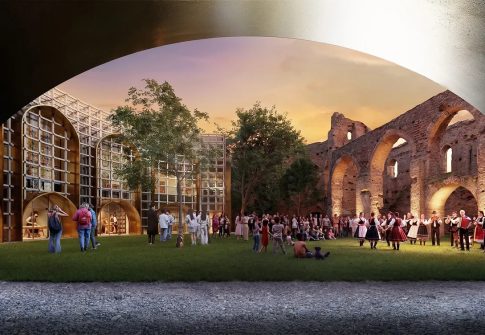
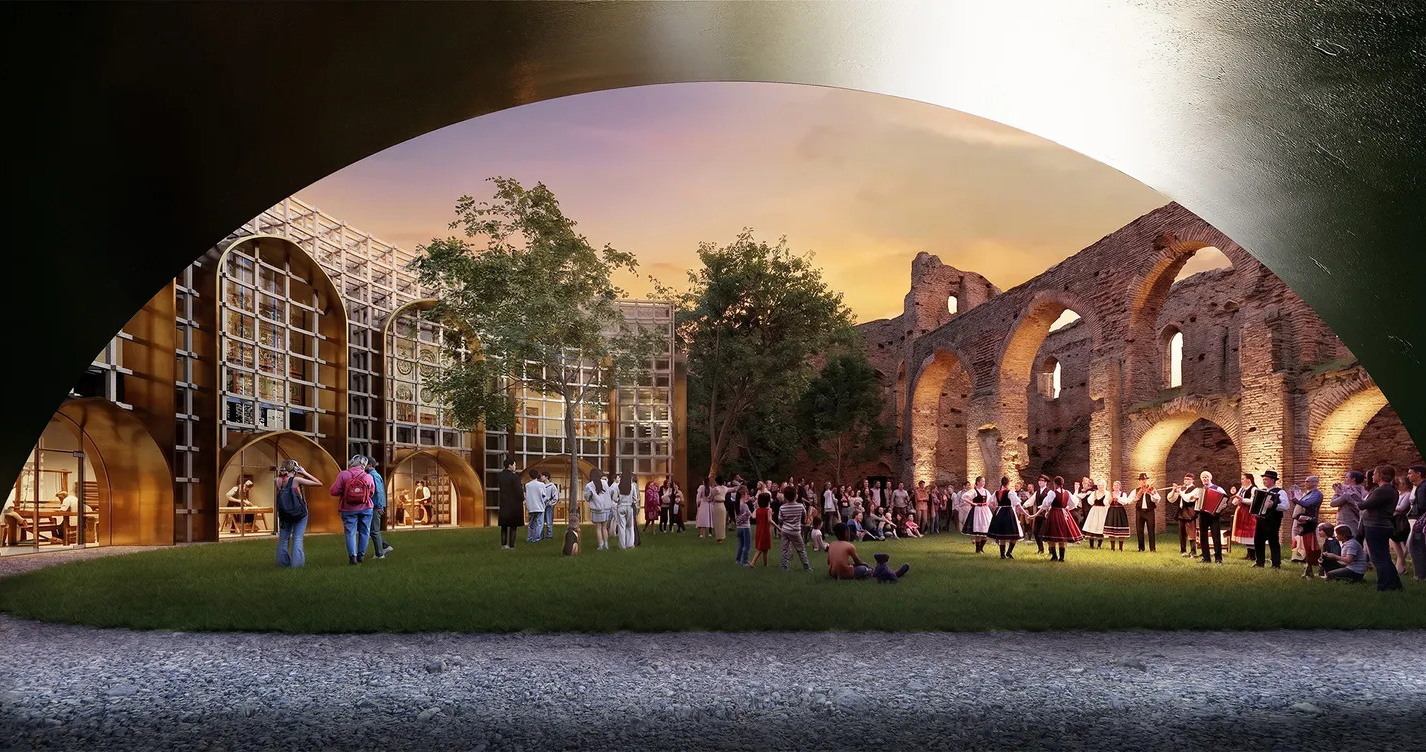
2026 | DIPLOMA | YEAR VI
The completion of studies at the Faculty of Architecture and Urbanism within Universitatea Politehnica Timișoara is achieved through a diploma examination structured into two complementary components, theoretical and applied in nature.
Part I consists of the defense of a theoretical dissertation and a preliminary research study (pre-diploma), which establishes the conceptual foundation of the final project. The dissertation is developed within one of three academic units:
Complex Architecture
Heritage Development and Reuse
Urban Planning
Part II involves the public defense of the diploma project, presented through written and graphic documentation demonstrating the candidate’s ability to integrate and apply theoretical knowledge in the coherent resolution of an architectural or urban issue.
The topic may be selected from those proposed within the thematic unit or formulated by the candidate in consultation with the academic supervisor.
The final assessment considers the rigor of the research process, theoretical grounding, conceptual coherence, interdisciplinary dimension, and the overall architectural quality of the proposed solution.
For the full texts please click on the pages of the brochure below.
Complex Architecture
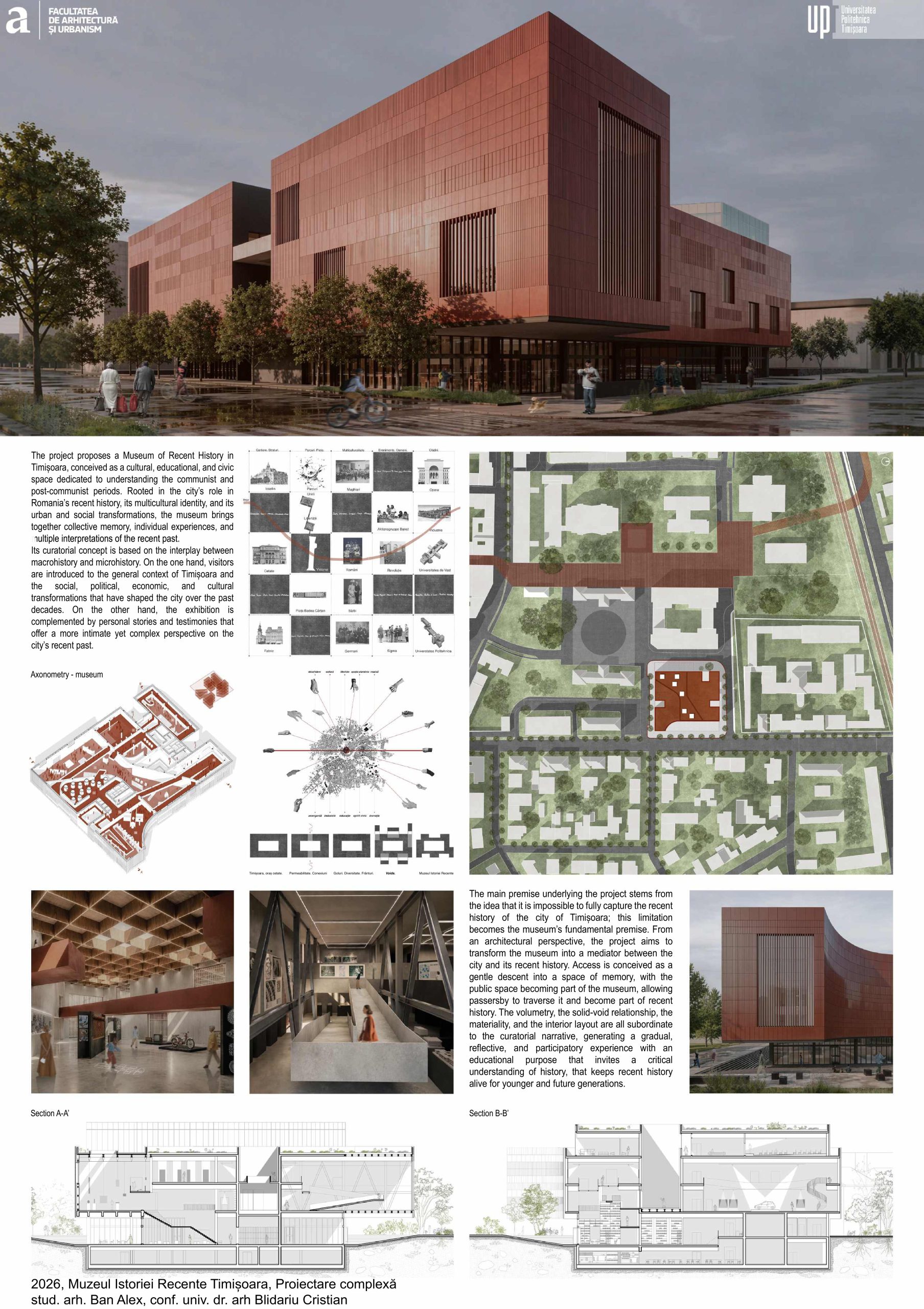
Student: Ban Alex Georgel
Coordinating Professor: Conf. Dr. Arch. Cristian Blidariu
During the pre-diploma presentation, several essential aspects requiring further development were highlighted. The first concerned the redesign of the building’s access, so that the descent towards the museum would become gentler and function as a public transitional space, accessible also to passers-by who do not enter the museum itself. In this way, the exterior space becomes part of the museum experience, while city users are indirectly engaged in the discourse on recent history.
A second aspect concerned the further development of the building’s materiality and external expression, through a clearer definition of the façades and the relationship between solid and void. Particular attention was also given to establishing a more thoughtful relationship between the public plaza spaces and important elements of the built context, such as the Memorial of the Revolution and Popa Șapcă Street. Another direction of development involved partially aligning the building with the street frontage along Popa Șapcă Street, in order to achieve a more coherent urban integration.
At the same time, the clarification of the museum route was considered necessary, so that the visitor’s journey would be more clearly defined and effectively support the curatorial narrative. During the diploma stage, these observations were incorporated into the further development of the project, contributing to a more refined relationship between the building, the city, and the museum experience.
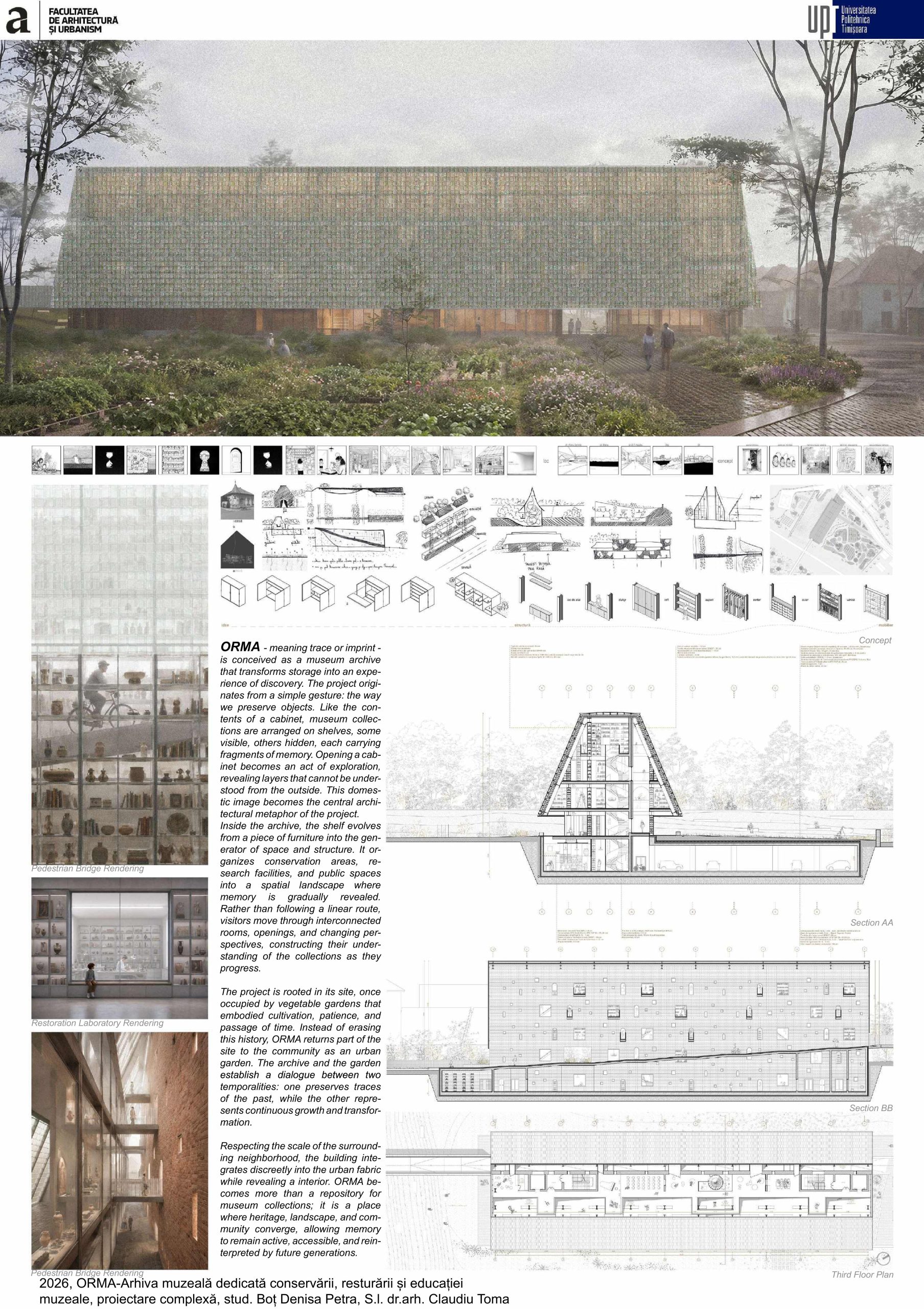
Student: Boț Denisa Petra
Coordinating Professor: S.l. Dr. Arch. Claudiu Toma
The ORMA project represents the outcome of an approach that began with research into the relationship between heritage, memory, and architecture, and continued through the development of a proposal capable of addressing a real need of the Satu Mare County Museum. Beyond providing infrastructure dedicated to the preservation of collections, the project seeks to transform the way the museum archive is understood and perceived.
Traditionally, an archive is a hidden space intended exclusively for conservation and research. ORMA proposes a different perspective, in which the protection of heritage does not exclude bringing it closer to the community. On the contrary, the project is based on the belief that memory can be better protected when it is known, understood, and shared. Thus, the archive becomes a space of discovery, where visitors not only observe the objects but also understand the processes and the people involved in preserving them.
At the same time, the project demonstrates that a museum archive can go beyond the role of a technical building and become an active element of the city. Through the public walkway, community garden, and its relationship with the Someș riverbank, the archive does not function in isolation but complements the urban structure and creates new connections between heritage, landscape, and everyday life.
The ORMA concept influenced every design decision, from the functional organization and structural solution to the choice of materials and the way light enters the interior. The cabinet, shelf, transparency, and garden are not independent elements, but fragments of the same idea: that memory is built through accumulation, discovery, and the continuous relationship between past and present.
Ultimately, ORMA proposes not merely a new museum archive, but a different way of looking at heritage. Not as a collection of objects preserved behind closed doors, but as a living memory, continuously connected to people and to the place of which it is part. Architecture thus becomes more than a shelter for heritage; it becomes the medium through which traces of the past continue to be discovered, understood, and passed on.
At the same time, the project highlights the essential role of the museum archive in safeguarding and protecting cultural heritage. Every preserved object represents a fragment of collective history, and maintaining it in optimal conditions means, in essence, preserving the identity of a community. By opening the archive to the public, heritage ceases to be merely a resource intended for specialists and becomes a tool for education, research, and cultural dialogue. The project therefore proposes an architecture that not only preserves the past but also actively contributes to shaping the cultural awareness of present and future generations, demonstrating that protecting heritage ultimately means protecting the memory and identity of a society.
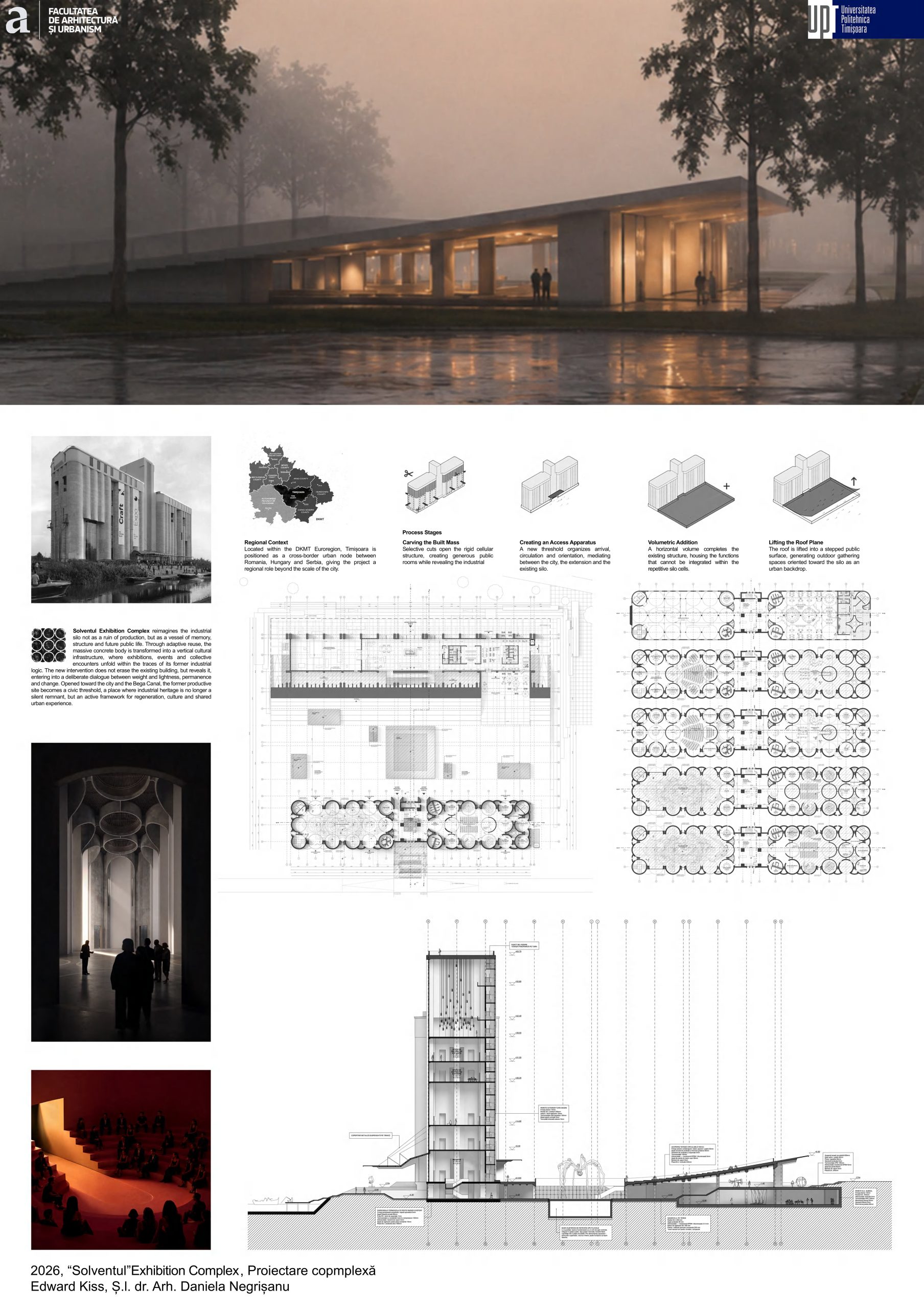
Students: Kiss Edward Ștefan
Coordinating Professor: S.l. Dr. Arch. Daniela Negrișanu
The proposal develops a regional exhibition complex on the Solventul platform, conceived as both economic and cultural infrastructure for Timișoara and as a tool for the urban regeneration of a post-industrial territory. The detailed intervention focuses on the conversion of the IPCMC II grain silo, one of the site’s most representative industrial structures, complemented by a contemporary extension that allows it to accommodate its new functional program.
The project aims to preserve and enhance the site’s industrial heritage through adaptive reuse, maintaining the silo’s architectural identity while integrating it into a contemporary complex capable of hosting exhibitions, conferences, and cultural events
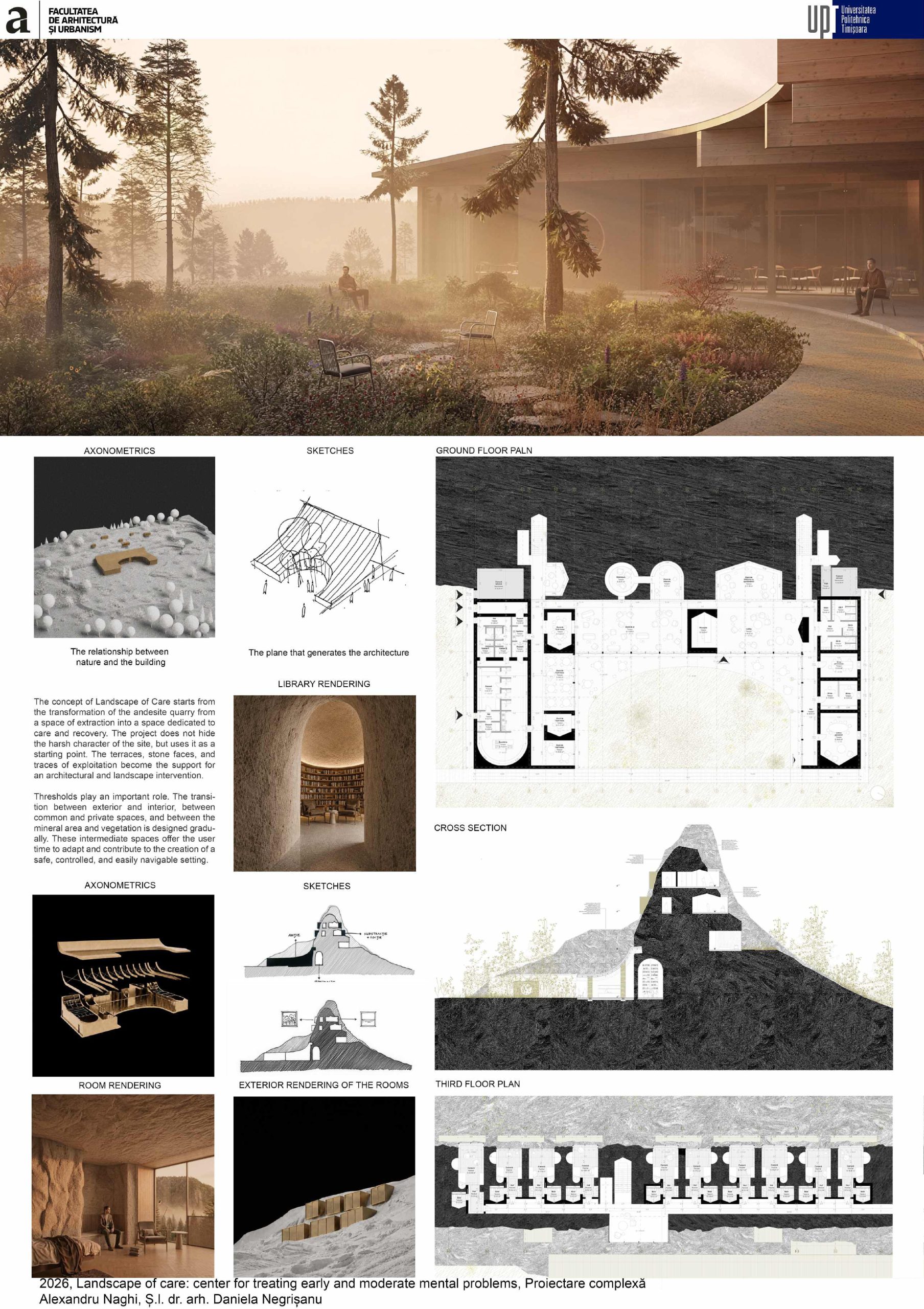
Student: Naghi Alexandru
Coordinating Professor: S.l. Dr. Arch. Daniela Negrișanu
The Landscape of Care project proposes the conversion of the former andesite quarry in Colibița into a care center for people with early and moderate mental health disorders, demonstrating how a landscape shaped by industrial exploitation can become a setting for recovery and regeneration. Rather than erasing the traces of industrial activity, the intervention integrates them into a new relationship between architecture, nature, and the user.
The project seeks to preserve the existing qualities of the site while limiting interventions. Functional organization, structural systems, material choices, and sustainability strategies are developed as a unified approach, creating an environment that supports recovery through continuous contact with the landscape, carefully controlled spatial sequences, and the use of natural materials.
The project argues that architecture can contribute to the therapeutic process not only by providing appropriate functional conditions, but also by shaping the experience of space. The rhythm of movement, the balance between retreat and openness, the presence of vegetation, and the dialogue with the quarry’s exposed rock complement medical care and contribute to recovery.
Beyond its specific function, the project proposes a model for intervening in post-industrial landscapes, where environmental regeneration and user recovery are understood as complementary processes. Landscape of Care thus demonstrates how architecture can become an instrument of care—for both people and places seeking a new meaning.
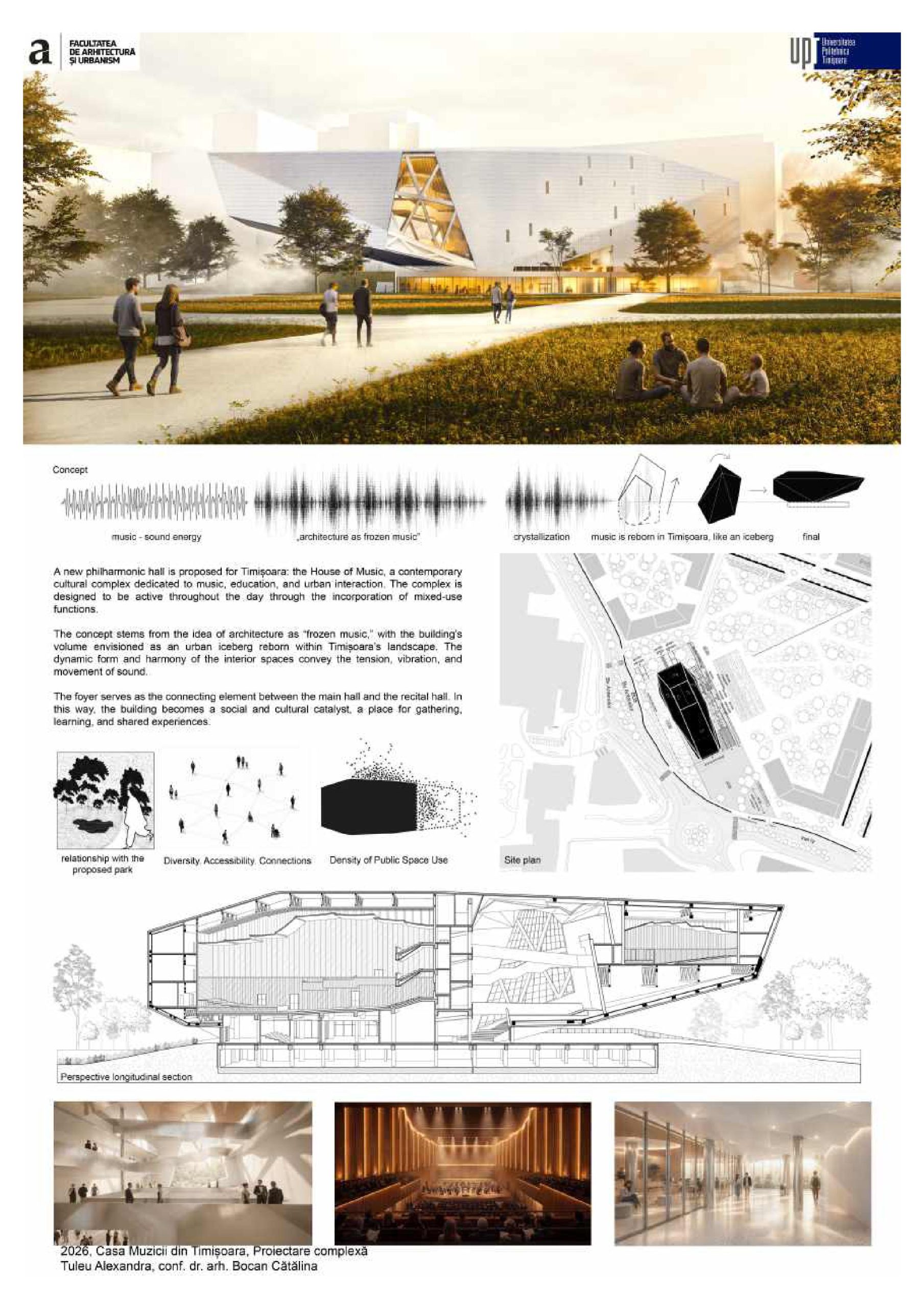
Student: Tuleu Alexandra-Elena
Coordinating Professor: Conf. Dr. Arch. Cătălina Bocan
The project proposes a direct response to the shortcomings of the current headquarters of the “Banatul” Philharmonic. The Capitol building was not originally designed as a philharmonic, resulting in major acoustic deficiencies, limited hall capacity, insufficient spaces for artists, and no possibility for expansion. The new site on Antenelor Boulevard also presented geometric constraints due to its elongated plot. Nevertheless, the proposal demonstrates that the site can accommodate an extensive program through optimized functional organization and vertical development. Its highly visible corner position also creates challenges for concealing back-of-house and logistical areas, but is ultimately used to transform the building into a visual landmark and focal point along several major urban axes.
Structurally, the project involved significant technological challenges, requiring multiple iterations and calculation variants. The main difficulty was the design of the 40-meter cantilever, which provides climatic protection for the entrance while creating a gradual transition between the public and urban spaces and the proposed natural landscape.
Acoustics represent another key aspect of the project. The main concert hall and recital halls are designed according to the high acoustic requirements of the shoebox typology. Independent volumes and specialized rehearsal rooms address the acoustic and spatial deficiencies of the former venue, while HVAC equipment is acoustically isolated within dedicated buffer spaces. Logistical circulation is completely separated from the routes used by artists and the public.
In terms of long-term sustainability, the project goes beyond the limitations of conventional performance venues by creating a building that can remain active throughout the day. An accessible mixed-use component includes a learning center, music education spaces, a café, restaurant, and commercial areas, attracting diverse audiences while generating additional revenue and supporting long-term economic viability.
Ultimately, the new House of Music goes beyond being an isolated architectural object, becoming an important project for the urban and cultural development of Timișoara. By relocating the Philharmonic from the overstressed historic center, the intervention not only helps decongest the Cetate area but also acts as a social catalyst for the regeneration of a previously declining urban landscape.
Heritage Development and Reuse
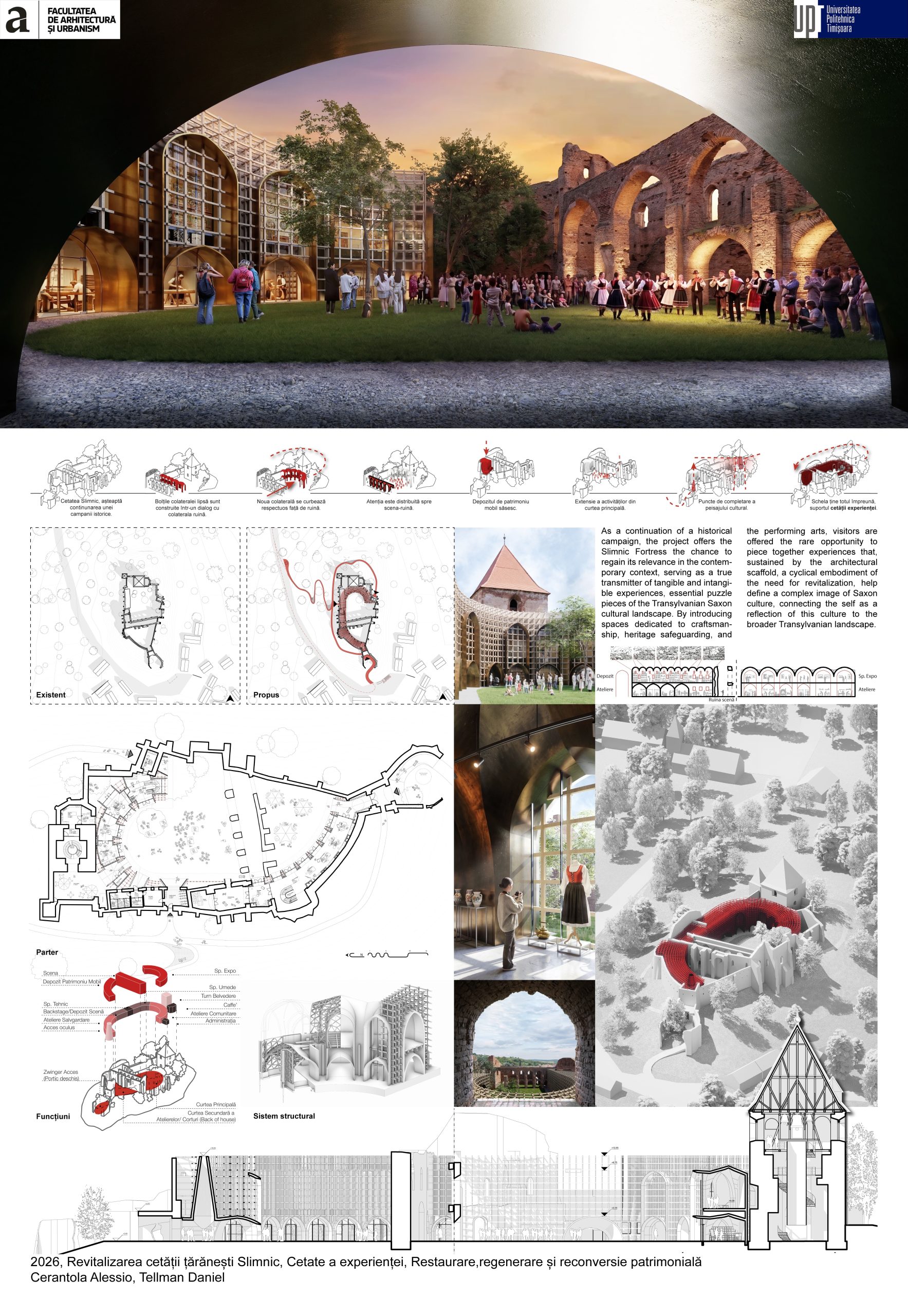
Student: Alessio Cerantola
Coordinating Professor: Asist.drd.arh. Daniel Tellman
The Slimnic Fortress project represents, in my view, how a place can unconsciously shape an architectural theme and program through its history, its process of decay, and, above all, its story—so deeply intertwined with the character of the site that the solution seems to have been shaped by the fortress itself.
My role in this process, which represents the culmination of my personal journey, was similar to that of an “identity archaeologist.” I believe the solution does not belong entirely to me, but rather emerged from the process described above.
Slimnic Fortress is, in essence, a Fortress of Experience, not because the proposed interventions transform it into one, but because it has always been a place of experience through its identity, atmosphere, and history. For this reason, the proposed intervention is also ephemeral.
The proposal within the fortress acts as a means of activating and intensifying its existing character, while accelerating efforts to preserve not only the fortress itself, but also the wider Transylvanian Saxon cultural heritage. By using a cyclical architectural language rooted in the identity of the place, the project creates a generational pulse of site reactivation, transforming the fortress into a timeless anchor.
Moreover, Slimnic becomes a Fortress of Experience because it does not exist in isolation. The network of Saxon fortifications, historical witnesses, and the surrounding landscape collectively transform it into a carrier of shared experiences.
Ultimately, the abandoned construction site of the Gothic hall church and Slimnic Peasant Fortress reflects a broader regional reality, where heritage loss has already occurred and continues today. “Revitalization of Slimnic Peasant Fortress – Fortress of Experience” seeks to preserve this heritage, both directly and indirectly, through a total experience aimed at reintegrating the fortress into the consciousness of the present.
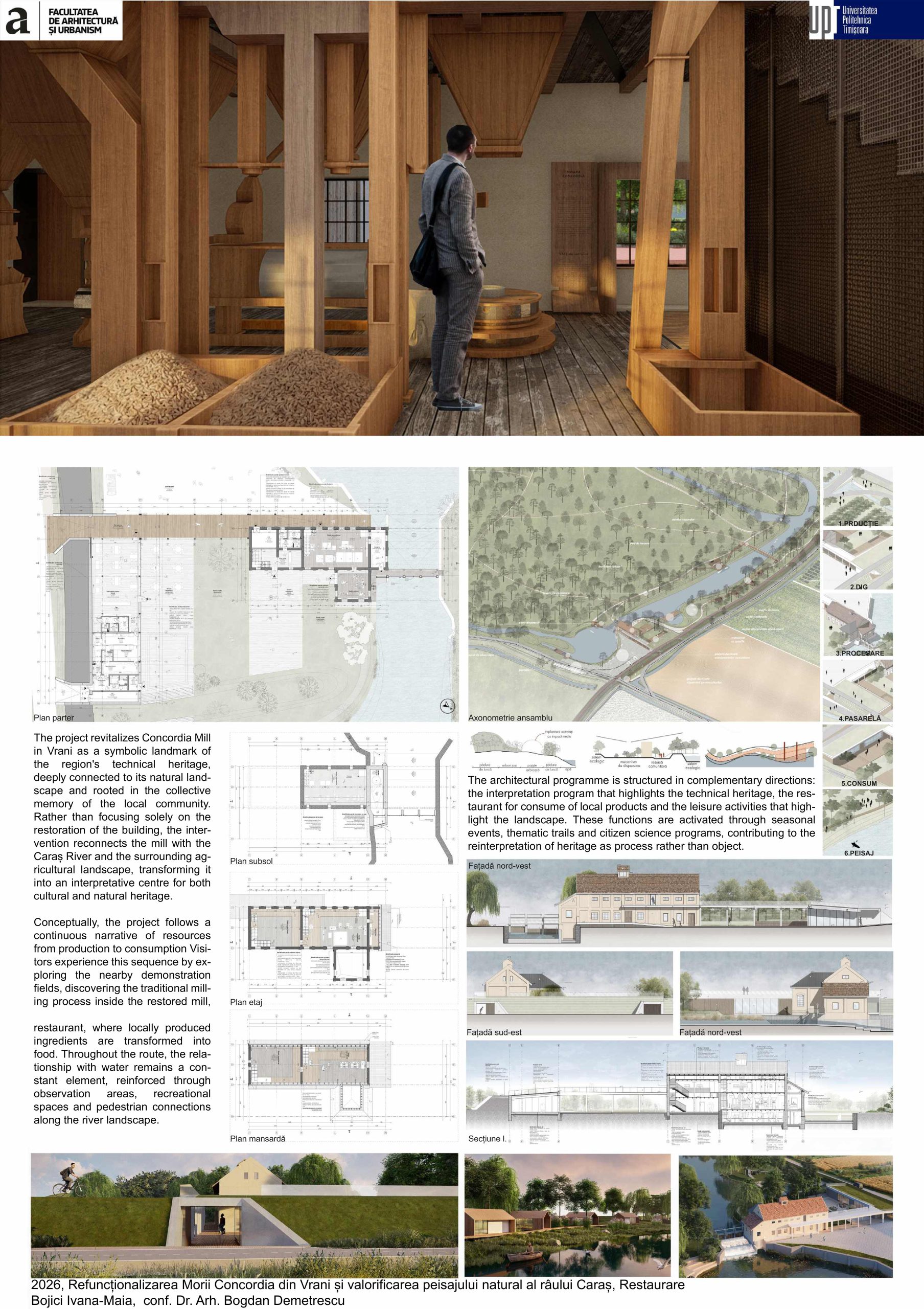
Student: Bojici Ivana-Maia
Coordinating Professor: Conf. Dr. Arch. Bogdan Demetrescu
The analysis of this stage highlights that the transition from the macro to the micro scale requires incorporating the concept of the relationship between people and water. All landscape interventions are unified through the materialization of two axes: one perpendicular and one parallel to the river. The historic Concordia Mill has significant potential for adaptive reuse, not only as a tourist destination but also as a community hub, activated periodically through activities that strengthen community cohesion. For this reason, involving local stakeholders is essential for easier management and greater tourism potential.
All the necessary resources for the project’s sustainable development are available, provided that the Caraș renaturalization interventions are addressed during the initial stages. In areas exposed to fluctuations, particularly within the natural accommodation zone, the design responds to these risks by raising the walking levels of the platforms forming the routes.
The defining element of the project is the relationship between people and water, which has historically generated various types of infrastructure along the river, including dams, canals, and agricultural processing facilities. The project therefore proposes to reinterpret this infrastructure as a landscape device, centered around a route articulated through wooden elements that connect the interior of the mill with the exterior landscape.
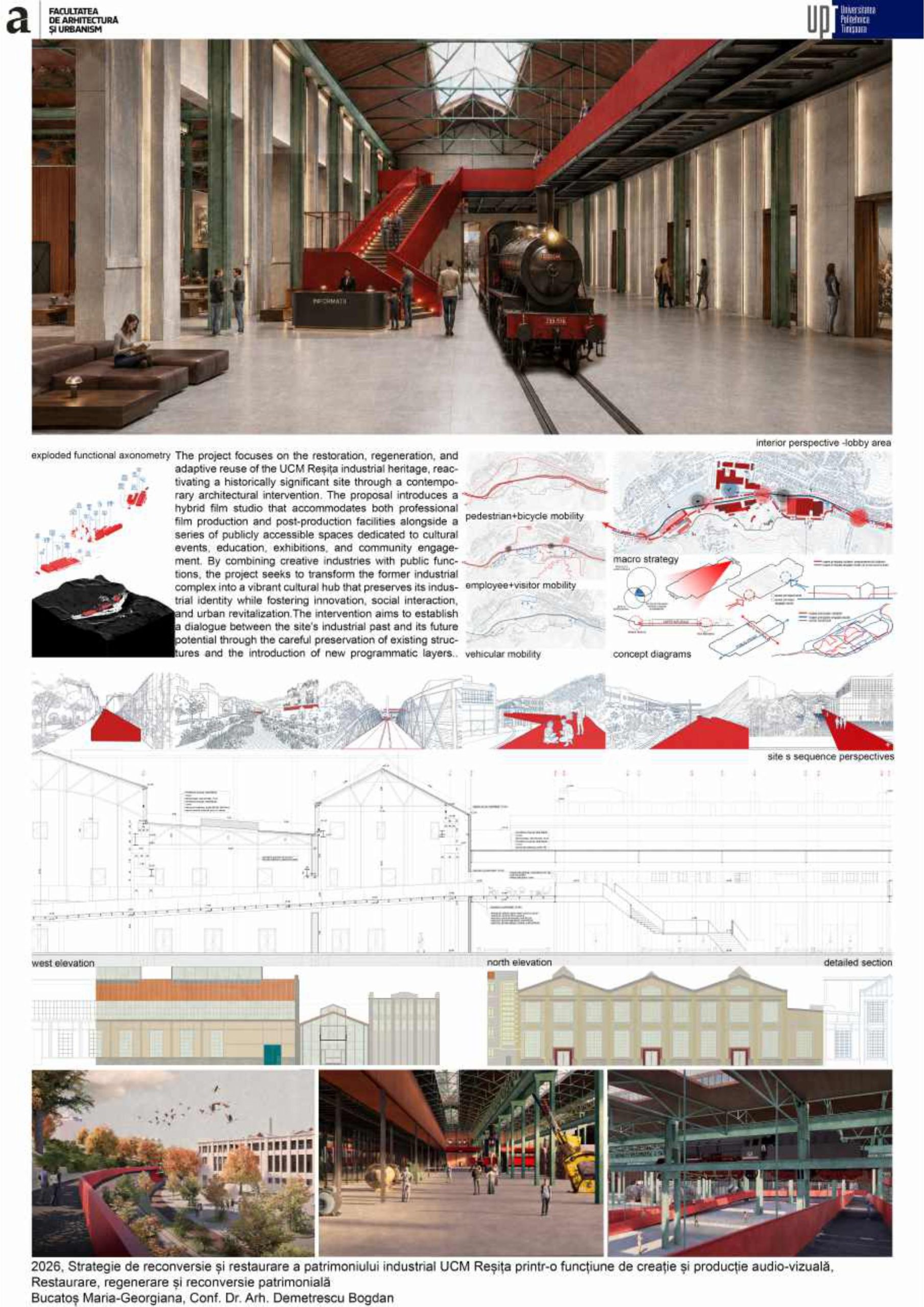
Student: Bucatoș Maria-Georgiana, Popa Nicolae-Daniel
Coordinating Professor: Conf. Dr. Arch. Bogdan Demetrescu
The pre-diploma stage provided the theoretical and conceptual foundation for the diploma project, focusing on an in-depth understanding of the former UCM Reșița industrial platform and the identification of a viable direction for its adaptive reuse.
The outcome was the development of a conversion strategy at both macro and micro scales, based on introducing an audiovisual creation and production program, considered compatible with the spatial and structural characteristics of the industrial complex.
During the pre-diploma presentation, the strategic directions, intervention concept, and approach to the selected industrial heritage were validated as the basis for further project development. The feedback mainly concerned the further development and detailing of the proposal, without altering its fundamental principles. The project therefore required development at all levels of intervention, from territorial and urban strategy to the detailed design of the selected implementation area.
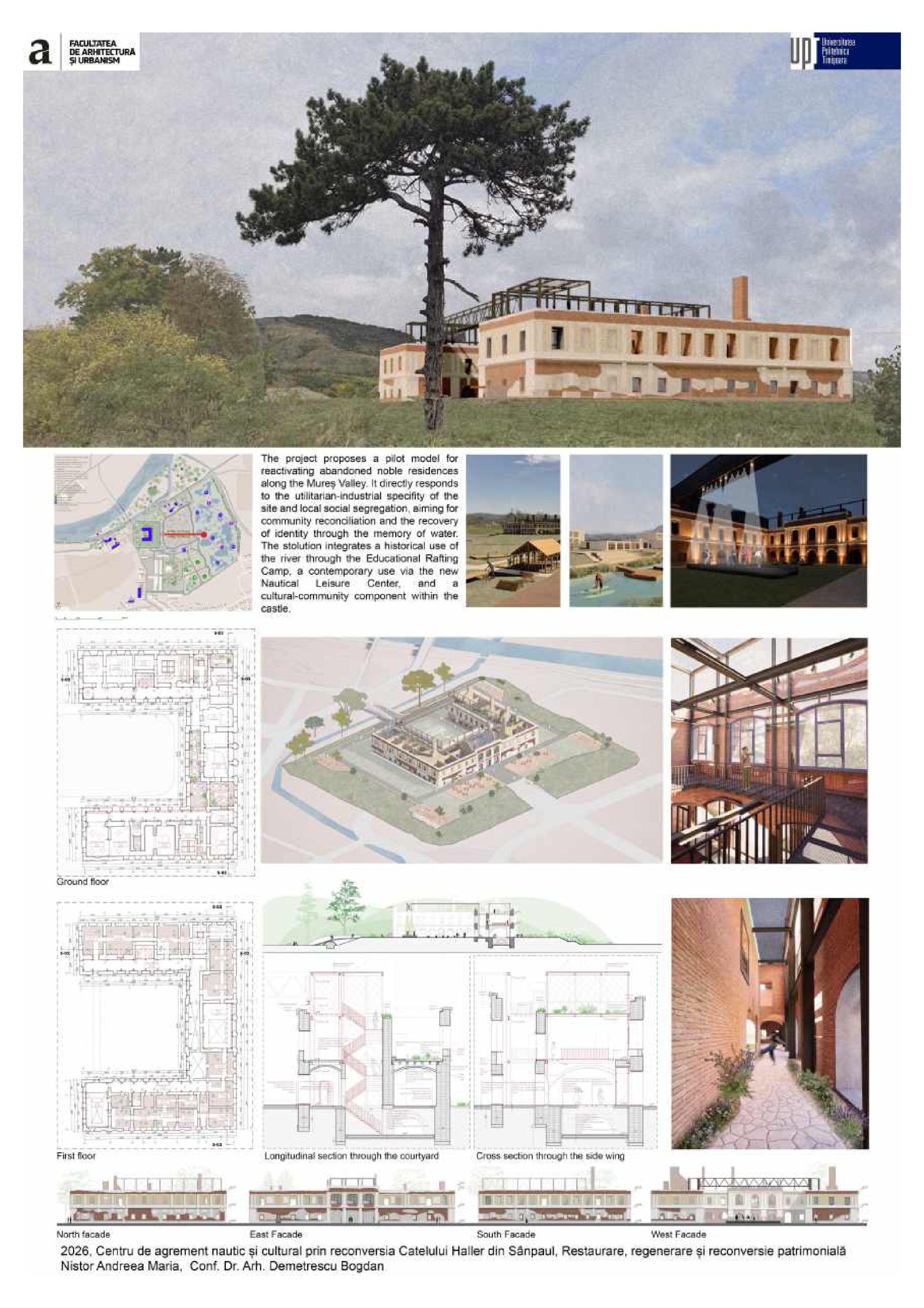
Student: Nistor Andreea Maria
Coordinating Professor: Conf. Dr. Arch. Bogdan Demetrescu
The project establishes a complex strategic model for the revitalization of the built and intangible heritage of the Mureș Valley. It demonstrates how a landscape marked by a traumatic past and fragmented by utilitarian industrial development, such as the expansion of the gravel quarry, can be healed and returned to a human scale and to nature.
At the level of the monument, the intervention at Haller Castle in Sânpaul proposes a new approach to restoration. Instead of a rigid and historically inaccurate reconstruction, the project adopts the concept of a “stabilized ruin,” preserving the monument’s narrative value, highlighting the patina of time, and transforming the imperfections of the masonry into an intentional theatrical setting. New architectural insertions—from independent box-in-box volumes to a movable walkway transformed into a scenographic device—use a contemporary, reversible, and non-invasive language.
This approach is complemented by sensitive technical and ecological solutions, combining hard capping with soft capping through controlled vegetation, mediating between historic fabric and the vitality of nature.
Functionally and economically, the project demonstrates that conservation alone is insufficient without community involvement and a self-sustaining model. The proposed hybrid program combines a nautical recreation center as the economic component, cultural spaces within the ruin as the community component, and a traditional camp dedicated to rafting as the tourism and educational component. Together, these functions honor the “memory of water,” reconcile the history of the nobility with that of the rafting communities, and restore the lost connection between local inhabitants and the Mureș River.
Ultimately, the strategy proposed for Sânpaul aims to become a pilot project extending beyond the site itself. It offers a replicable methodology for the declining noble residences along the Mureș Corridor, demonstrating how heritage architecture, supported by technical innovation and landscape sensitivity, can generate ecological regeneration, sustainable development, and social cohesion.
Urban Planning
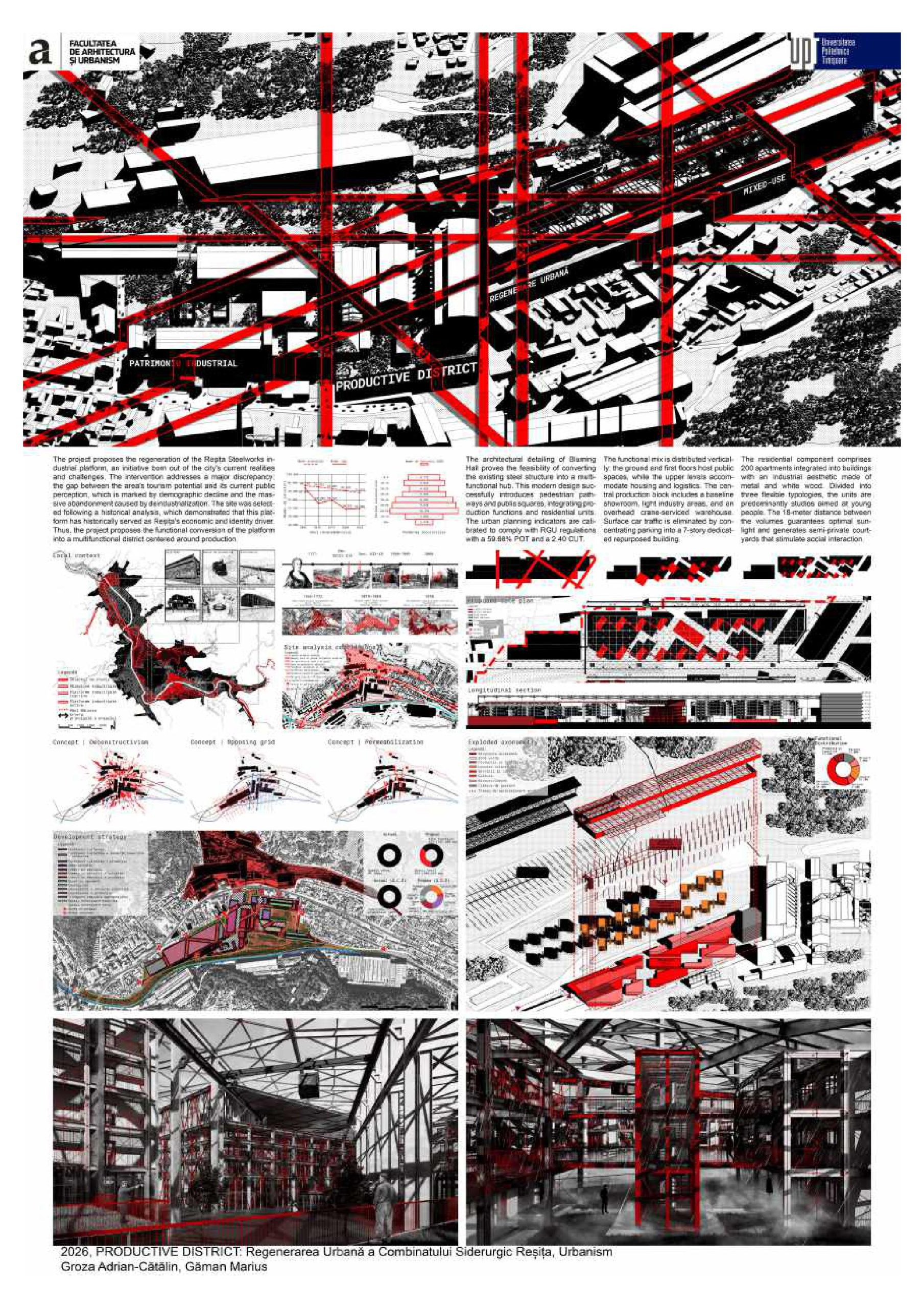
Student: Groza Adrian-Cătălin
Coordinating Professor: Conf. Dr. Arch. Marius Găman
The project proposes an urban regeneration strategy for the southern platform of the Reșița Steel Plant (CSR), transforming a 28.80-hectare underused industrial territory into a mixed-use district based on the Productive District concept. Rather than relying on large-scale demolition or passive museification, the strategy combines light urban production, culture, commerce, offices, and collective housing.
Grounded in the principles of Productive City, Human Scale Development, and Regenerative Tourism, the project operates from the urban scale to the scale of housing. The masterplan is structured around a linear park along the Bârzava River, reactivated through three landscape interventions: a natural area with an exhibition pavilion, a cultural area with an open-air cinema, and a viewpoint area with a metal tower. Together, they transform the riverbanks into active destinations for the community.
The network of public spaces, organized through urban corridors and mineral plazas created at pedestrian intersections, supports the adaptive reuse of the Bluming Hall. The intervention combines façade subtraction, roof perforation, and structural extension, allowing different functions to coexist within a hybrid program. Public and commercial functions occupy the ground floor, activating the building at street level, while private programs are placed above. Logistics are similarly organized, with commercial servicing at the periphery and industrial circulation separated vertically, using the overhead crane as a visible technological feature above the public spaces.
The urban parameters were calibrated according to the General Urban Planning Regulation (RGU), with a site coverage ratio (POT) of 59.66%, a floor area ratio (CUT) of 2.40, and 27.40% green space. The mobility strategy removes surface car traffic and prioritizes pedestrians by concentrating 700 parking spaces in a dedicated G+6 building, optimized on a 1,990 m² footprint.
At the residential scale, the project responds to local socio-economic conditions through small-scale modular collective housing, adapted to the industrial hall and organized around semi-private courtyards. Targeted primarily at young people, the residential component offers three flexible typologies (A, B, and C), dominated by compact apartments. Access via external corridors and metal walkways acts as both an urban filter and a social space. The visual identity is defined by the contrast between white wooden panels and red metal structures, creating a direct dialogue with the language of the central production buildings.
Through long-term phasing and rigorous technical calibration, the project reintegrates the former industrial enclave into Reșița’s economic and social network, establishing a model of sustainable, human-scale urban regeneration.
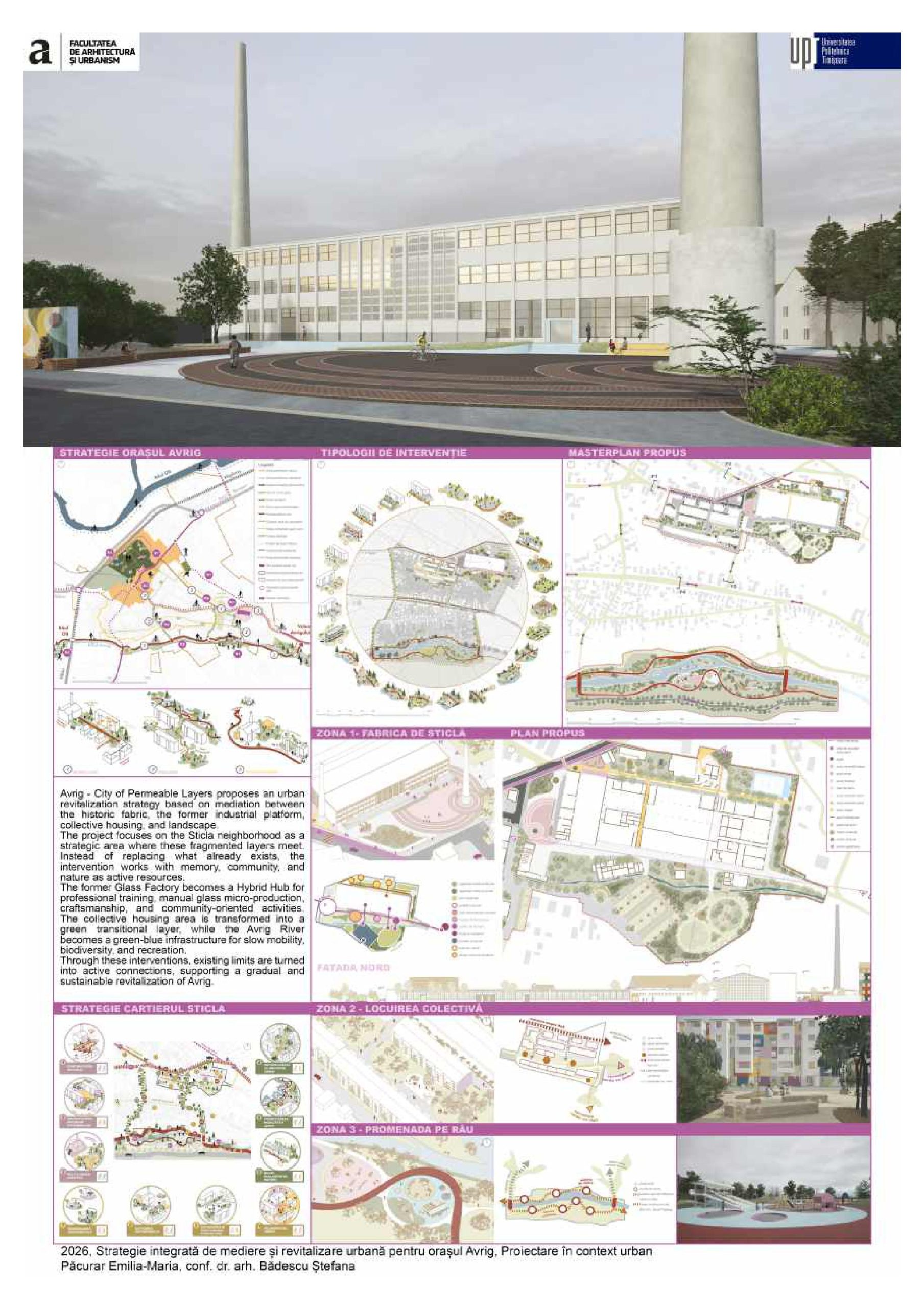
Student: Păcurar Emilia-Maria
Coordinating Professor: Asist. dr.arh. Ștefana Bădescu
The project starts from the observation that Avrig’s main challenges are not caused by a lack of resources, but by the fragmented relationships between them. The historic center, modernist neighborhood, industrial platform, and Avrig River are located close to one another but do not function as a coherent system. The project therefore proposes a strategy of mediation between these layers, using the past as a foundation for new forms of urban life rather than erasing it.
The conversion of the former Glass Factory represents the central intervention. By selectively preserving valuable structures, reopening historic routes, introducing vocational training, and activating micro-production, the industrial platform regains its role as an urban generator. The Hybrid Hub is conceived not simply as a cultural or tourism facility, but as an economic and community mechanism capable of providing jobs, skills, and continuity of local identity.
The collective housing area complements this intervention by improving everyday quality of life. Reorganized parking, increased green areas, inclusive furniture, community gardens, and neighborhood spaces transform the district into an active transition between the hub and the river. Housing is therefore treated not as a passive backdrop, but as an essential part of the proposed urban network.
The Avrig River corridor completes the system by reconnecting the city with nature. The promenade, biodiversity areas, rain gardens, active spaces, and observation tower transform the river from a boundary into a public and ecological infrastructure. It becomes a natural extension of the hub and neighborhood, while also establishing a broader connection towards the Olt River and the surrounding mountain landscape.
Through these three interventions, the project demonstrates that the regeneration of a small post-industrial city can be achieved without radical demolition or generic development. The strategy is based on continuity, adaptive reuse, mediation, and adaptation, redefining Avrig as a city of permeable layers where industrial memory, collective housing, and natural infrastructure are brought together to support a better quality of urban life.
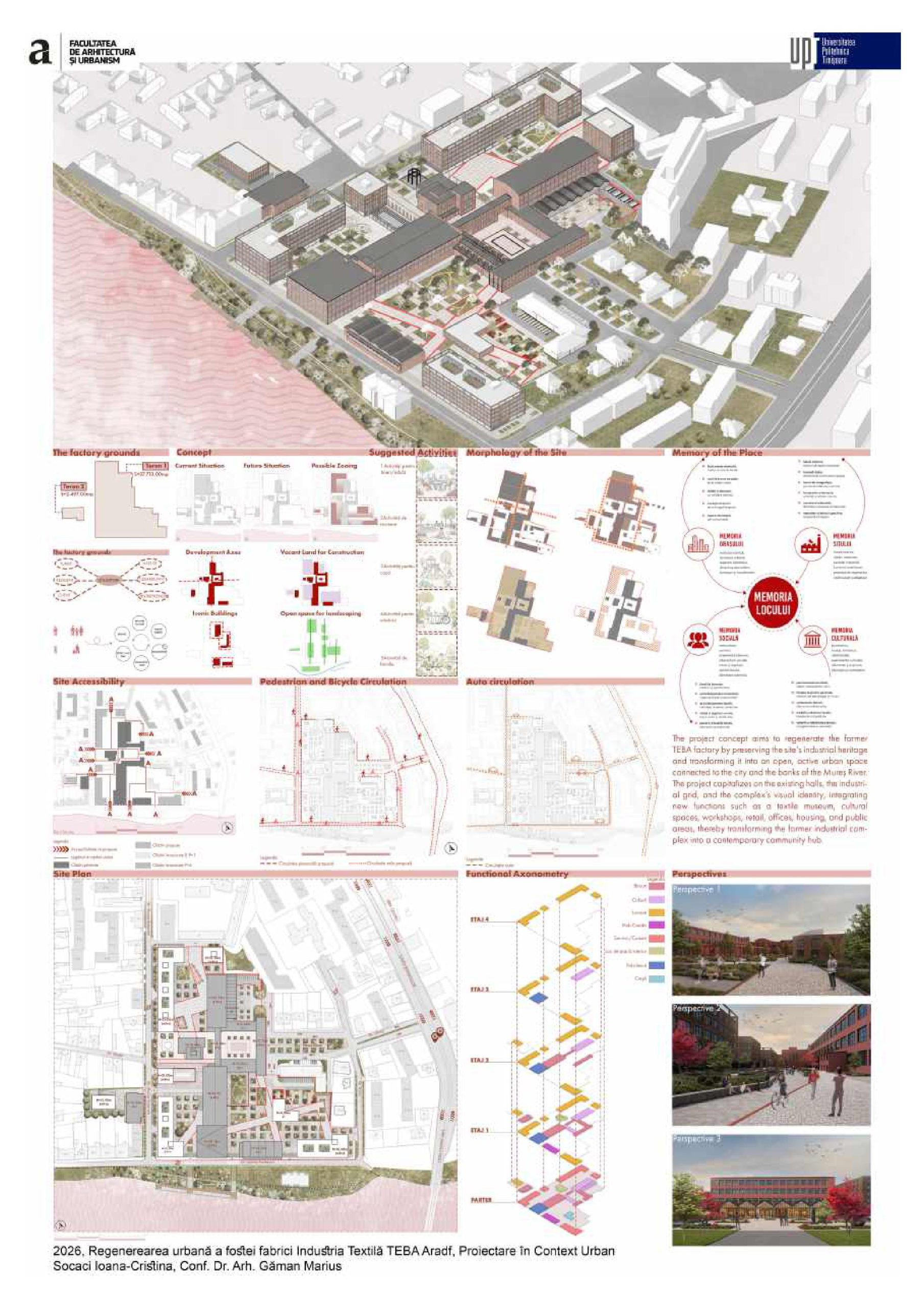
Student: Socaci Ioana-Cristina
Coordinating Professor: Conf. Dr. Arch. Marius Găman
The project demonstrates that the urban regeneration of the former TEBA Textile Factory in Arad is not merely an intervention on a disused industrial site in the heart of the city, but a complex process of recovering, reinterpreting, and reintegrating an important fragment of the city’s memory. The site is understood as a place shaped by historical, social, architectural, and urban layers that have contributed to its identity. The former TEBA factory is therefore not treated as an abandoned enclosure, but as a landmark of local industrial development, collective labor, and the transformations experienced by Arad over time.
A central idea of the project is that industrial heritage can become an active resource for contemporary development. Existing buildings, the hall structure, organizational axes, industrial grid, and architectural character are preserved and integrated into a new urban scenario. Through the rehabilitation and adaptive reuse of valuable structures, the site’s past is maintained without becoming rigid or museum-like, but is adapted to the current needs of the community. Memory thus becomes a design tool, providing continuity, meaning, and architectural authenticity.
The memory of the place is essential because it establishes a connection between space, time, and community. In the TEBA site, industrial memory is reflected in the preserved buildings, the structure of the complex, its relationship with the Mureș River, and the role the factory played in the local community. The intervention therefore does not erase the past, but transforms it into a foundation for a new form of urban life.
The main objective of the proposed regeneration is to open the site towards the city and the Mureș riverbank. The former closed, fragmented, and difficult-to-access platform becomes a permeable, active, and connected urban environment. New pedestrian routes, green spaces, public areas, and community hubs create a more accessible and welcoming setting, while cultural, educational, commercial, community, and work functions ensure activity throughout the day.
The project ultimately demonstrates that urban regeneration is not only about physically revitalizing buildings, but also about socially, culturally, and economically reconnecting a place with the city. Through public spaces, adaptive reuse, and integrated green areas, the former TEBA factory can become an urban destination and a place of encounter, culture, memory, and community.
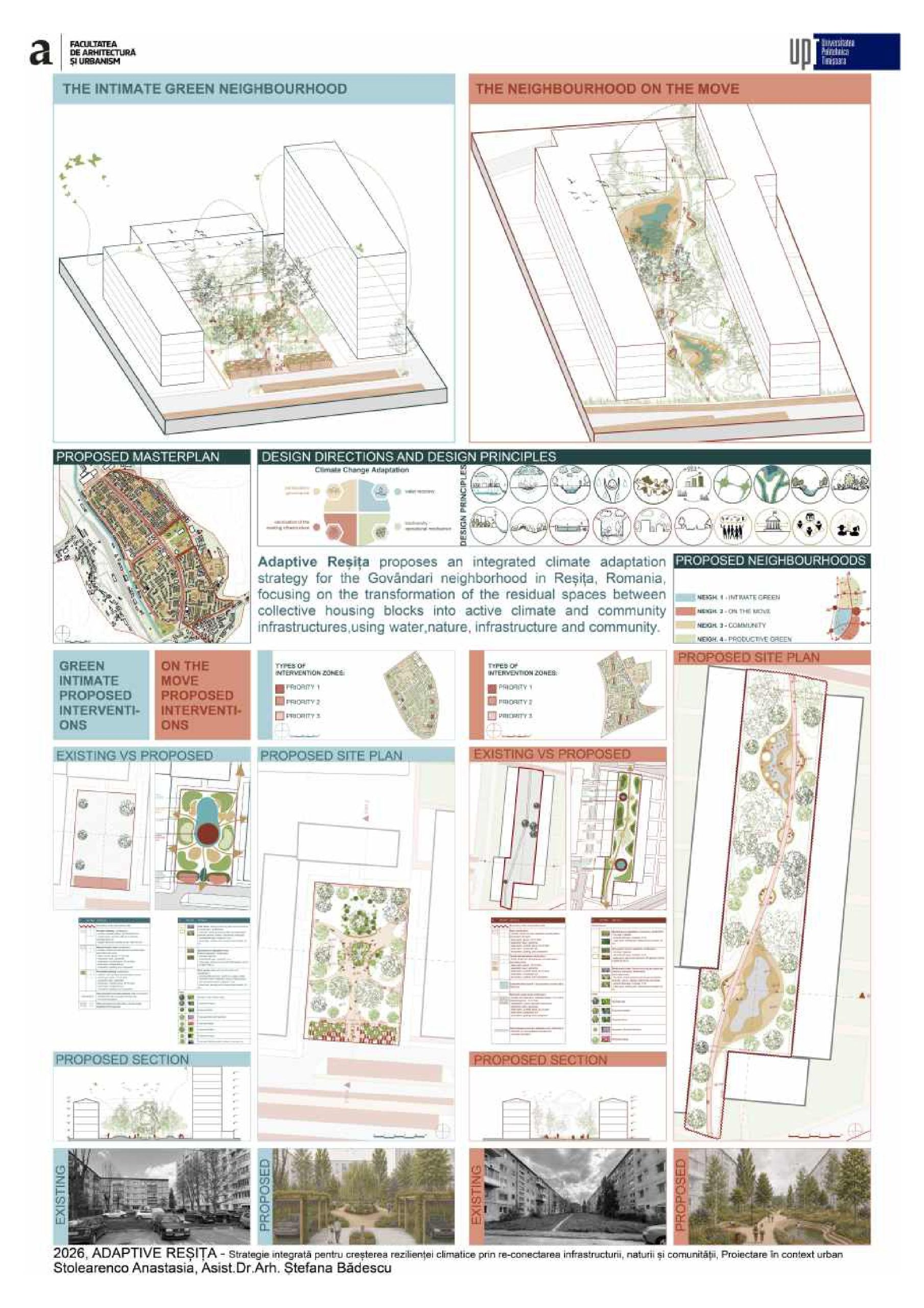
Student: Stolearenco Anastasia
Coordinating Professor: Asist.Dr.Arh. Ștefana Bădescu
The project started from the hypothesis that climate adaptation should not be treated exclusively as a technical issue, but as an integrated process in which water, biodiversity, existing infrastructure, and the community work together. In the Govândari district, this hypothesis was tested through multi-criteria interventions that transformed residual spaces between apartment blocks into areas supporting climate adaptation, community life, and biodiversity.
One of the main conclusions is that climate adaptation interventions become relevant only when they are firmly grounded in the specific reality of the place. By combining funding priorities, local administrative priorities, community consultation, and on-site diagnosis, the project was able to test its theoretical assumptions and adapt the interventions accordingly. This demonstrates that feasibility cannot be determined through theoretical analysis alone, but also depends on the actual condition of the site and the perceptions of its residents.
A second conclusion is that interventions, whether climate-related or not, should never be treated as isolated elements, but as parts of an integrated and coherent system, ensuring that positive impacts in one area do not generate negative consequences elsewhere.
A third important conclusion is the value of community involvement. The analysis of projects submitted for participatory budgeting, including those that were not funded, demonstrates that even limited community participation can reveal needs that are often overlooked.
Finally, the project shows that although urban administrations often prioritize large and highly visible spaces, the most vulnerable areas are frequently the “in-between spaces”—circulation routes, transitional areas, and spaces immediately surrounding residential buildings. These overlooked spaces can therefore become important elements in building climate-resilient, connected, and community-oriented neighborhoods.
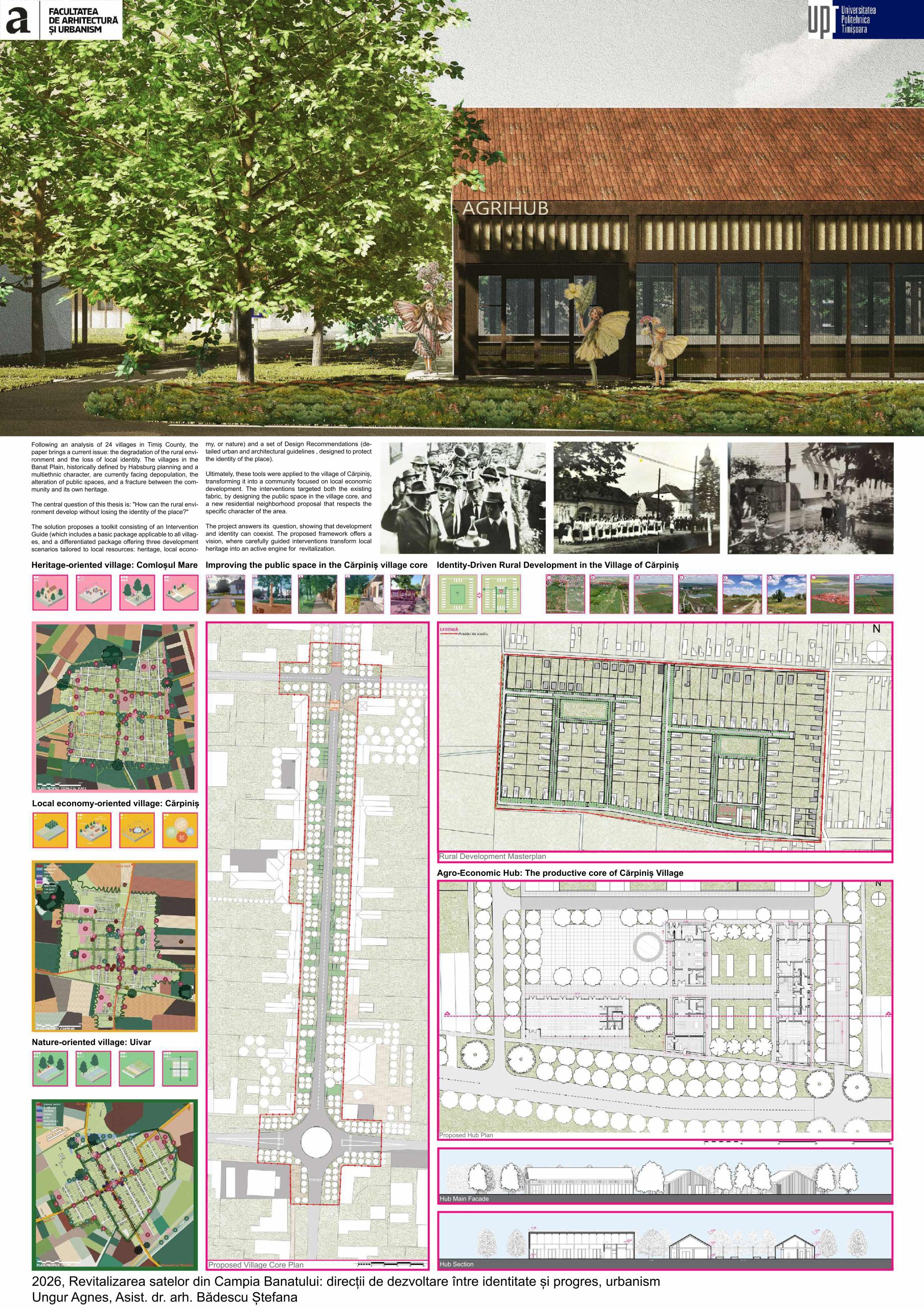
Student: Ungur Agnes
Coordinating Professor: Asist.Dr.Arh. Ștefana Bădescu
The project demonstrates that the sustainable revitalization of the contemporary Banat village, with Cărpiniș as a case study, does not mean preserving the settlement in the past, but implementing clear urban and technological regulations capable of balancing cultural and historical identity with socio-economic progress.
The project follows two interconnected directions:
1. Protecting and regenerating identity – Healing the present
A comparison between the idealized villages depicted in the paintings of Ștefan Jäger and the current landscape reveals severe degradation of public space caused by uncontrolled urbanization, excessive paving, and visual inconsistency. The proposed guidelines include P/P+M building heights, preservation of the rational street grid, honest materials such as brick, ceramic tiles, and wood, retention of grass-lined drainage channels, and restoration of tree alignments. Their immediate application is demonstrated through landscape proposals for pedestrian spaces around key village landmarks: the Town Hall, Secondary School, and Orthodox Church.
2. Ensuring progress – Developing the future
Future expansion should be carefully controlled through the rigorous continuation of the traditional orthogonal “chessboard” grid, while introducing innovative elements: more compact plots for young families, transforming the centers of blocks into public green parks instead of oversized productive gardens, and restricting car traffic within new residential areas.
The proposed Agro-Economic Hub becomes the engine of this active community. Reinterpreting the typology of the traditional Banat barn, it functions as a contemporary agora, incorporating EU-compliant production circuits for small-scale artisanal processing of vegetables, fruit, and dairy products. It provides local producers with year-round stability, permanent sales space, ecological education for students, and a platform for regional economic cooperation.
Ultimately, the project offers a replicable model for rural planning, in which traditional elements—such as the front-gate bench or the silhouette of Swabian houses—are functionally adapted to contemporary requirements of sustainability, hygiene, and social cohesion. In this way, the village can evolve from a simple “dormitory settlement” into a living cultural and economic organism.
2026 | PROIECTARE 9&10 | A05
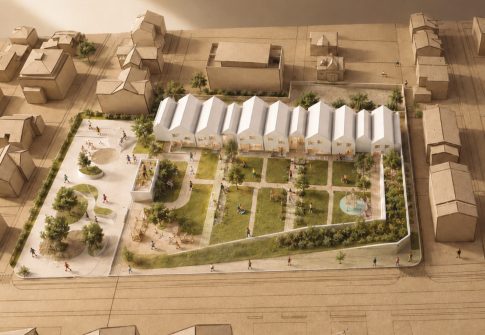
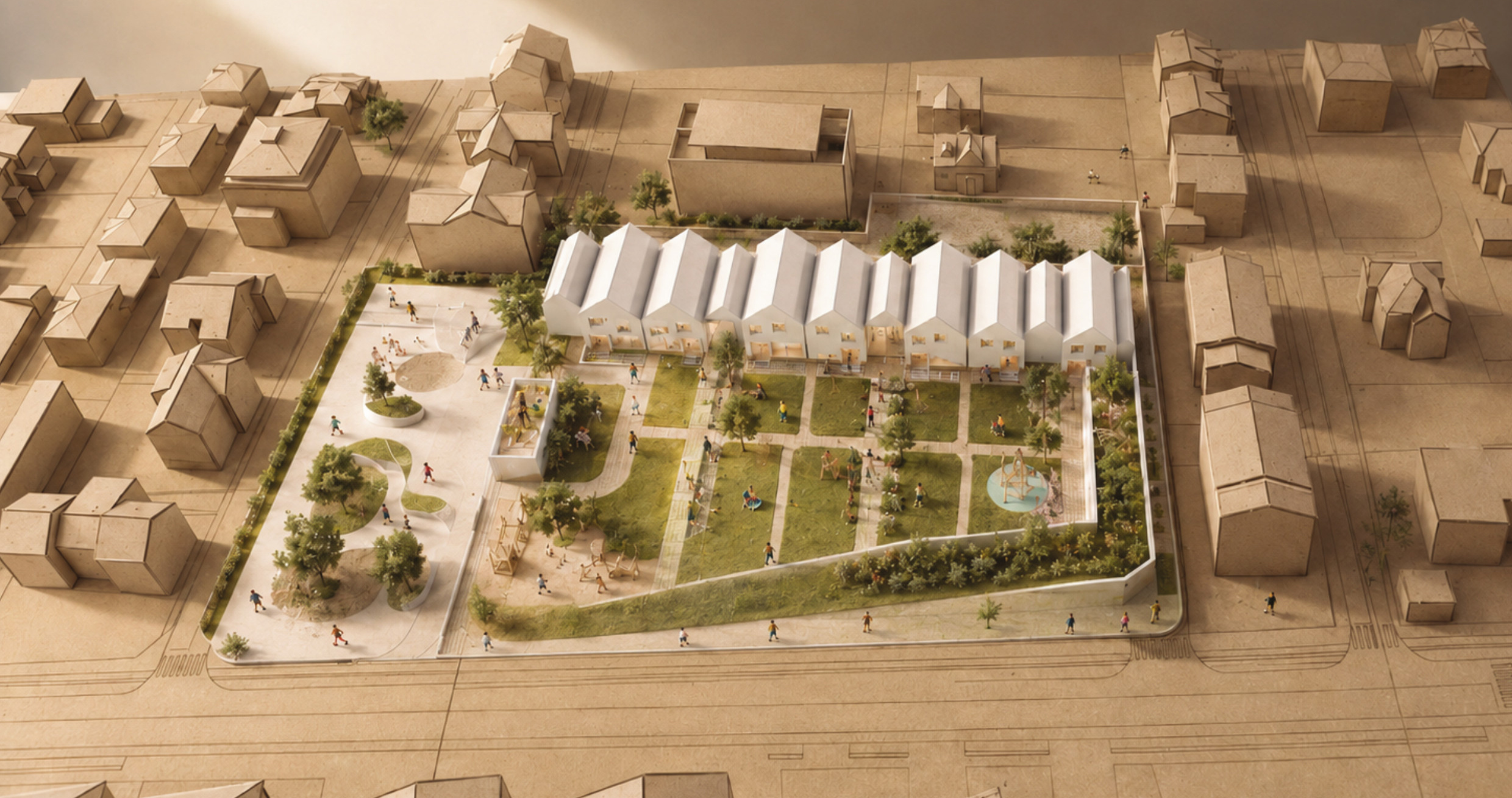
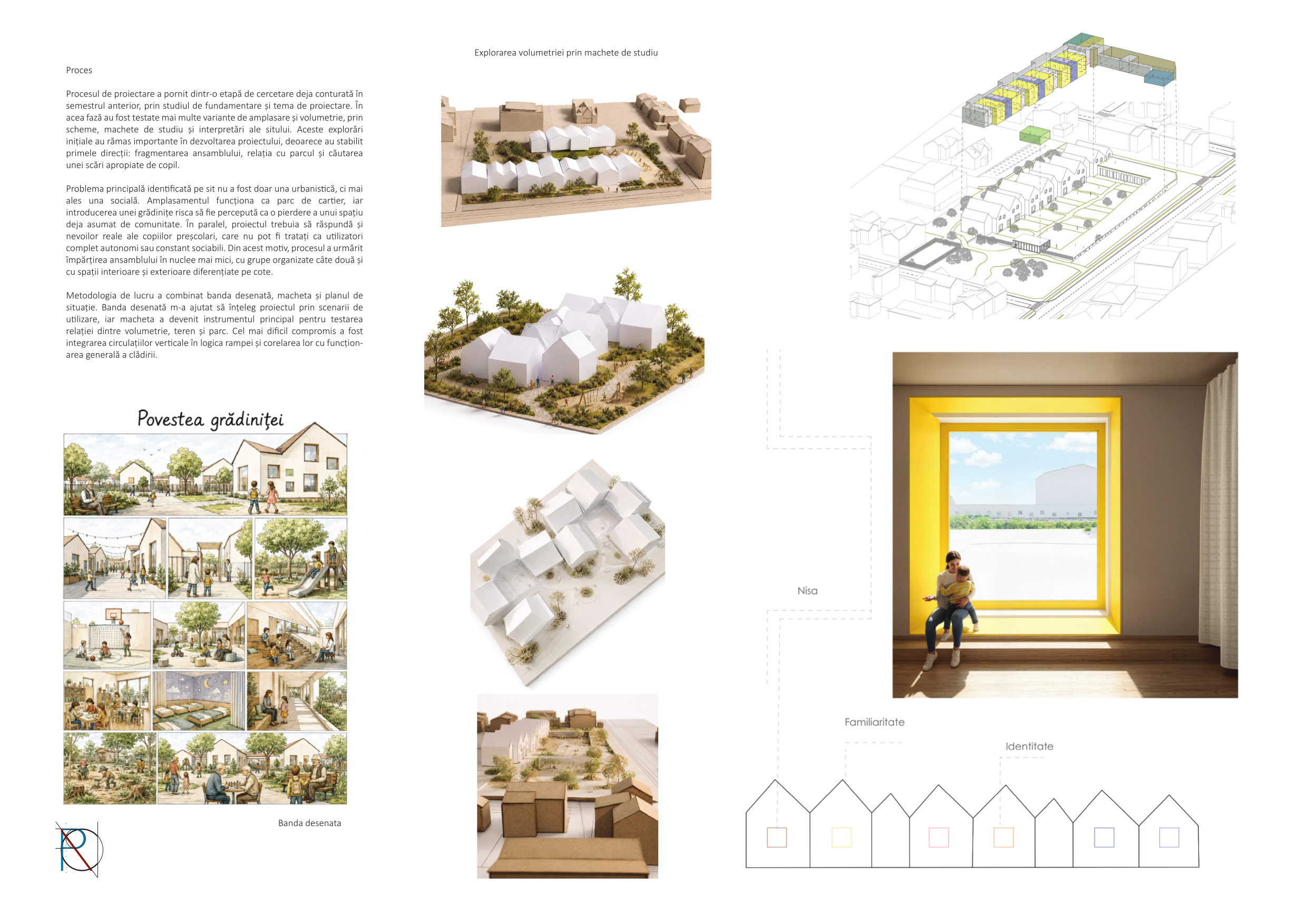
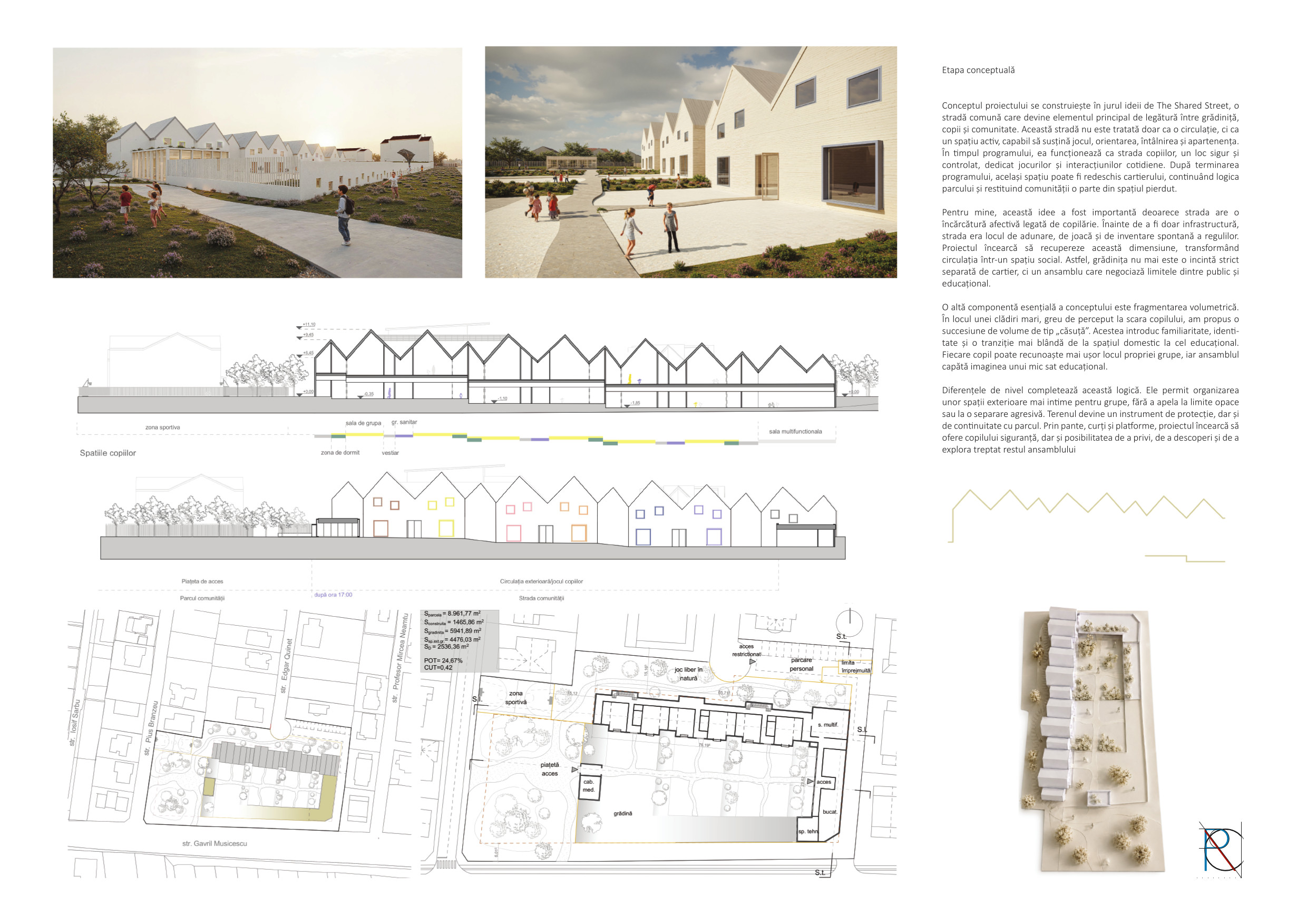
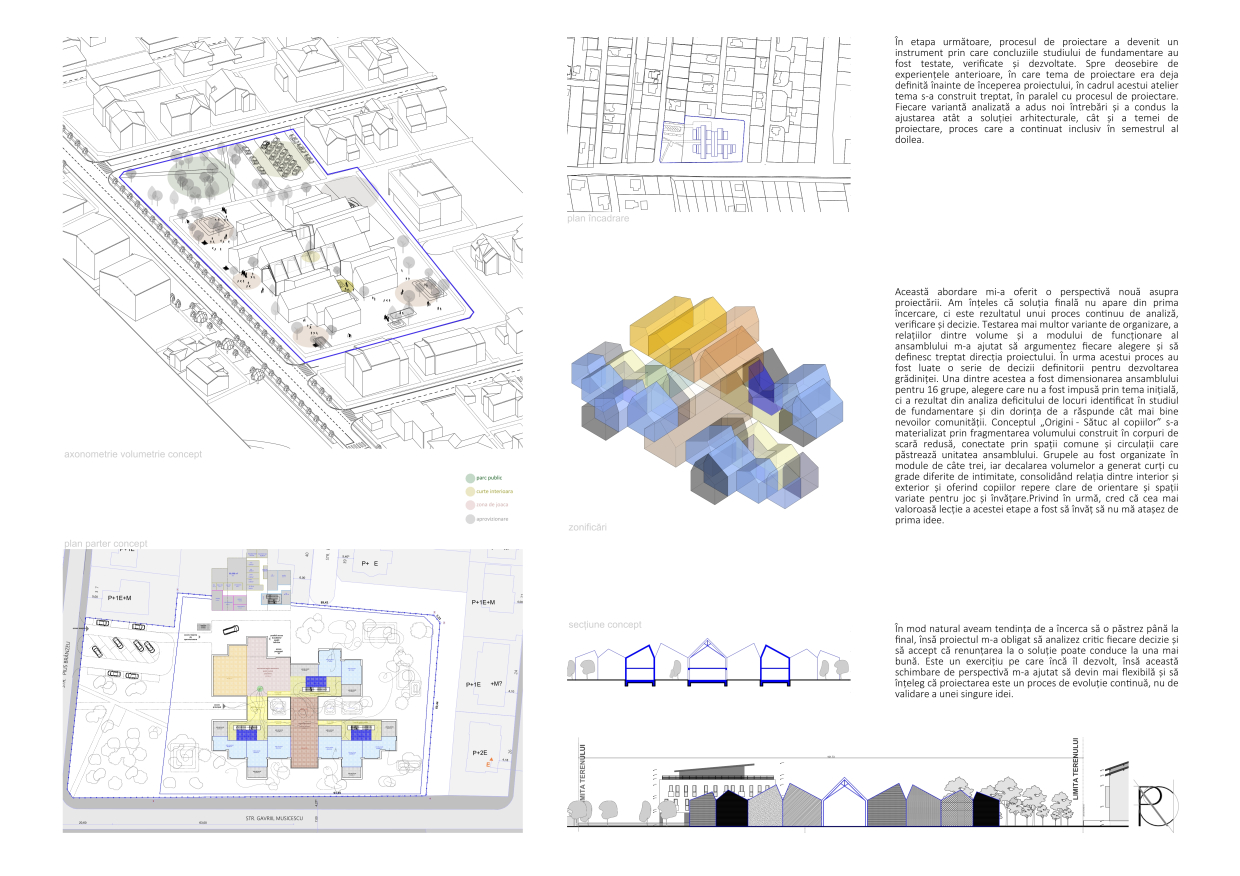
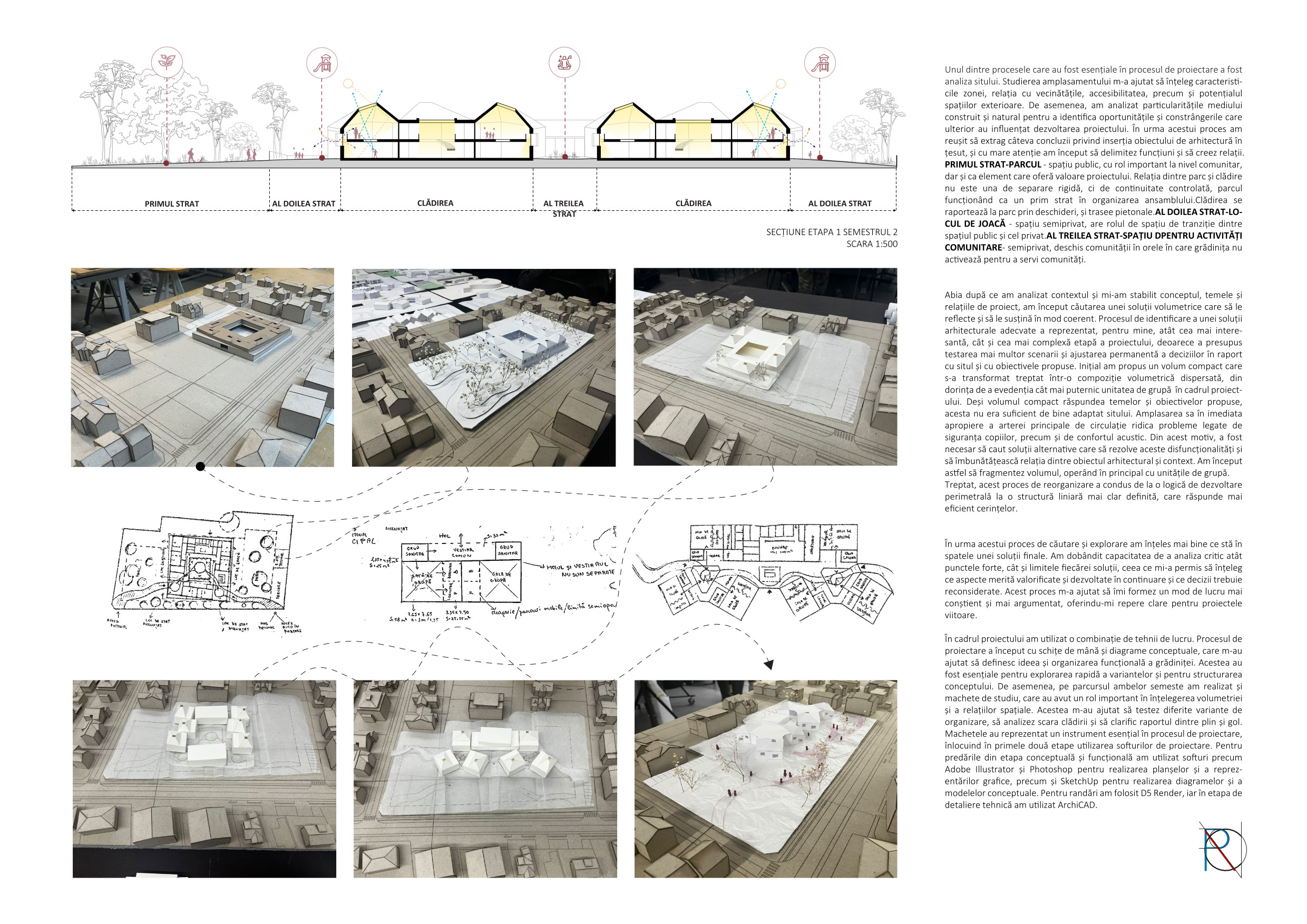
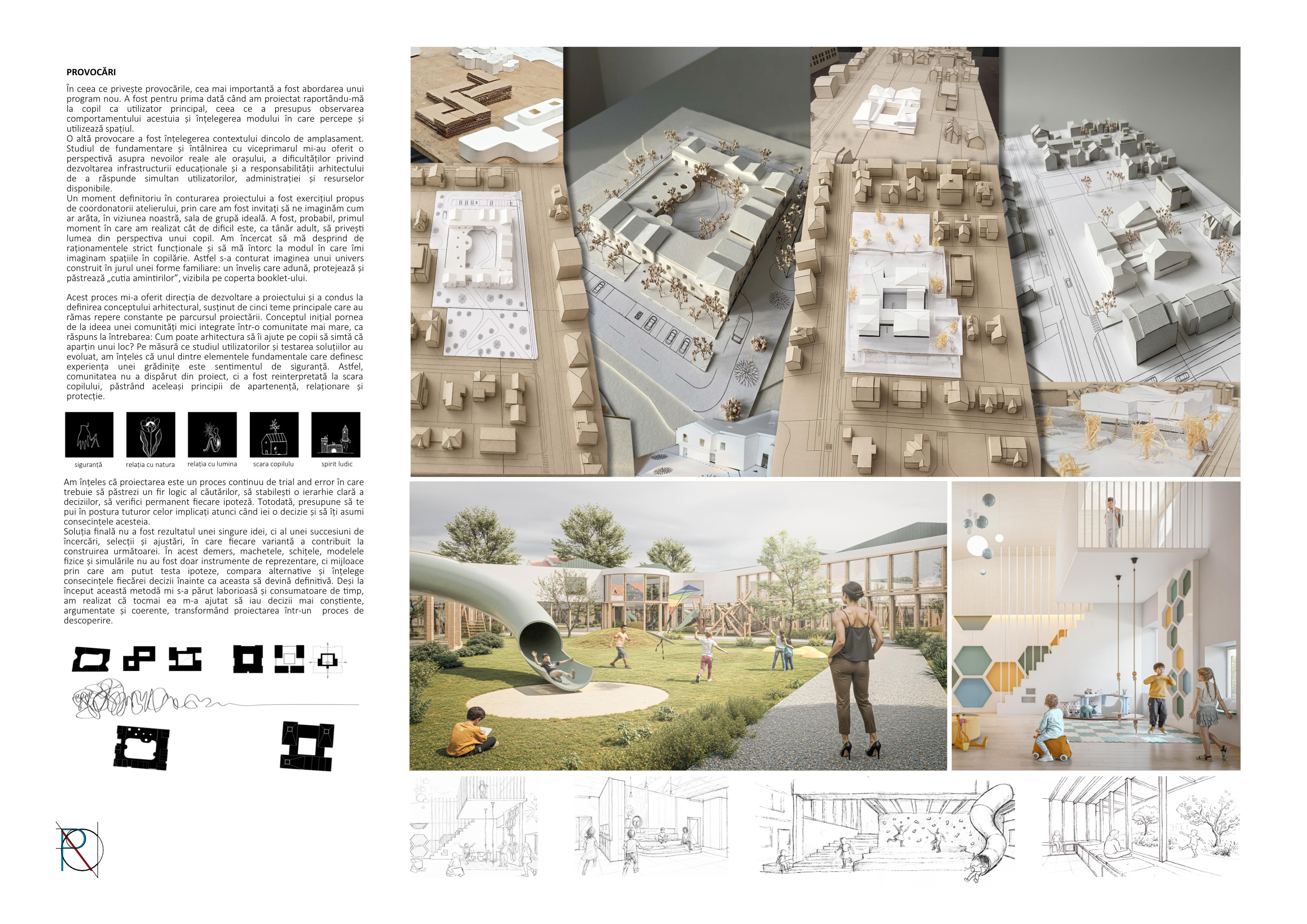
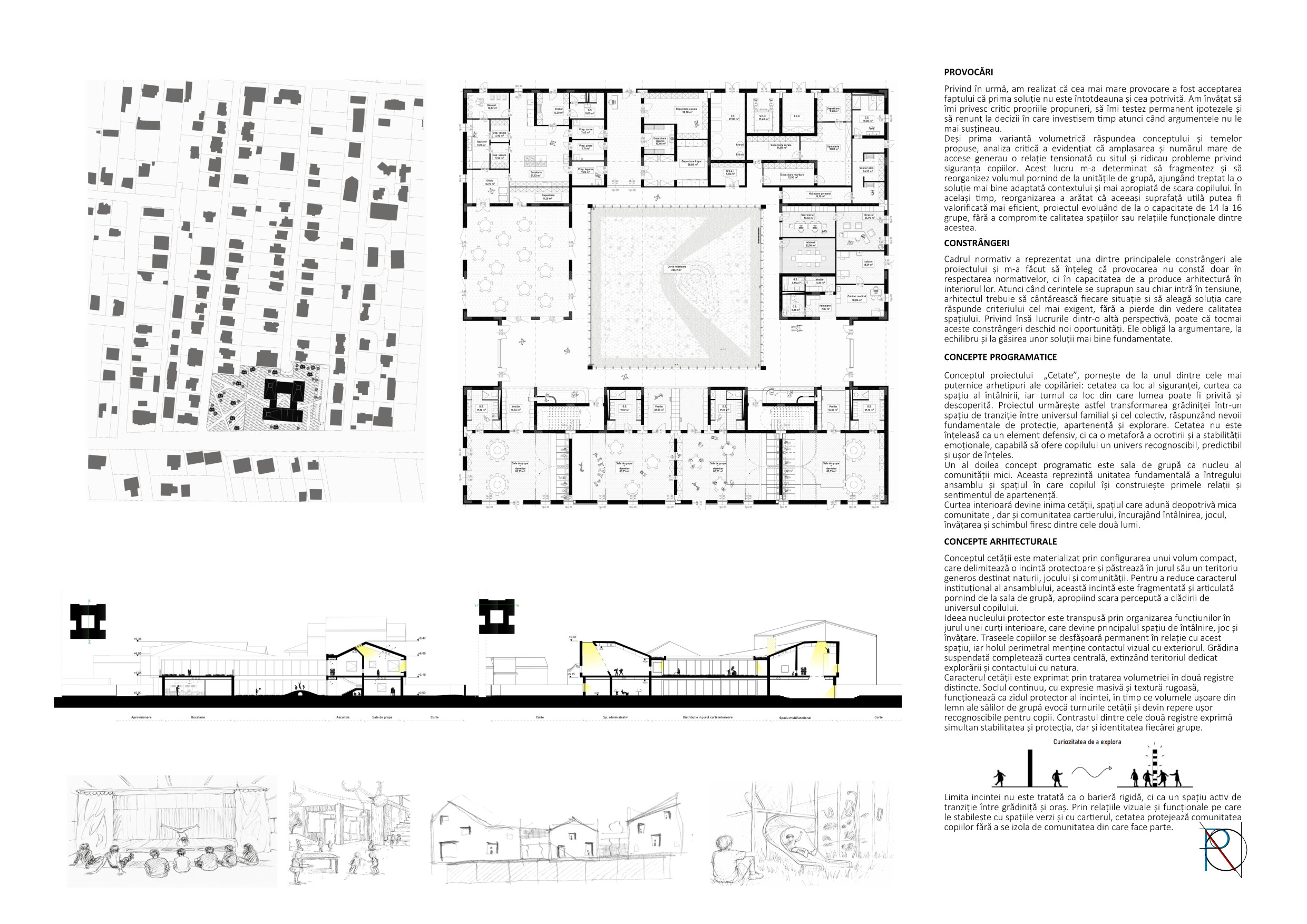
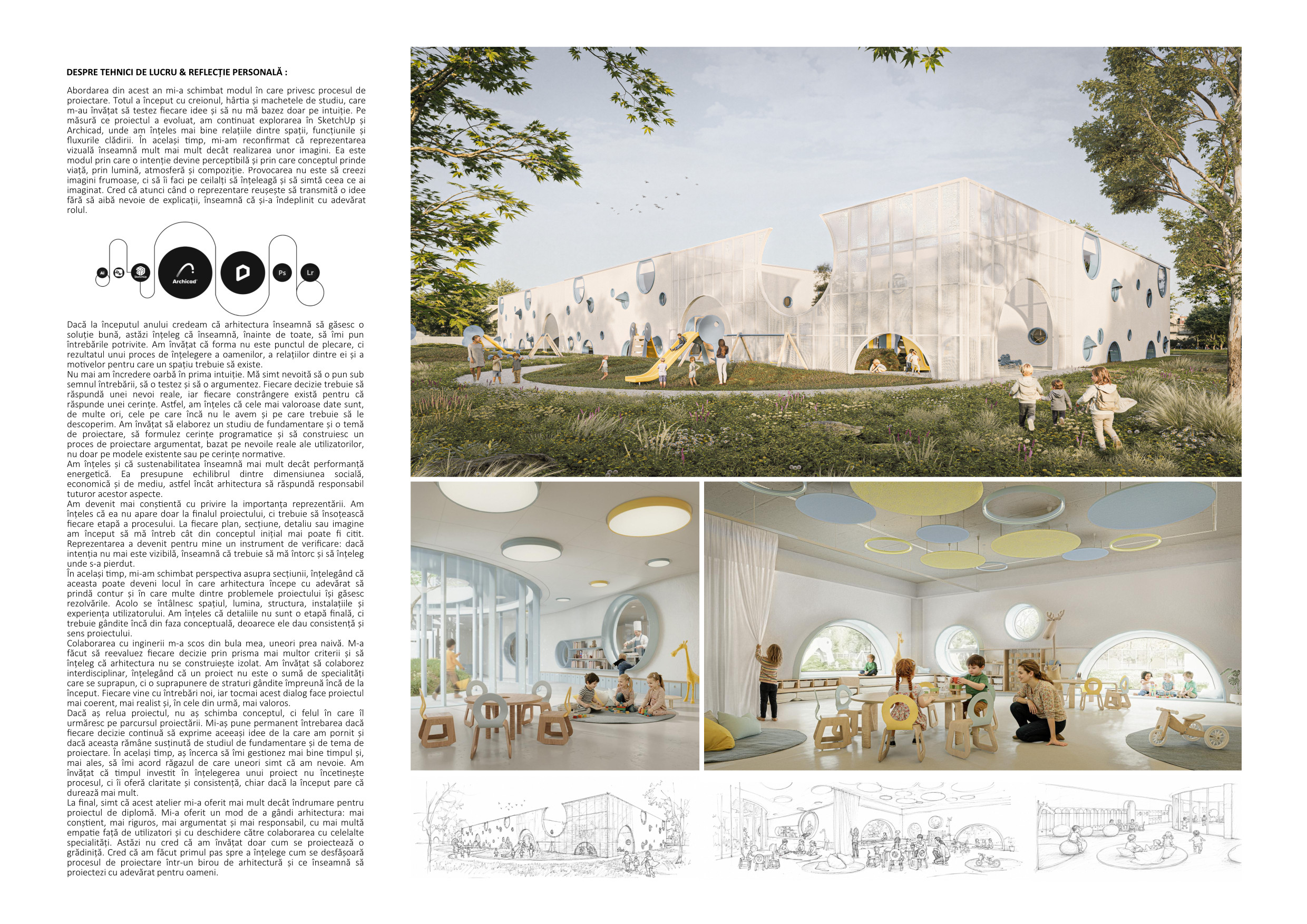
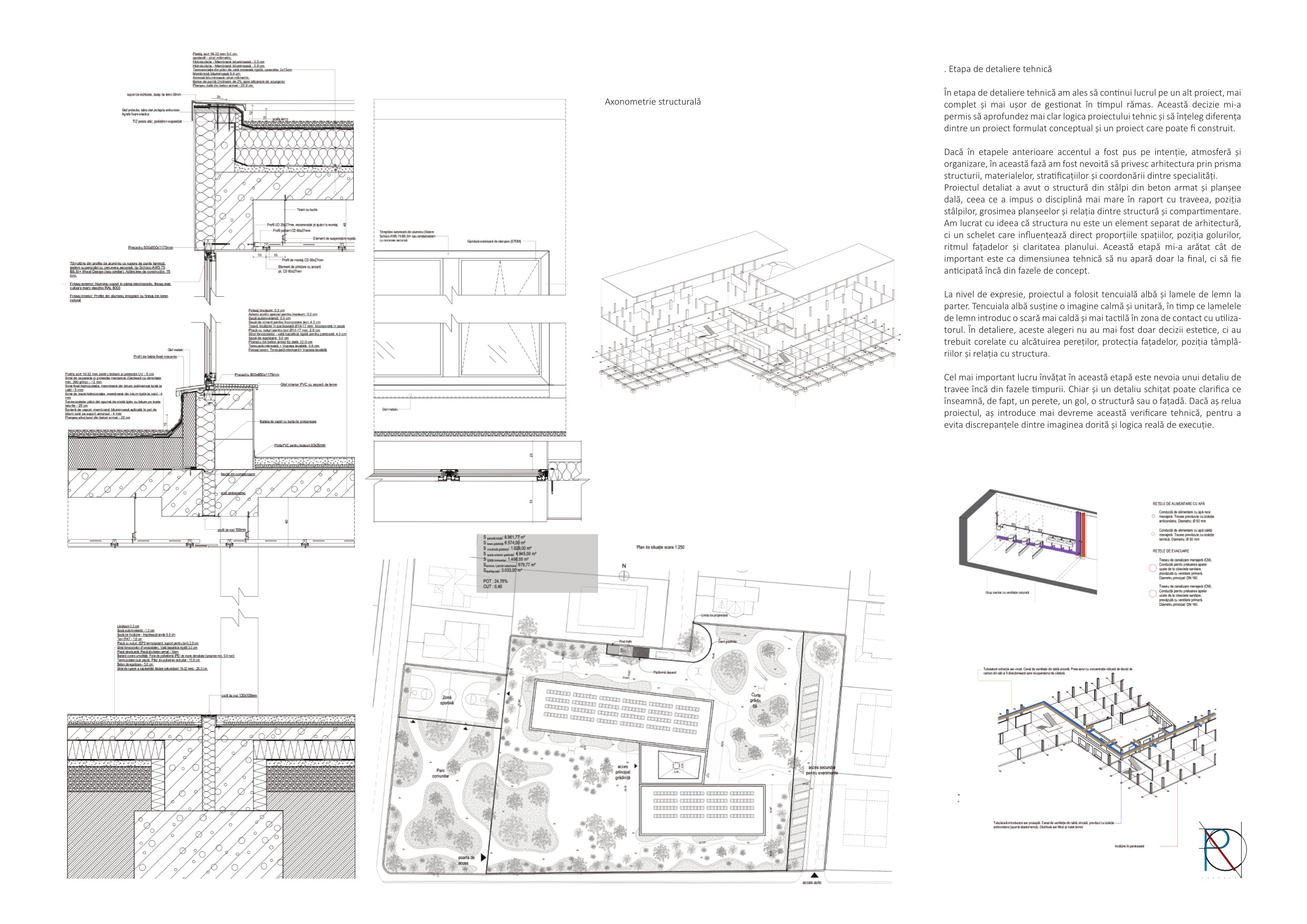
RO: Tema propusă la Atelierul de Proiectare Complexă din acest an continuă direcția anilor precedenți, oferind studenților cadrul necesar pentru a parcurge integral procesul de proiectare, de la studiile de fundamentare până la detalierea soluției.
Demersul pornește de la o problemă reală, legată de infrastructura educațională deficitară din zona metropolitană a municipiului Timișoara, și se dezvoltă progresiv într-o succesiune de etape care structurează atât acumularea de informație, cât și articularea răspunsului arhitectural.
Prima etapă este dedicată explorării și înțelegerii situației specifice. Accentul se pune pe problematizare și pe construirea unui suport de date solid, utilizând instrumentele cercetării științifice. Aceasta este urmată de o fază de definire a cerințelor de temă și de testare a unor direcții conceptuale, în care ipotezele programatice și spațiale sunt formulate, analizate și rafinate, prin intermediul instrumentelor specifice metodei proiective.
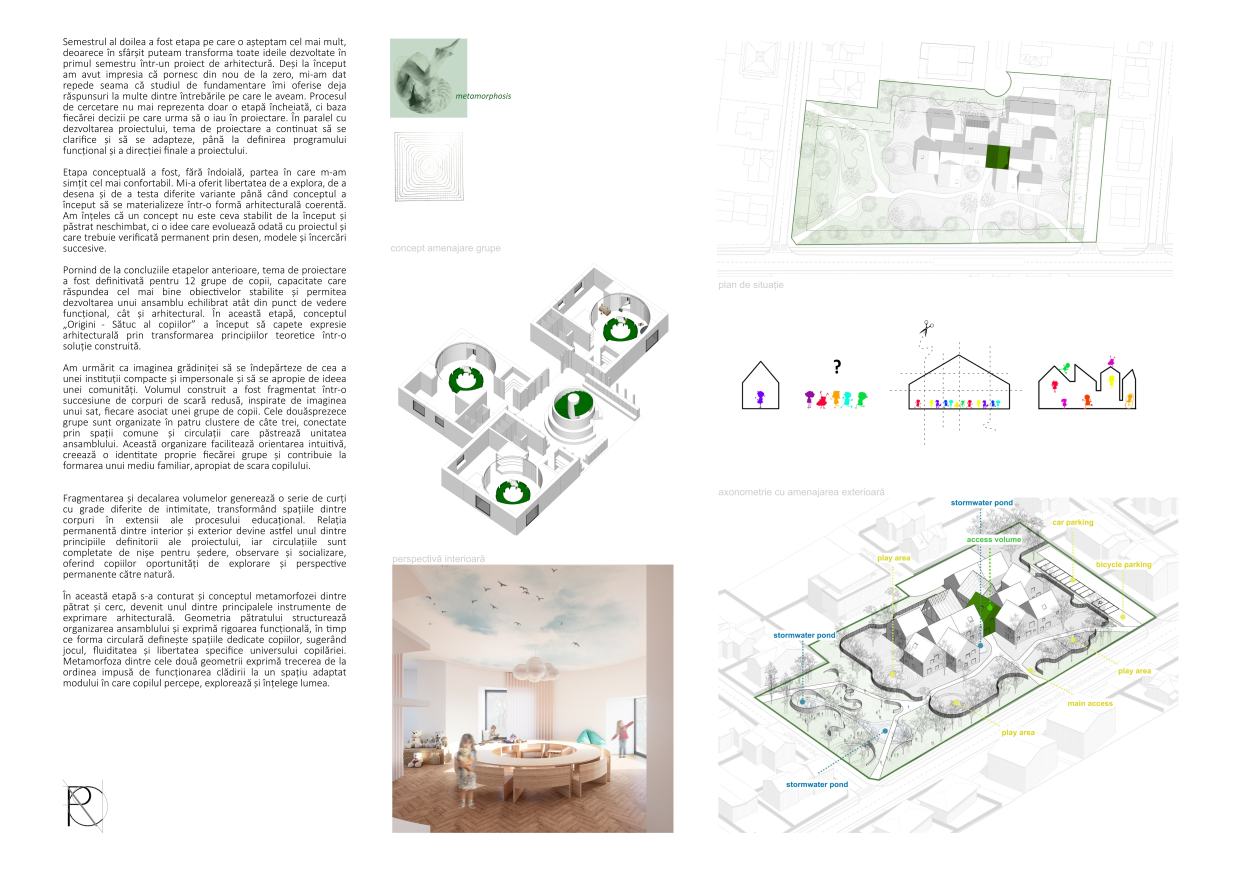
Etapa conceptuală, desfășurată în cel de-al doilea semestru, marchează trecerea către configurarea propriu-zisă a proiectului, punând accent pe dialectica dintre intuiție și rigoare, dintre libertatea gestului creativ și constrângerile contextuale, în vederea generării unor soluții coerente, relevante din punct de vedere arhitectural.
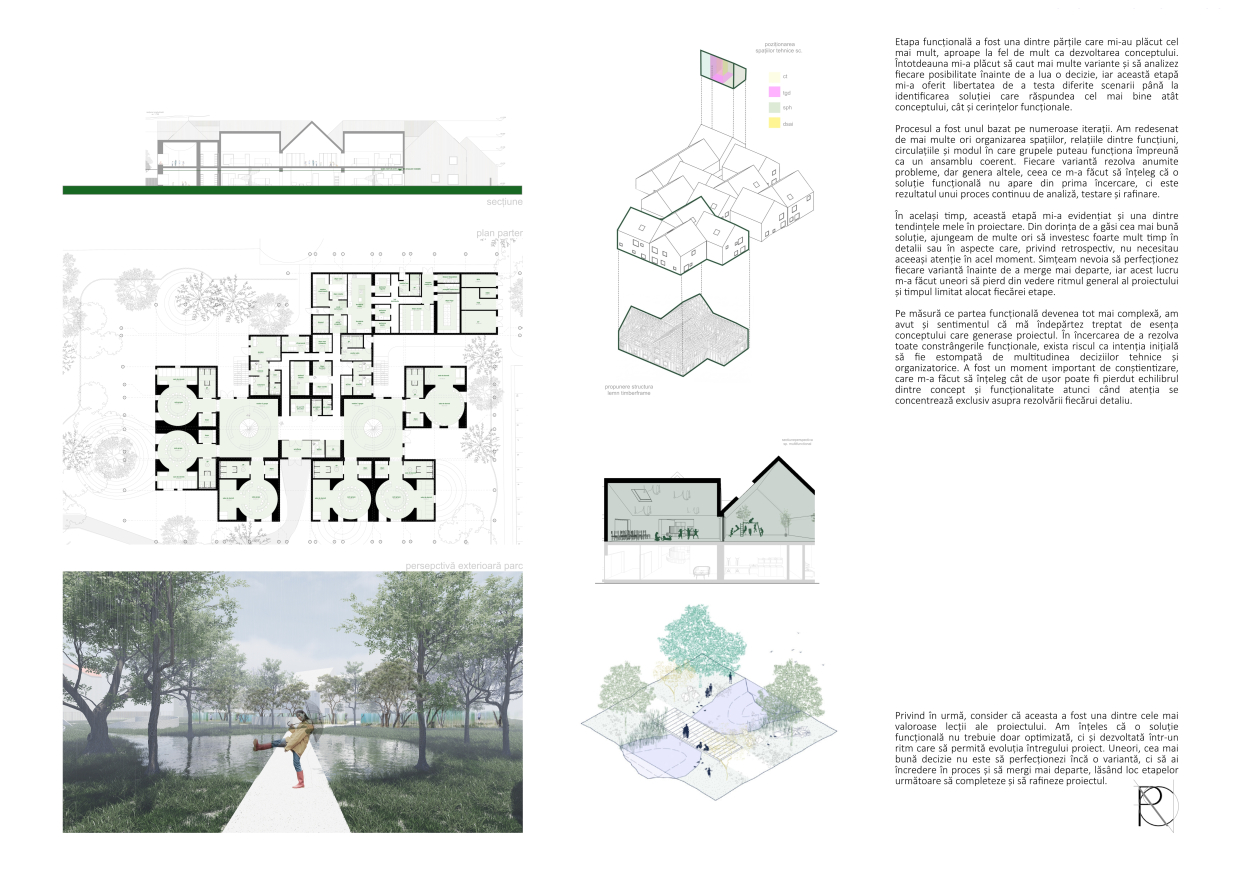
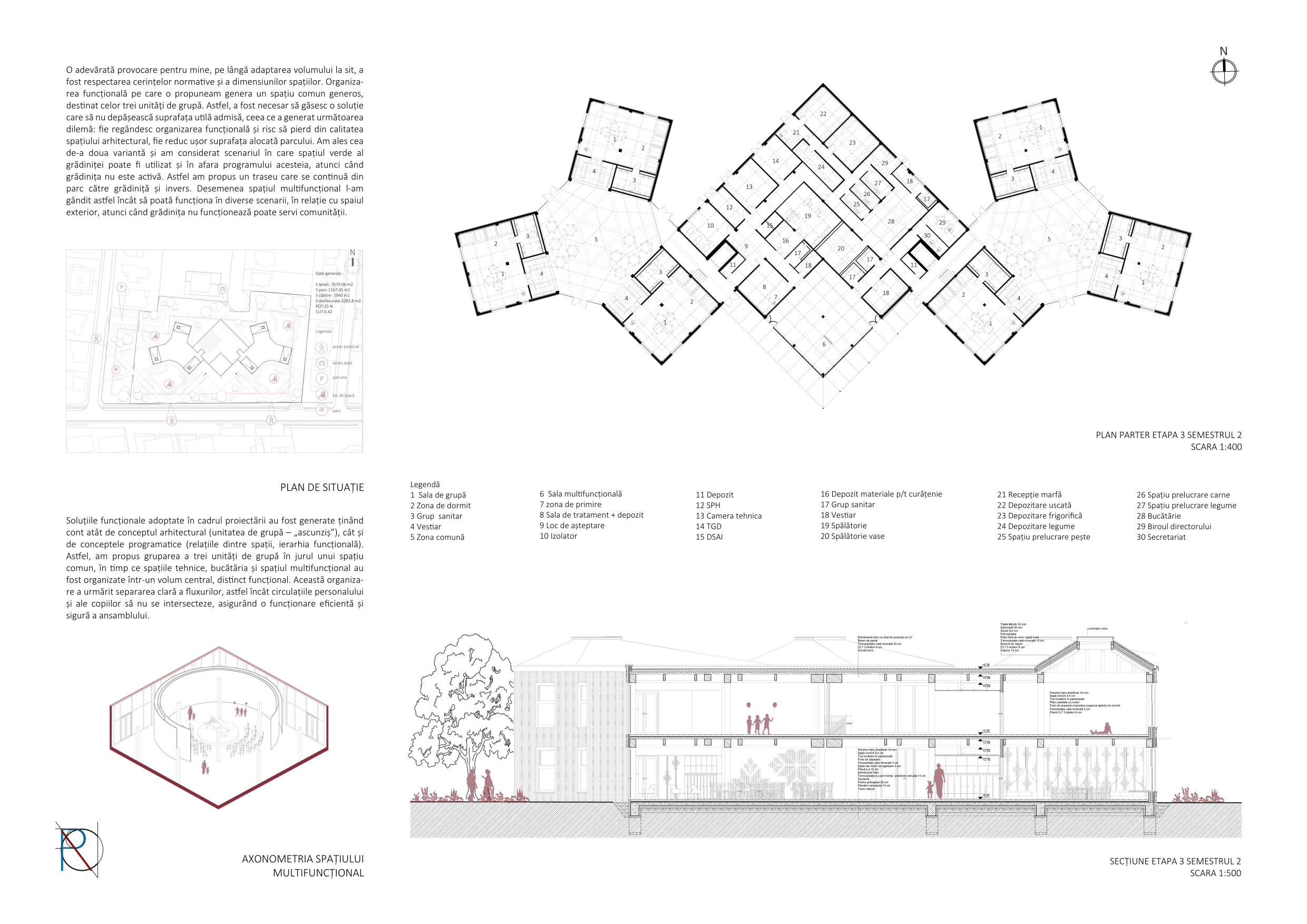
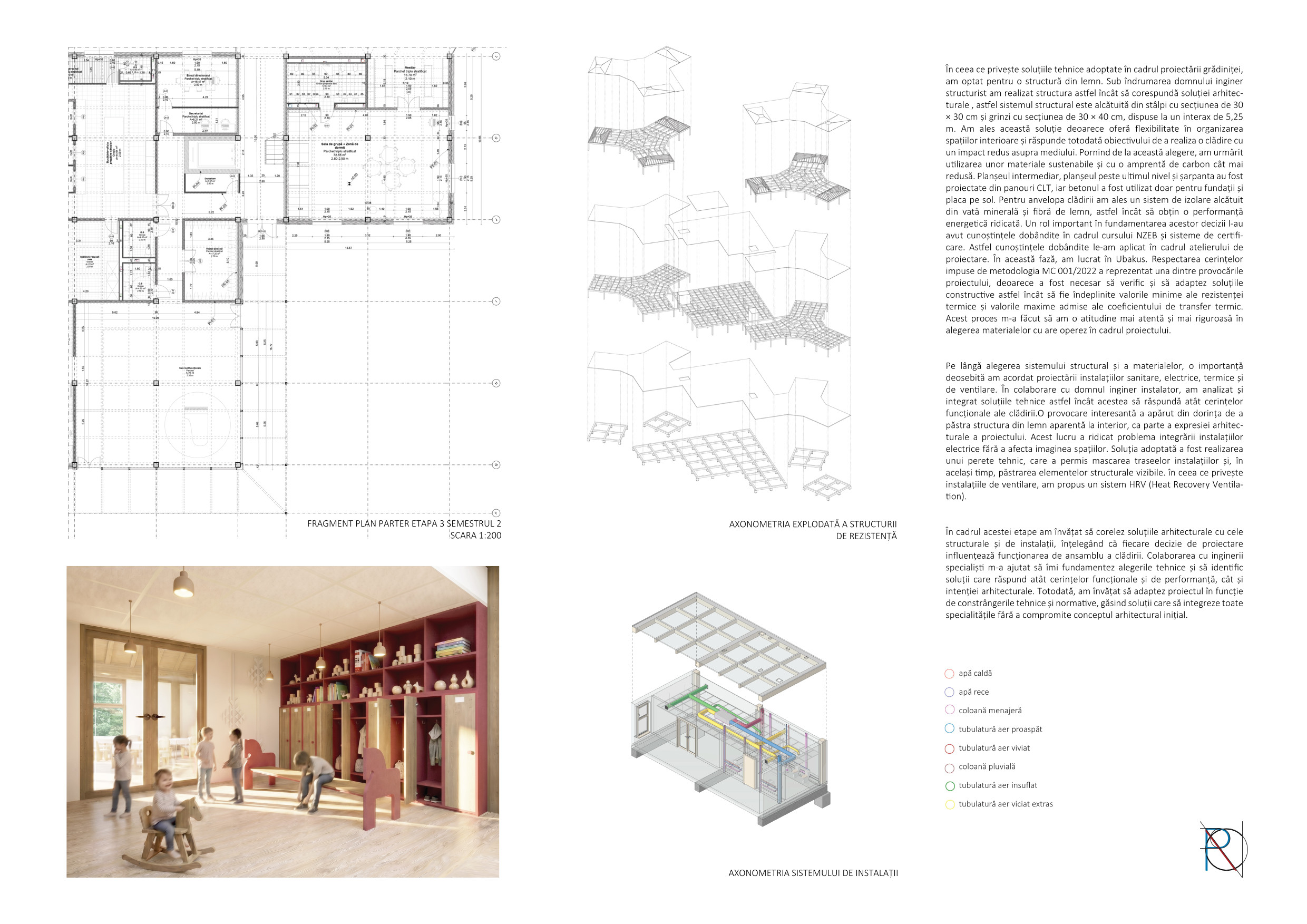
Următoarea etapă, dedicată detalierii soluției de arhitectură, urmărește dezvoltarea proiectului funcțional în acord cu intențiile conceptuale inițiale, precum și valorificarea relației de colaborare cu specialiștii implicați în procesul de proiectare.
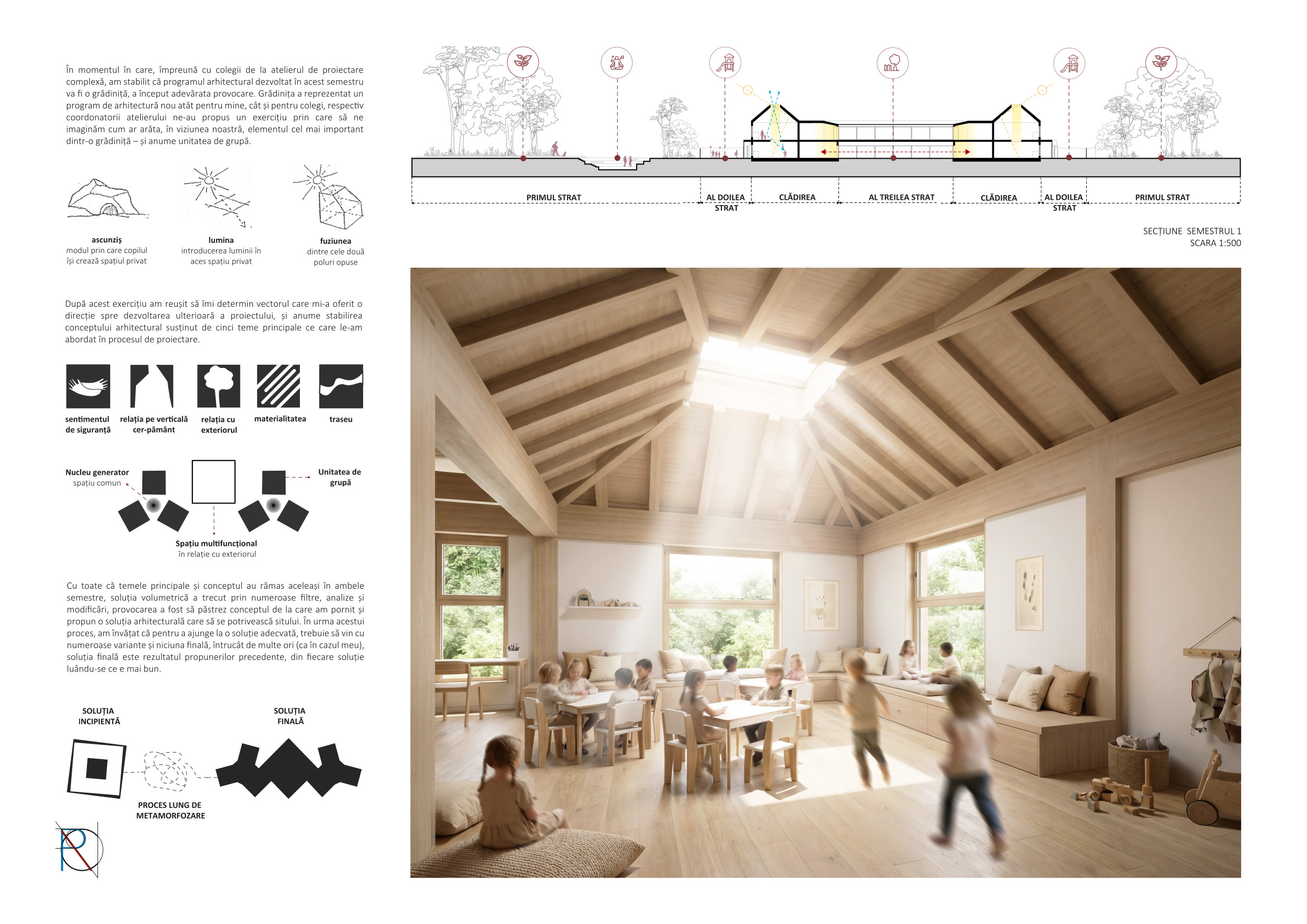
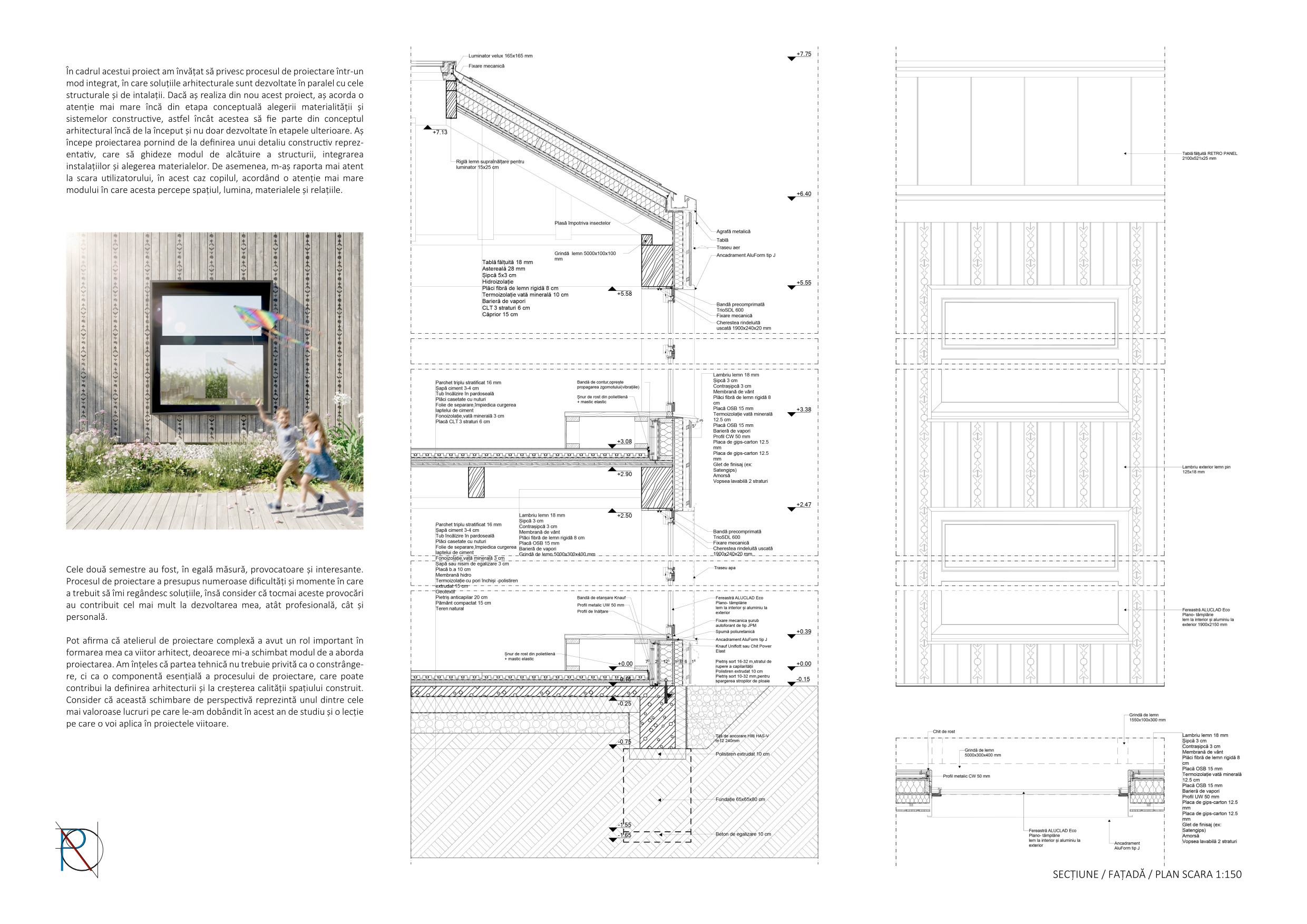
Etapa finală aprofundează proiectul la nivel tehnic, vizând elaborarea unor soluții de detaliu capabile să clarifice și să susțină demersul conceptual inițial.
EN: This year’s Advanced Architectural Design Studio builds upon the pedagogical framework established in previous years, guiding students through the complete architectural design process, from preliminary research and contextual analysis to the technical development of a fully resolved architectural proposal.
The studio addresses a real-world challenge arising from the shortage of educational facilities in the metropolitan area of Timișoara. The project unfolds through a sequence of interconnected stages that support both the progressive acquisition of knowledge and the development of a coherent architectural response.
The first stage is dedicated to investigating and understanding the specific context. Students are encouraged to identify and critically frame the design problem while building a solid knowledge base through research-informed methods. This is followed by the definition of the design brief and the exploration of alternative conceptual directions, during which programmatic and spatial hypotheses are formulated, evaluated, and progressively refined through iterative design inquiry.
The conceptual design stage, conducted during the second semester, marks the transition from research to design synthesis. Particular emphasis is placed on the productive dialogue between intuition and analytical reasoning, balancing creative exploration with the constraints imposed by site, programme, and context in order to generate coherent, well-founded, and architecturally meaningful proposals.
The subsequent stage focuses on the development of the architectural proposal, translating the conceptual intentions into a functional and spatially coherent design while promoting collaboration with the structural, building services, and other engineering consultants involved in the design process.
The final stage advances the project to the level of technical resolution, requiring students to develop detailed architectural solutions that substantiate, clarify, and reinforce the original design concept.
For the full texts please click on the pages of the brochure below.
2025 | DIPLOMA | YEAR VI
The completion of studies at the Faculty of Architecture and Urbanism within Universitatea Politehnica Timișoara is achieved through a diploma examination structured into two complementary components, theoretical and applied in nature.
Part I consists of the defense of a theoretical dissertation and a preliminary research study (pre-diploma), which establishes the conceptual foundation of the final project. The dissertation is developed within one of three academic units:
Complex Architecture
Heritage Development and Reuse
Urban Planning
Part II involves the public defense of the diploma project, presented through written and graphic documentation demonstrating the candidate’s ability to integrate and apply theoretical knowledge in the coherent resolution of an architectural or urban issue.
The topic may be selected from those proposed within the thematic unit or formulated by the candidate in consultation with the academic supervisor.
The final assessment considers the rigor of the research process, theoretical grounding, conceptual coherence, interdisciplinary dimension, and the overall architectural quality of the proposed solution.
For the full texts please click on the pages of the brochure below.


Complex Architecture
Student: Lac Alexandra
Coordinating Professor: S.l. Dr. Arch. Daniela Negrișanu
The proposed concept illustrates the impact of architecture in the context of memory loss, highlighting its ability to mediate the disconnection between perception and meaning. These aspects analyze the shaping of identity through anamnesis, stimulated by architectural experiences and evoked reminiscences, as well as the mechanisms of perception, which involve the use of the senses for a deep exploration of architecture. The center, beyond being a treatment space, becomes an active factor in the therapeutic process, which, although it will not solve the issue of cognitive decline, will optimize the patients’ quality of life through the built environment’s capacity to generate interactions that reflect the essence of their identity.
Student: Lușcă Maria Claudia
Coordinating Professor: Arch. Adam Romi
The architectural language is shaped by the psychological profile and needs of a person who has experienced trauma, drawing on the principles of healing architecture. Trauma fragments the mind into “before” and “after” episodes, often dominated by fear and pain. In this context, architecture becomes a therapeutic support in the healing process, addressing behavioral, physical, emotional, and cognitive impacts. Healing architecture leverages the power of the built environment to influence psychological well-being. For domestic violence victims, spaces must promote safety, calm, and identity restoration. Environmental factors—light, natural materials, colors, and spatial organization—directly affect stress levels and the recovery process. Beyond visual perception, the multisensory experience of space (texture, smell, sound, shadow) fosters a sense of belonging. Thus, the building becomes more than a shelter—it becomes a space of healing and hope.
Students: Găleșanu Eduard, Hotea Timotei, Pașca Georgiana
Coordinating Professor: Conf. Dr. Arch. Cristian Blidariu
MEKA – Museum of Ecological Knowledge and Awareness transforms the Mecatim industrial platform in Timișoara into a mixed ensemble: plastic recycling factory, research institute, and museum dedicated to the material plastic.
Addressing the post-industrial waste crisis, the project redefines the ruin as active public infrastructure. The existing metal structure is complemented by prefabricated modules made of recycled plastic and local soil, configuring a hybrid system with a reduced footprint.
The continuous flow—collection, extrusion, 3D printing, exhibition—becomes an open didactic stage for the public. Intermediate spaces, a circular walkway, and vegetated courtyards filtered by translucent façades mediate the relationship between technological process and city, cultivating community engagement. Plastic, simultaneously raw material and architectural expression, is revalorized through architecture, with recycling becoming a founding cultural act.
Student: Maxim Silvia-Elena
Coordinating Professor: S.l. Dr. Arch. Claudiu Toma
At the edge of Timișoara, in the Fratelia neighborhood, time seems to have forgotten to move forward. The small houses, with gabled roofs and walls made of solid brick or adobe, tell stories of simplicity, calm, and community. On these quiet streets, life flows slowly: people chatting at their gates, benches that listen to thoughts, windows that open toward the world. The Brick Bond project was born from the desire to preserve this identity and transform it into a foundation for the future. Inspired by the habits and daily gestures of the locals, the project reinterprets the street as a protected indoor space — a playground for children and a space of reconnection for the community. Here, details become symbols: a bench, a window, a door — all reimagined in the spirit of a quiet, shared life. The rotated volume is built on the footprint of the former cultural center, as a gesture of respect for the past and an act of reviving collective memory. Made of perforated metal, it expresses the community’s delicacy, transparency, and sensitivity. Surrounding it, a brick wall embraces it — like a protective shell that binds the new to the old. Brick Bond is about connections — between people, between past and present, between tradition and future. It is a gesture of reconnecting with local memory, an invitation to play, to dialogue, and to come together.
Heritage Development and Reuse
Student: Avram Casian Alexandru
Coordinating Professor: Conf. Dr. Arch. Gabriela Domokos-Pașcu
The mosaic complex in Fabric consists of the Neolog synagogue, the prayer house, and the former Israelite care center for the elderly. Over time, the surrounding area has been altered by the appearance of industrial sites, office buildings, medical offices, and multiple private parking lots. Within the project of converting the mosaic complex into a research center with a museum program and the cross-border headquarters of The Art Nouveau European Route, the reconnection of the 3 buildings was carried out and their correlation with the nearby public space, as well as with the 2 courtyards of the mosaic complex. At the conceptual level of the arrangement, the aim was to extend Parcul Regina Maria beyond the fence line, in fact reclaiming an area called Vorpark which was integrated into the park until the end of the 19th century, until it was parceled and built upon. To ensure the physical connection between the 3 buildings, a glass-structured pavilion was inserted, around which a drainage channel was placed. At the functional level, the synagogue accommodates musical and theater performances, conferences, as well as temporary exhibitions within the complex. The prayer house accommodates permanent exhibitions, a conference or presentation room, and a space dedicated to interactive activities with the community. The 2 aforementioned buildings have public functions, while the Coșariu house is a research center (semi-private).
Student: Petrica Anca Ștefania
Coordinating Professor: S.l. Dr. Arch. Maja Bâldea
The project addresses the noble ensemble of Petala Castle in the village of Clopodia, Timiș County, focusing on the revitalization of the castle, its annexes, and the dendrological park. The region has a rich history and has been inhabited by various ethnic groups who have shaped the area and its characteristics to this day. Revitalizing the ensemble has the potential to attract tourism to the area, strengthen the inhabitants’ sense of place, and serve as a catalyst for similar initiatives across the Banat region. The proposal includes multiple stages of development, ranging from the addition of a traditional restaurant to on-site accommodation. These new interventions are carefully integrated into the landscape and create a dialogue with the existing buildings.
Urban Planning
Student: Costică Bogdan Andrei
Coordinating Professor: Conf. Dr. Arch. Marius Găman
The project proposes a strategic intervention in the area of the former Disciplinary Battalion in Caracal, aiming to regenerate a neglected urban periphery affected by social, economic, and infrastructural challenges. The city faces issues such as rural migration, rising housing costs, poor transport infrastructure, and limited access to essential services and green spaces. The project introduces an urban expansion model based on food urbanism and co-housing, promoting urban agriculture as a tool for food self-sufficiency, economic resilience, and community revitalization. Various urban agriculture typologies are integrated (educational gardens, therapeutic spaces, greenhouses, orchards, etc.) managed by private producers, cooperatives, youth, or volunteers, depending on context. In terms of housing, the proposal includes four main typologies: collective and semi-collective units in the central area, row houses at the northern edge as a transition, individual homes near productive zones in the south, and commercial-service areas at the entrance. Each typology supports diverse social needs and fosters active, cohesive communities.
Student: Olar-Nicola Dragoș
Coordinating Professor: Conf. Dr. Arch. Marius Găman
The project focuses on transforming a key block in the Freidorf area of Timișoara into a model of sustainable urban development. It applies theoretical concepts such as New Urbanism, Urban Densification, and Acupuncture to address the challenges faced by the neighborhood, including urban fragmentation and inadequate infrastructure. The proposed interventions aim to improve connectivity, diversify land use, and enhance the neighborhood’s identity. Key aspects include the construction of new educational and medical facilities, of public spaces that encourage social interaction, and the development of a pedestrian-friendly street network. The project also emphasizes the importance of increasing residential density without compromising the quality of life. By introducing new green spaces and optimizing the area’s infrastructure, the project seeks to revitalize Freidorf, making it a vibrant and self-sufficient community. Overall, this kind of urban development not only addresses the immediate needs of the community but also serves as a potential model for the development of other areas in Timișoara. The anticipated result is a more cohesive and sustainable urban environment that enhances the quality of life.
Student: Restivan Francesca Tiziana
Coordinating Professor: Conf. Dr. Arch. Mirela Szitar-Sârbu
The project proposes the transformation of the former TEBA industrial site into a vibrant urban complex with mixed functions adapted to the current needs of the city of Arad. Located on the banks of the Mureș River, close to the city center, the site benefits from a strategic position but is marked by the degradation typical of abandoned industrial areas. The intervention aims to valorize the existing industrial heritage through sustainable functional conversions, complemented by new residential buildings, commercial spaces, cultural, educational, and social facilities. Public spaces play a key role in shaping the ensemble, with urban squares, community gardens, themed playgrounds, and a riverside promenade being proposed. By integrating sustainable mobility principles and reconnecting the site to the urban fabric, the project seeks to create a dynamic urban hub that supports social cohesion, functional diversity, and the preservation of the site’s memory within a contemporary urban framework.
2025 | DESIGN GRAFIC | A03
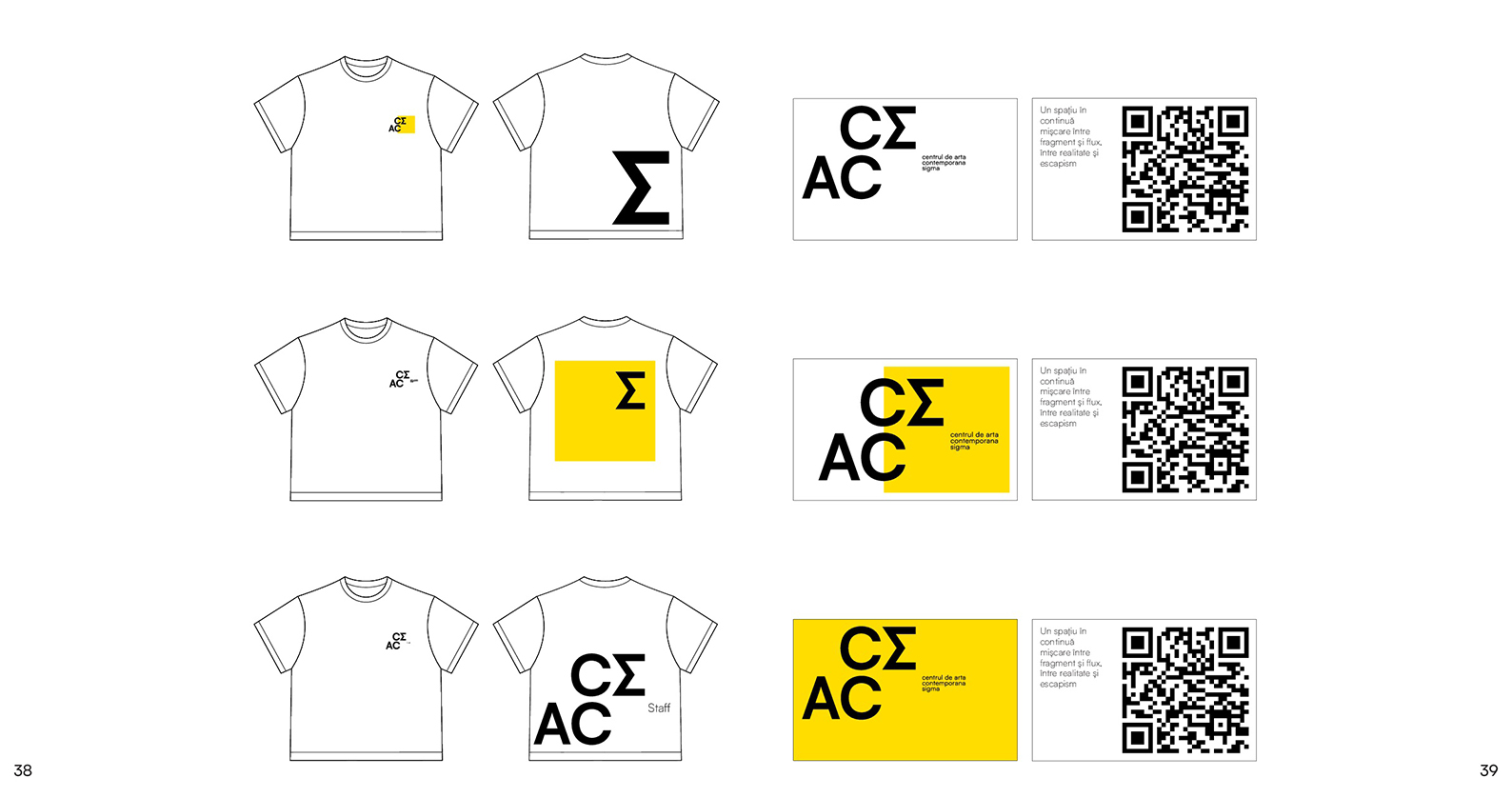
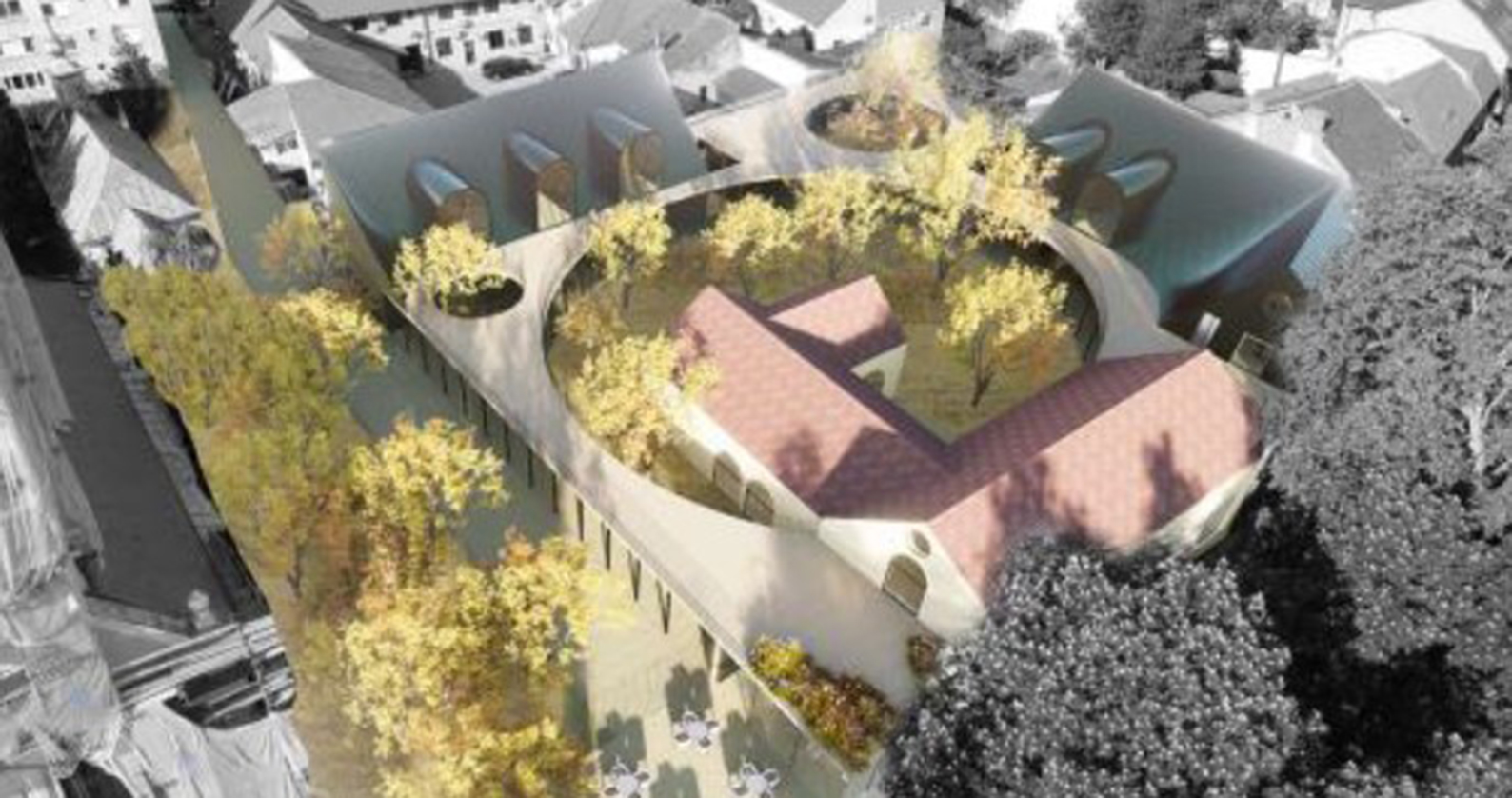
RO: Exercițiul dezvoltat de generația 2024–2025 a avut ca obiect realizarea unui portofoliu de identitate și branding pentru programul arhitectural studiat în cadrul atelierului de proiectare 6: un centru cultural pe malul canalului Bega.
Conceput ca parte a activităților de seminar, portofoliul este dezvoltat în trei etape principale. Prima etapă este dedicată definirii valorilor fundamentale ale proiectului printr-o serie de cinci imagini evocatoare, menite să comunice temele centrale ale conceptului arhitectural fără a recurge la reprezentări arhitecturale directe. Scopul este de a distila atmosfera conceptuală și narațiunea proiectului într-un limbaj vizual care precede imaginea arhitecturală propriu-zisă.
A doua etapă continuă această explorare prin transpunerea valorilor identificate într-o identitate verbală și grafică. Studenții definesc un nume al proiectului (brand) și dezvoltă un logo sau logotip, parcurgând un proces care include atât exerciții de type design, cât și de typesetting.
În a treia etapă, studenții construiesc structura și layout-ul general al portofoliului, testând în același timp sistemul de identitate vizuală printr-o serie de aplicații grafice. Acestea includ postere, bannere pentru social media, elemente de merchandising și inserții în spațiu, permițând explorarea identității ca sistem coerent de comunicare la nivelul diferitelor medii și scări de reprezentare.
EN: The exercise developed by the 2024–2025 cohort focused on the creation of a branding and identity portfolio for the architectural program studied within the Architectural Design Studio 6: a cultural center on the banks of the Bega Channel.
Conceived as part of the seminar activities, the portfolio is developed through three main stages. The first stage is dedicated to the definition of the project’s core values through a series of five evocative images intended to communicate the central themes of the architectural concept without relying on direct architectural representations. The aim is to distill the conceptual atmosphere and narrative of the project into a visual language that precedes the architectural image itself.
The second stage continues this exploration by translating the identified values into a verbal and graphic identity. Students define a project name (brand) and develop a logo or logotype, engaging in a process that includes both type design and typesetting.
In the third stage, students construct the overall structure and layout of the portfolio, while also testing the visual identity system across multiple graphic applications. These include posters, social media banners, merchandising elements, and spatial insertions, allowing the identity to be explored as a coherent communication system across different media and scales.
2025 | PROIECTARE 4 | A02
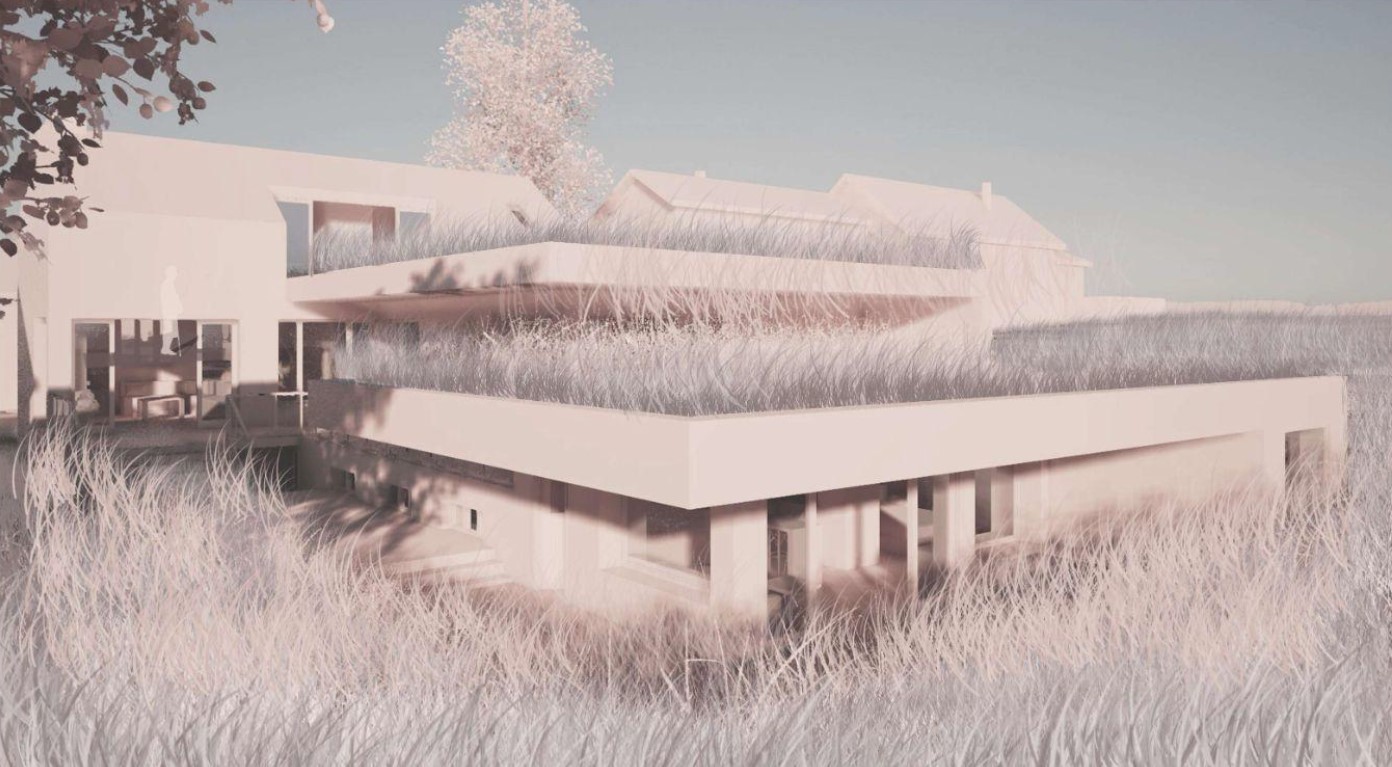
RO: Tema de proiectare propune realizarea unui ansamblu de locuire de urgență administrat de Biserică, amplasat într-un context urban istoric valoros din Oradea, pe malul drept al râului Crișul Repede, în zona Olosig, în cadrul extins al complexului Patriarhiei Reformate Olosig. Proiectul urmărește integrarea unei intervenții contemporane într-un sit caracterizat de prezența unor clădiri cu valoare arhitecturală, de relația directă cu țesutul istoric și de proximitatea unui important coridor verde format de parc și riveran.
Conform scenariului, Biserica investește într-o formă de locuire de urgență, destinată unor categorii defavorizate — studenți, familii și persoane vârstnice — oferită pe o perioadă de până la doi ani, la un cost minim. În acest sens, proiectul propune nu doar unități de locuire de diferite dimensiuni, ci și spații comune pentru rezidenți, alături de funcțiuni publice complementare, precum o cafenea deschisă comunității. Organizarea funcțională și volumetrică trebuie să răspundă atât nevoilor individuale ale locatarilor, cât și necesității de a crea un cadru colectiv coerent, favorabil interacțiunii și sprijinului reciproc.
Intervenția presupune o abordare atentă față de contextul construit și natural, precum și față de dimensiunea socială și comunitară a programului. Astfel, proiectul investighează echilibrul dintre integrarea în țesutul urban existent, valorificarea relației cu spațiul verde și exprimarea unei arhitecturi contemporane.
EN: The design brief proposes the development of an emergency housing complex managed by the Church, located within a valuable historic urban context in Oradea, on the right bank of the Crișul Repede River, in the Olosig area, as part of the extended precinct of the Olosig Reformed Patriarchy complex. The project aims to integrate a contemporary architectural intervention into a site characterized by the presence of buildings with architectural value, a direct relationship with the historic urban fabric, and the proximity of an important green corridor formed by the park and the riverbank.
According to the scenario, the Church invests in a form of emergency housing intended for disadvantaged groups — students, families, and elderly people — offered for a period of up to two years at a minimal cost. In this context, the project proposes not only housing units of various sizes, but also shared spaces for residents, along with complementary public functions such as a café open to the community. The functional and volumetric organization must respond both to the individual needs of the inhabitants and to the necessity of creating a coherent collective environment that encourages interaction and mutual support.
The intervention requires a sensitive approach towards the built and natural context, as well as towards the social and community dimension of the program. Thus, the project investigates the balance between integration into the existing urban fabric, the enhancement of the relationship with green spaces, and the expression of a contemporary architectural language.
2025 | PROIECTARE 3 | A02
RO: Tema generală a anului II este locuirea, abordată în cadrul primului semestru prin exerciții de proiectare care urmăresc înțelegerea relației dintre spațiul, utilizator și context. Studiul investighează modul în care arhitectura poate configura cadre de viață coerente și adaptabile, în care dimensiunea funcțională se îmbină cu cea perceptiv-emoțională, iar organizarea spațială devine suport al intimității, al interacțiunii și al aproprierii mediului construit.
Demersul proiectual pune accent pe explorarea calităților fizice ale spațiului — proporții, geometrie, lumină, materialitate — precum și pe gestionarea relațiilor dintre diferitele grade de privat, semiprivat și public. În același timp, este urmărită integrarea intervențiilor în contextul natural și construit, valorificând specificul sitului și potențialul acestuia.
EN: The general theme of the second year is dwelling, addressed during the first semester through design exercises that aim to understand the relationship between domestic space, the user, and context. The study investigates how architecture can shape coherent and adaptable living environments in which the functional dimension is intertwined with the perceptual-emotional one, and spatial organization becomes a support for intimacy, interaction, and the appropriation of the built environment.
The design approach emphasizes the exploration of the physical qualities of space — proportions, geometry, light, and materiality — as well as the management of relationships between different degrees of privacy: private, semi-private, and public. At the same time, the integration of architectural interventions within both the natural and built context is pursued, by valuing the specificity of the site and its potential.
RO: Prima temă este structurată în două componente de studiu care converg, în final, într-o lucrare comună. Prima componentă, dedicată locului personal, investighează spațiul domestic ca o configurație în care dimensiunea funcțională și cea perceptiv-emoțională se suprapun, generând un cadru esențial al locuirii. Calitățile fizice ale spațiului — proporțiile, geometria, materialitatea sau lumina — împreună cu cele funcționale sunt concentrate într-un volum restrâns, definind esența intimității și a aproprierii spațiale. Astfel, locul este înțeles ca o expresie a identității locuitorului și ca o narațiune personală construită prin utilizare și percepție. A doua componentă dezvoltă această premisă prin proiectarea unei locuințe înșiruite pentru un cuplu, integrată într-un sistem rezidențial coerent. Organizarea spațială urmărește gestionarea eficientă a tranzițiilor dintre spațiile private, semiprivate și publice, precum și valorificarea relației cu exteriorul prin intermediul curții sau al terasei. În acest context, locuirea este definită de echilibrul dintre individualitate și coerența ansamblului construit, dintre necesitatea intimității și dinamica colectivă a habitatului.
EN: The first project is structured into two study components that ultimately converge into a common final proposal. The first component, focused on the personal place, investigates domestic space as a configuration in which the functional and the perceptual-emotional dimensions overlap, generating an essential framework for dwelling. The physical qualities of space — proportions, geometry, materiality, and light — together with functional aspects, are concentrated within a reduced volume, defining the essence of intimacy and spatial appropriation. Thus, the place is understood as an expression of the inhabitant’s identity and as a personal narrative shaped through use and perception.
The second component develops this premise through the design of a terraced house for a couple, integrated within a coherent residential system. Spatial organization aims to efficiently manage the transitions between private, semi-private, and public spaces, while also enhancing the relationship with the exterior through the courtyard or terrace. In this context, dwelling is defined by the balance between individuality and the coherence of the built ensemble, between the need for intimacy and the collective dynamics of the habitat.
RO: Cea de-a doua temă a semestrului propune reinterpretarea locuirii temporare în mediul rural, prin configurarea unui spațiu adaptabil nevoilor dinamice ale unei familii extinse, organizate pe două generații. Demersul proiectual urmărește valorificarea specificului sitului — dimensiunea parcelei, cadrul natural și relația cu țesutul existent — ca premise pentru definirea unei soluții arhitecturale coerente și integrate. Distribuția funcțională, poziționarea volumetrică și expresia formală reflectă atât scenariile de utilizare individuală, cât și pe cele colective. Intervenția presupune, totodată, înțelegerea și reinterpretarea caracteristicilor contextului construit și natural, precum și explorarea potențialului acestuia de a susține forme flexibile și evolutive de locuire.
EN: The second project of the semester proposes a reinterpretation of temporary dwelling in the rural environment by configuring a space adaptable to the dynamic needs of an extended family organized across two generations. The design approach aims to capitalize on the specificity of the site — the plot dimensions, the natural setting, and the relationship with the existing built fabric — as key premises for defining a coherent and integrated architectural solution. Functional distribution, volumetric positioning, and formal expression are conceived to reflect both individual and collective patterns of use.
At the same time, the intervention involves understanding and reinterpreting the characteristics of the natural and built context, while exploring its potential to support flexible and evolving forms of dwelling.
2024 | DIPLOMA | YEAR VI
The completion of studies at the Faculty of Architecture and Urbanism within Universitatea Politehnica Timișoara is achieved through a diploma examination structured into two complementary components, theoretical and applied in nature.
Part I consists of the defense of a theoretical dissertation and a preliminary research study (pre-diploma), which establishes the conceptual foundation of the final project. The dissertation is developed within one of three academic units:
Complex Architecture
Heritage Development and Reuse
Urban Planning
Part II involves the public defense of the diploma project, presented through written and graphic documentation demonstrating the candidate’s ability to integrate and apply theoretical knowledge in the coherent resolution of an architectural or urban issue.
The topic may be selected from those proposed within the thematic unit or formulated by the candidate in consultation with the academic supervisor.
The final assessment considers the rigor of the research process, theoretical grounding, conceptual coherence, interdisciplinary dimension, and the overall architectural quality of the proposed solution.
For the full texts please click on the pages of the brochure below.
Complex Architecture
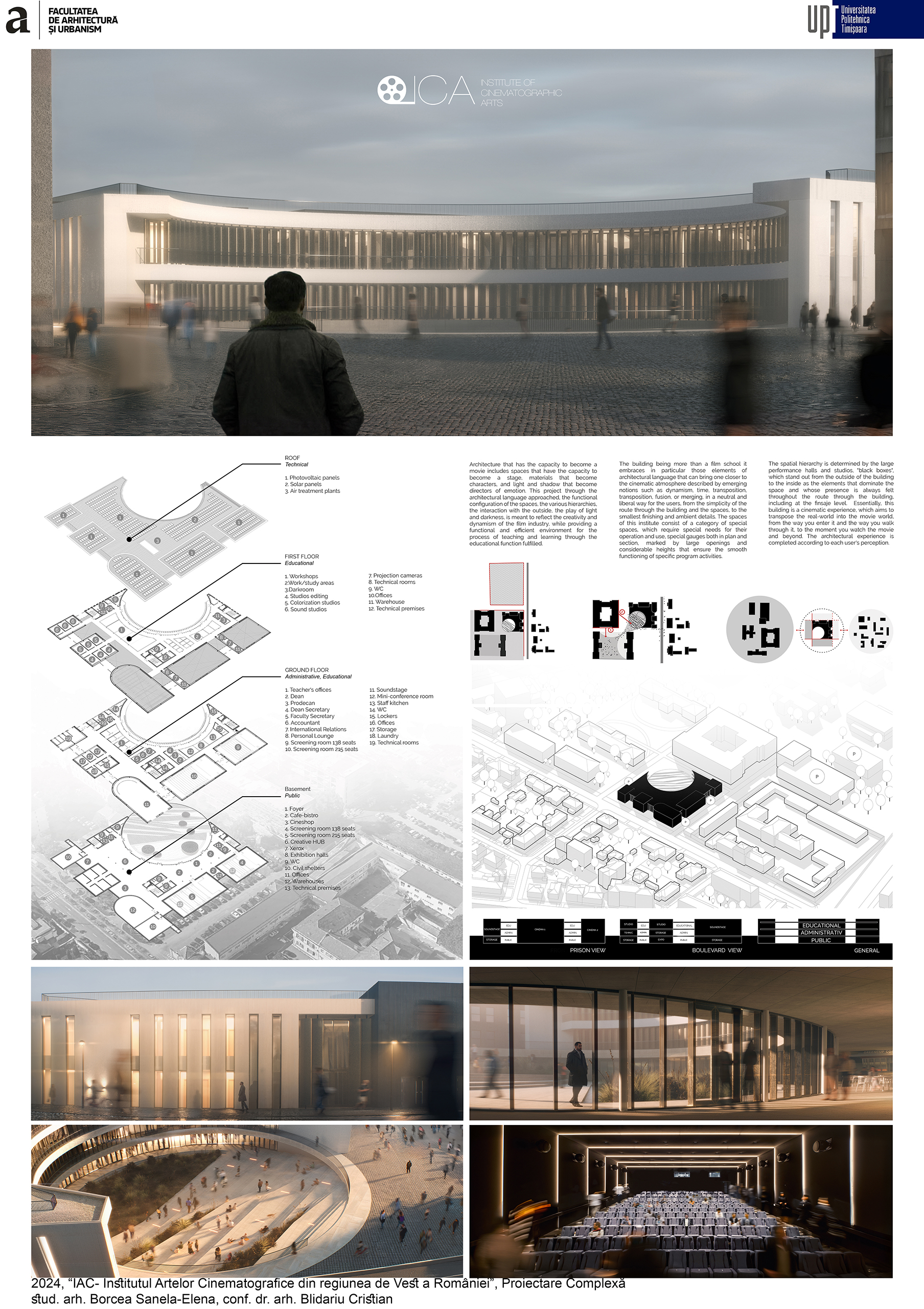
Student: Borcea Sanela
Coordinating Professor: Conf.dr.arh. Cristian Blidariu
Architecture that has the capacity to become a movie includes spaces that have the capacity to become a stage, materials that become characters, and light and shadow that become directors of emotion. This project through the architectural language approached, the functional configuration of the spaces, the various hierarchies, the interaction with the outside, the play of light and darkness, is meant to reflect the creativity and dynamism of the film industry, while providing a functional and efficient environment for the process of teaching and learning through the educational function fulfilled.
The building being more than a film school, it embraces in particular those elements of architectural language that can bring one closer to the cinematic atmosphere described by emerging notions such as dynamism, time, transposition, transposition, fusion, or merging, in a natural and liberal way for the users, from the simplicity of the route through the building and the spaces, to the smallest finishing and ambient details. The spaces of this institute consist of a category of special spaces, which require special needs for their operation and use, special gauges both in plan and section, marked by large openings and considerable heights that ensure the smooth functioning of specific program activities.
The spatial hierarchy is determined by the large performance halls and studios, “black boxes”, which stand out from the outside of the building to the inside as the elements that dominate the space and whose presence is always felt throughout the route through the building, including at the finale level. Essentially, this building is a cinematic experience, which aims to transpose the real-world into the movie world, from the way you enter it and the way you walk through it, to the moment you watch the movie and beyond. The architectural experience is completed according to each user’s perception.
Student: Lazari Ludmila
Coordinating Professor: Arh. Marius Miclăuș
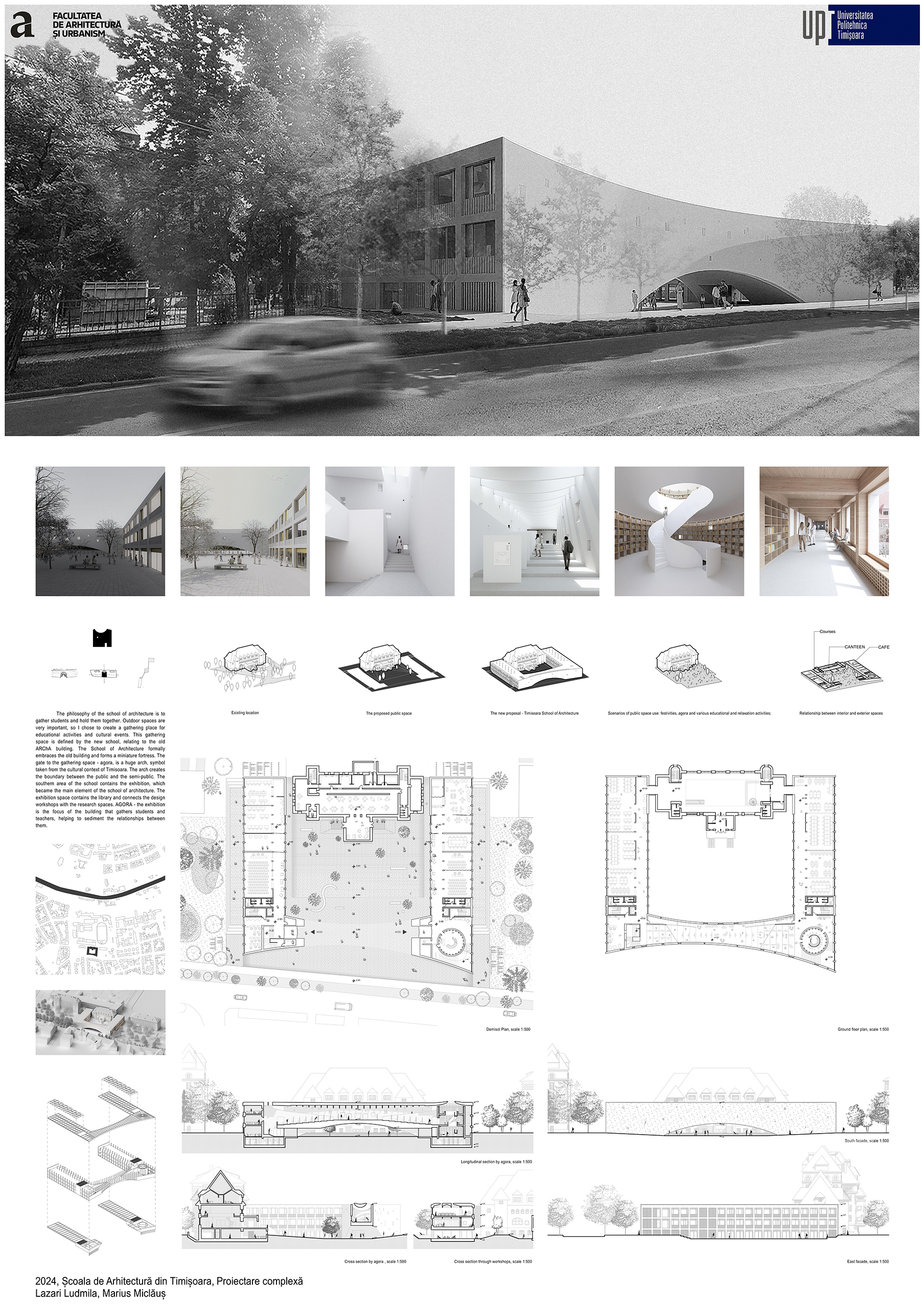
The philosophy of the school of architecture is to gather students and hold them together. Outdoor spaces are very important, so I chose to create a gathering place for educational activities and cultural events. This gathering space is defined by the new school, relating to the old ARChA building. The School of Architecture formally embraces the old building and forms a miniature fortress. The gate to the gathering space – agora, is a huge arch, symbol taken from the cultural context of Timisoara. The arch creates the boundary between the public and the semi-public. The southern area of the school contains the exhibition, which became the main element of the school of architecture. The exhibition space contains the library and connects the design workshops with the research spaces. AGORA – the exhibition is the focus of the building that gathers students and teachers, helping to sediment the relationships between them.
Student: Penișoară Diana
Coordinating Professor: Conf.dr.arh. Cătălina Bocan
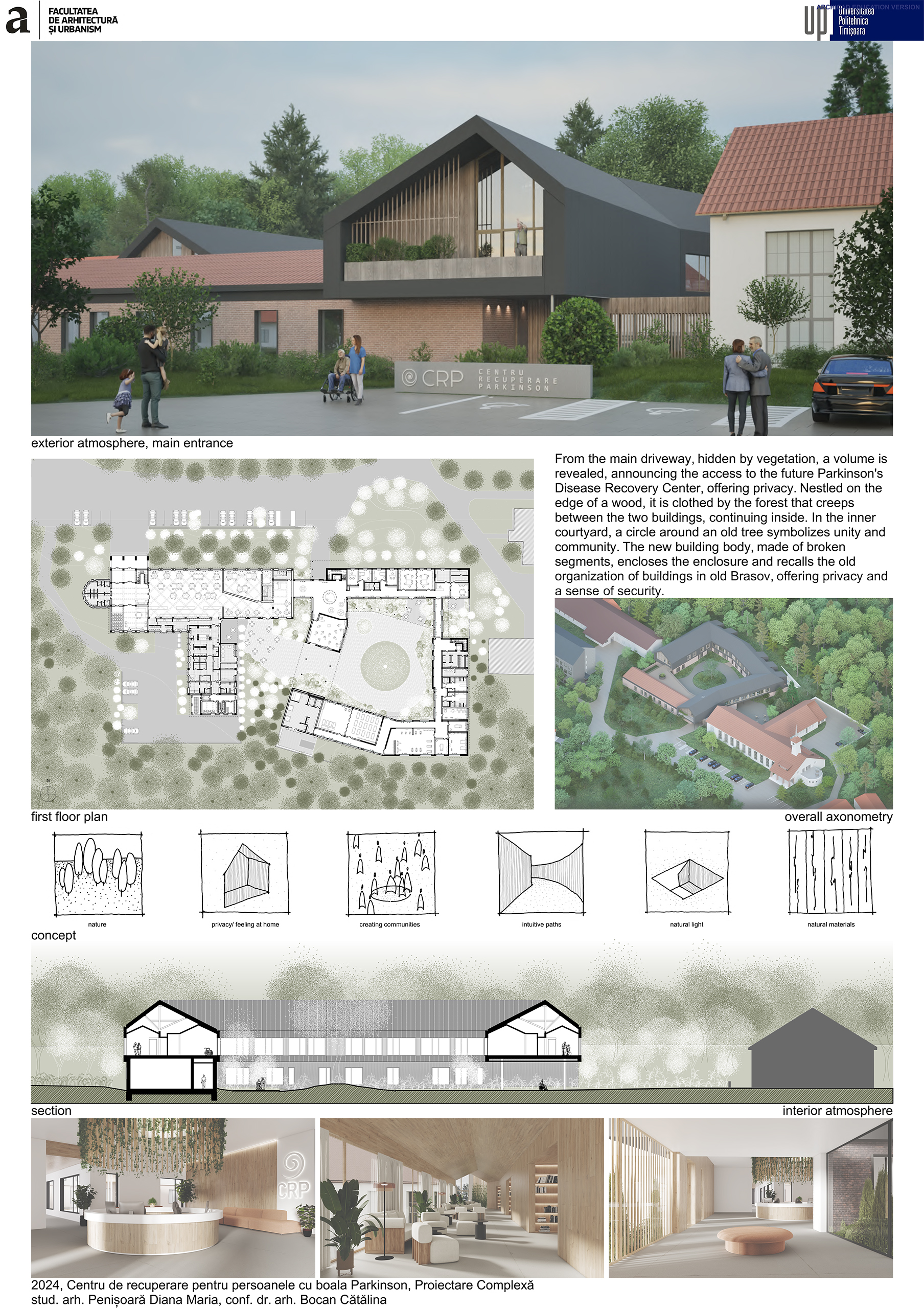
From the main driveway, hidden by vegetation, a volume is revealed, announcing the access to the future Parkinson’s Disease Recovery Center, offering privacy. Nestled on the edge of a wood, it is clothed by the forest that creeps between the two buildings, continuing inside. In the inner courtyard, a circle around an old tree symbolizes unity and community. The new building body, made of broken segments, encloses the enclosure and recalls the old organization of buildings in old Brasov, offering privacy and a sense of security.
Student: Sîrb Corneliu
Coordinating Professor: S.l.dr.arh Daniela Negrișanu
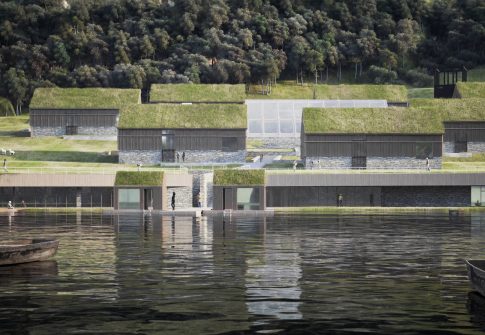
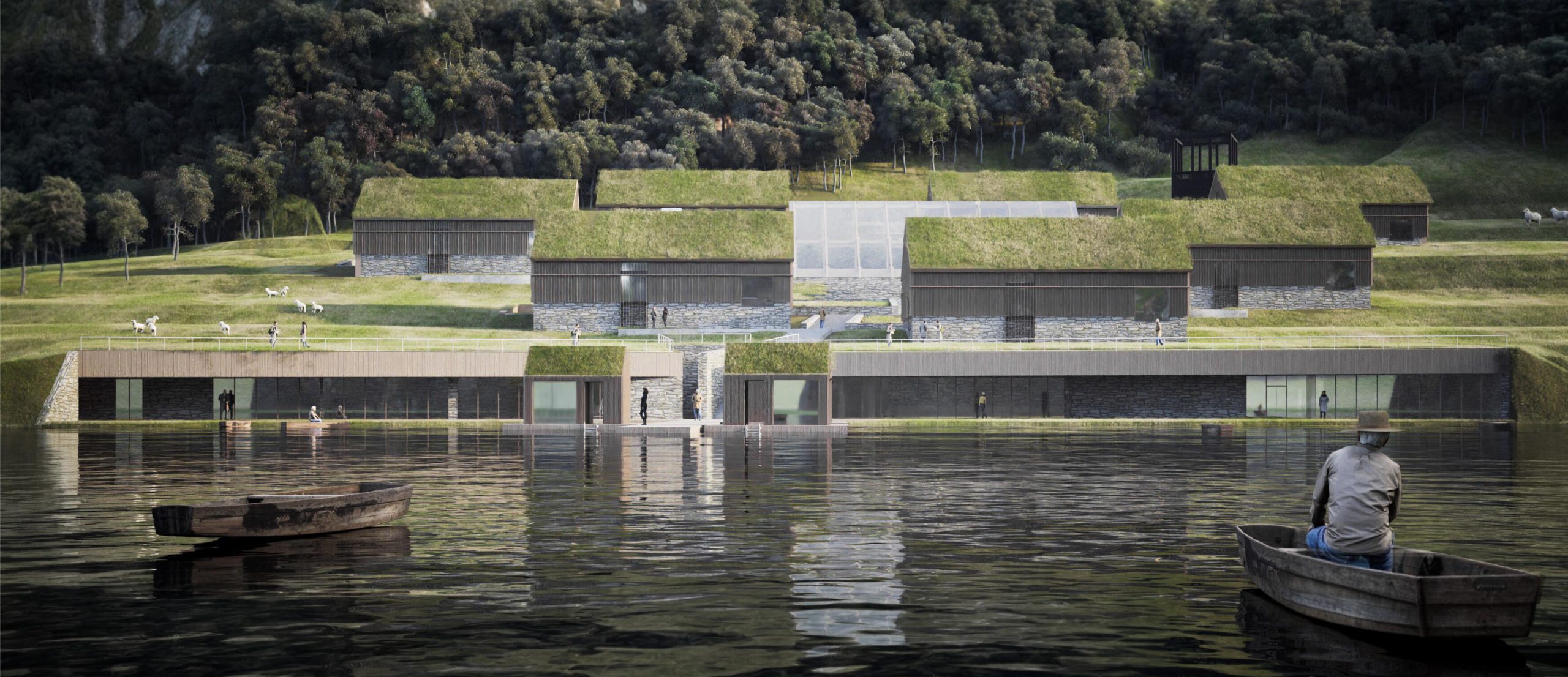
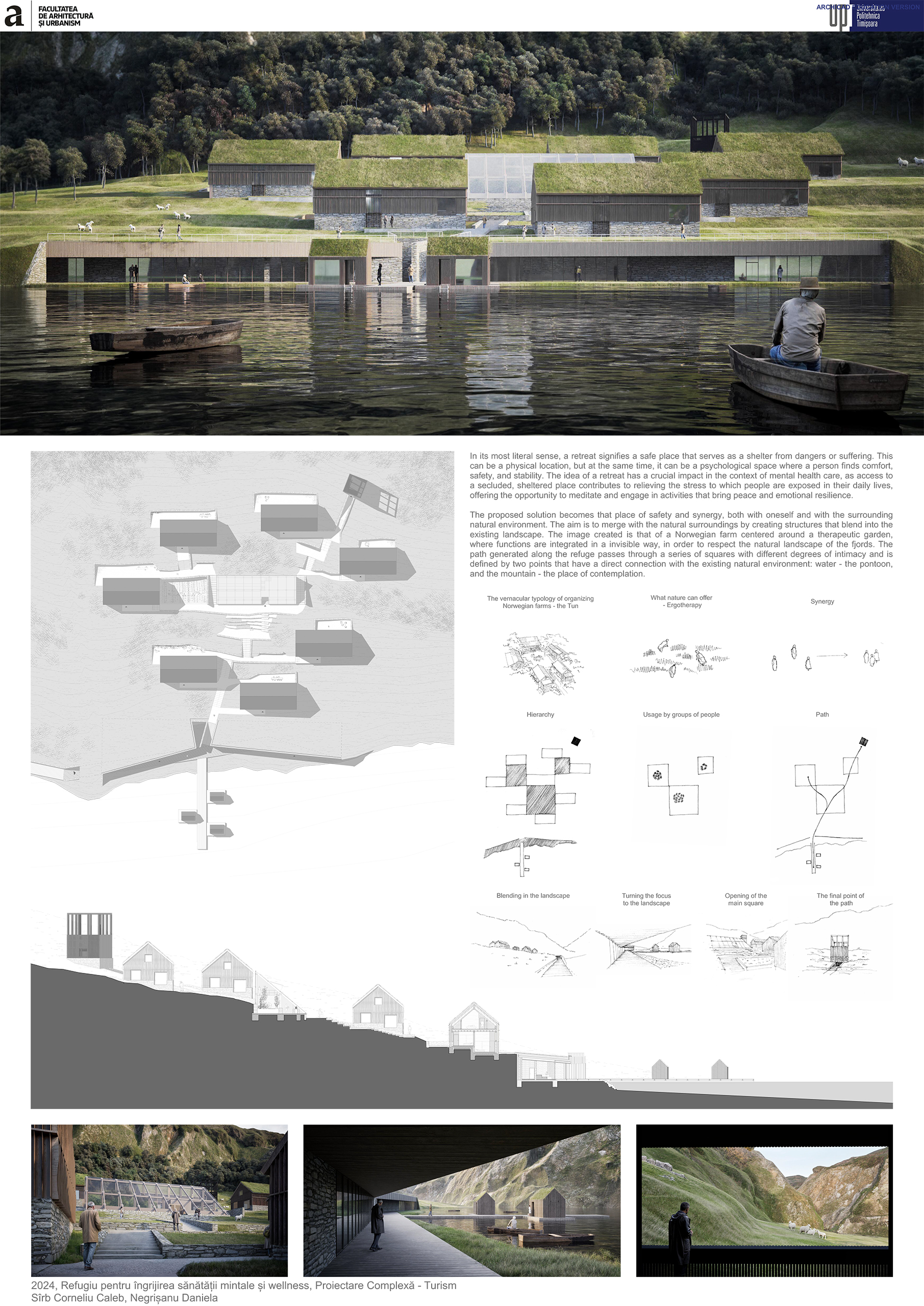
In its most literal sense, a retreat signifies a safe place that serves as a shelter from dangers or suffering. This can be a physical location, but at the same time, it can be a psychological space where a person finds comfort, safety, and stability. The idea of a retreat has a crucial impact in the context of mental health care, as access to a secluded, sheltered place contributes to relieving the stress to which people are exposed in their daily lives, offering the opportunity to meditate and engage in activities that bring peace and emotional resilience.
The proposed solution becomes that place of safety and synergy, both with oneself and with the surrounding natural environment. The aim is to merge with the natural surroundings by creating structures that blend into the existing landscape. The image created is that of a Norwegian farm centered around a therapeutic garden, where functions are integrated in an invisible way, in order to respect the natural landscape of the fjords. The path generated along the refuge passes through a series of squares with different degrees of intimacy and is defined by two points that have a direct connection with the existing natural environment: water – the pontoon, and the mountain – the place of contemplation.
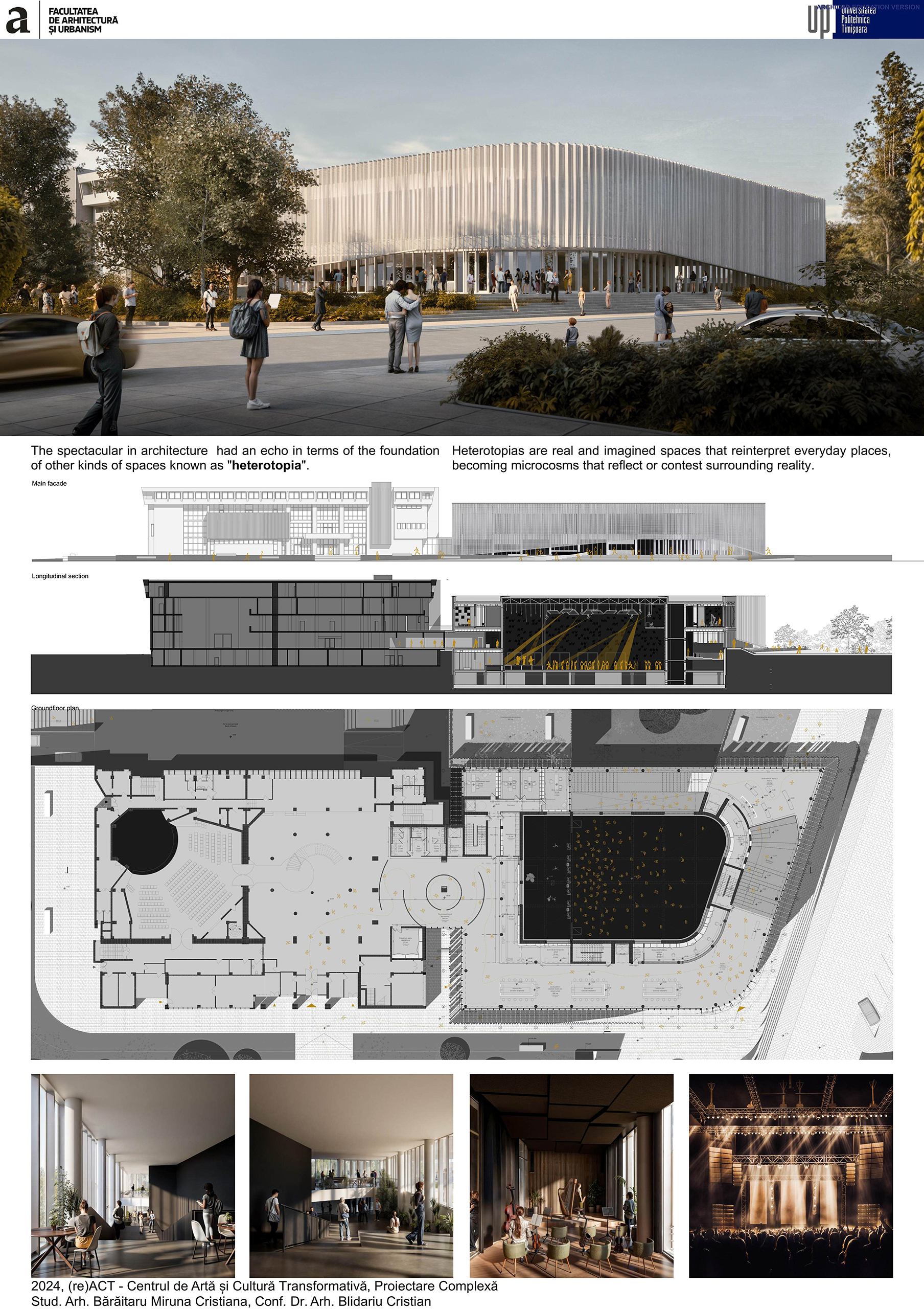
Student: Bărăitaru Miruna
Coordinating Professor: Conf.dr.arh. Cristian Blidariu
The purpose of this paper is to bring to the fore the hypothesis through which theories can take a form as close as possible to the concrete, based on foundations that—starting from the identification of socio-cultural problems—have metamorphosed into goals and ambitions, culminating, as will emerge from this approach following the pre-diploma phase, in their transposition into an architectural response. By developing and implementing the discussions initiated within the pre-diploma framework, we arrived at the definition of a complex functional theme that explores promising directions for the development of a Transformative Art and Culture Center in Timișoara.
In order to reach the foundation of this essential result, spatial requirements were carefully considered, approached in parallel with the needs of users and the expectations of beneficiaries, as well as the technical requirements that allowed the ideas to take on a significant material form.
Finally, the sought-after spectacular framework is highlighted, considered the most appropriate and suggestive for the stated design theme, while also encouraging the imaginative spirit to extend beyond the limits of the predictable.
Student: Ardelean Alexandru
Coordinating Professor: S.l.dr.arh Daniela Negrișanu
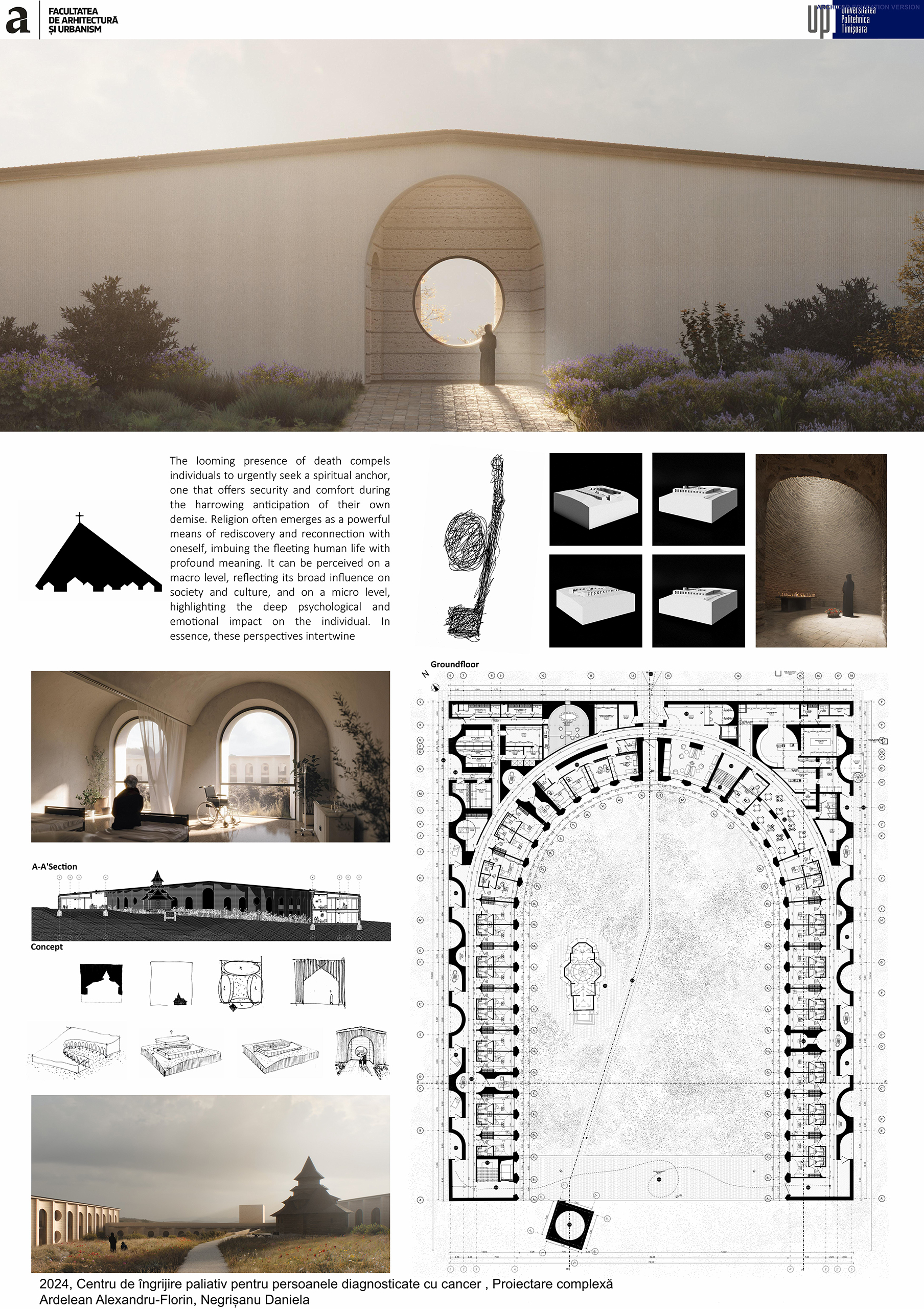
For those nearing the moment of death, religion becomes a spiritual lever through which they find comfort and refuge. Through religion, these patients seek a reconnection with the self, which can become a generator of meaning for the transience of human existence. Thus, religion is an essential element in the healing—or at least the alleviation—of terminally ill patients. The architecture of such a center must be one of protection, born from the patients’ primary needs. Beyond resolving the functional component, architecture must be attentive to the emotions of those who experience it.
The threshold, as a spatial tool, succeeds in creating the transition between two worlds: the exterior one, of possibilities, and the interior one, of care and the feeling of home. Each room is conceived as a microcosm in which the patient can withdraw and contemplate in peace and intimacy. The relationship with nature is strong through large glazed surfaces, precisely because of the patients’ need to remain constantly connected to light, to the sun, and to vegetation—elements that have proven to be as important as medication in their treatment. This relationship is, however, controlled, offering views only toward a garden that provides psychological safety.
The route is the key to the project, with gradual transitions from public to private, and the spatial experience transforms the project into one defined by movement and progression.
In conclusion, the construction of a palliative care center becomes an act of profound humanity, where architecture is not only a physical space but also a spiritual refuge. This sanctuary of comfort reflects the impermanence of human existence and the search for deeper meaning in the face of mortality. Through the careful integration of patients’ emotional and spiritual needs, the space becomes a manifestation of care and compassion, offering protection and reconnection with the self. Thus, architecture rises to the level of a philosophy of life and death, emphasizing the importance of human connection and the bond with nature in the most vulnerable moments of existence.
Heritage Development and Reuse
Student: Németh Barbara
Coordinating Professor: Conf.dr.arh. Bogdan Demetrescu
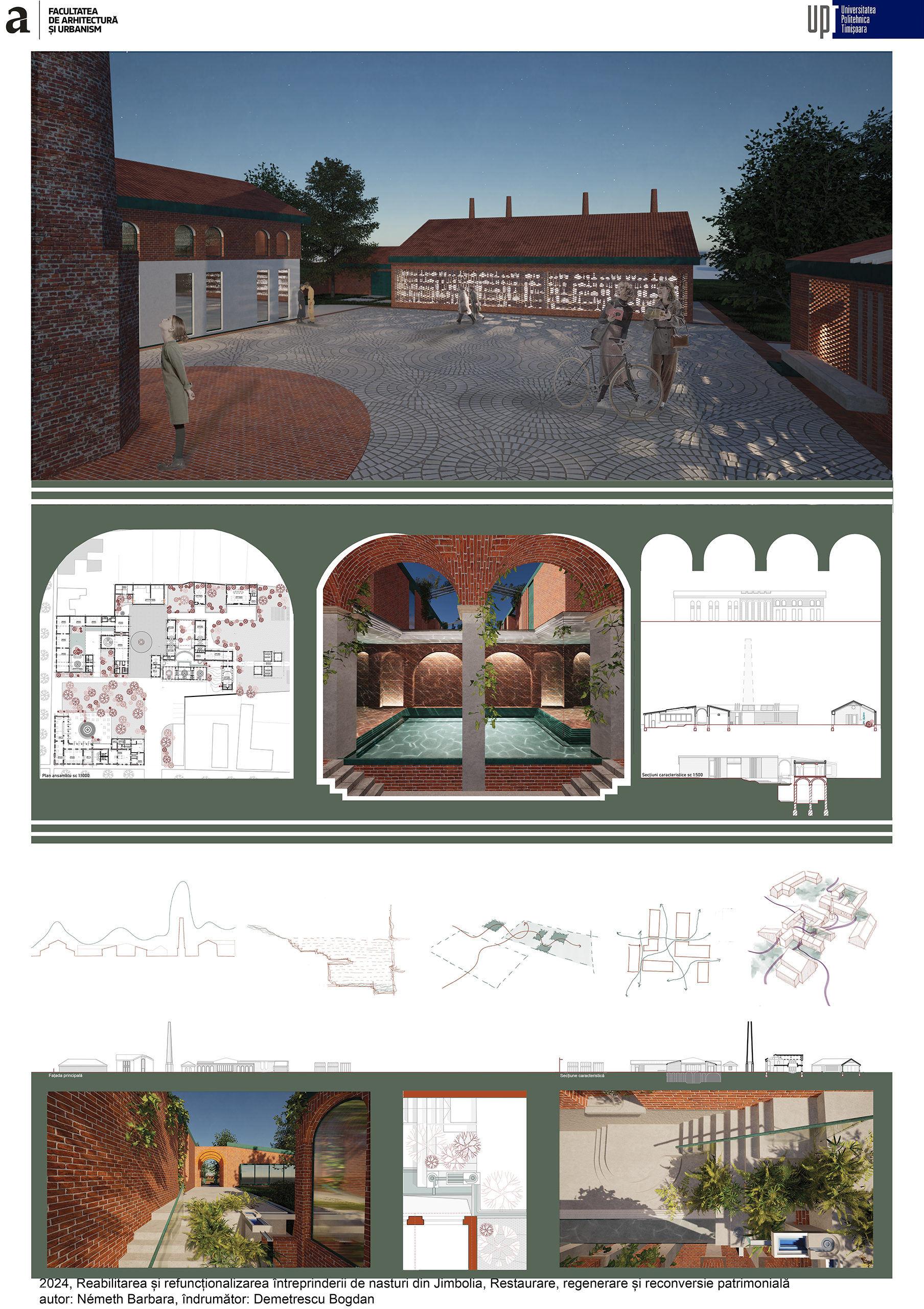
The adaptive reuse project of the Button and Comb Factory in Jimbolia stands out through its approach, which combines respect for historical heritage with the contemporary needs of the community. A detailed study of the city’s historical evolution highlighted the importance of this structure not only as a remnant of the industrial past, but also as a potential catalyst for Jimbolia’s economic and cultural regeneration. Transforming the factory into a multifunctional center dedicated to traditional crafts successfully creates a bridge between past and present, offering new opportunities for residents.
The conversion of the factory into a hub for artisanal workshops and cultural spaces directly addresses the need to revitalize the craft traditions that once defined the local identity before industrialization. This project not only provides a space for preserving and promoting these traditions, but also stimulates local economic development by attracting tourists and supporting local craftsmen.
The proposed architectural intervention respects and enhances the historical characteristics of the site. Preserving essential elements, such as the chimney, and integrating them into the new function of the space reflects a careful balance between conservation and modernization. Through this project, the factory not only regains its importance in the urban landscape, but also becomes a symbol of regeneration and innovation.
An essential aspect of the project is the active involvement of the community in the rehabilitation process. Organizing open workshops, events, and educational programs will strengthen the sense of local belonging. Furthermore, the use of sustainable materials and the integration of modern technologies for energy efficiency ensure that the new center will be environmentally friendly and adapted to contemporary requirements.
The functional reconversion of the Button and Comb Factory in Jimbolia represents not only a physical transformation of a building, but also a revival of the community and craft spirit. By preserving historical elements and integrating them into a modern context, the project contributes to the creation of a strong local identity and the promotion of cultural sustainability. Ultimately, this initiative not only reaffirms Jimbolia as an important cultural and economic center, but also paves the way for new forms of urban development that respect and capitalize on existing heritage.
Student: Sarca Daria
Coordinating Professor: Conf.dr.arh. Andrei Racolța
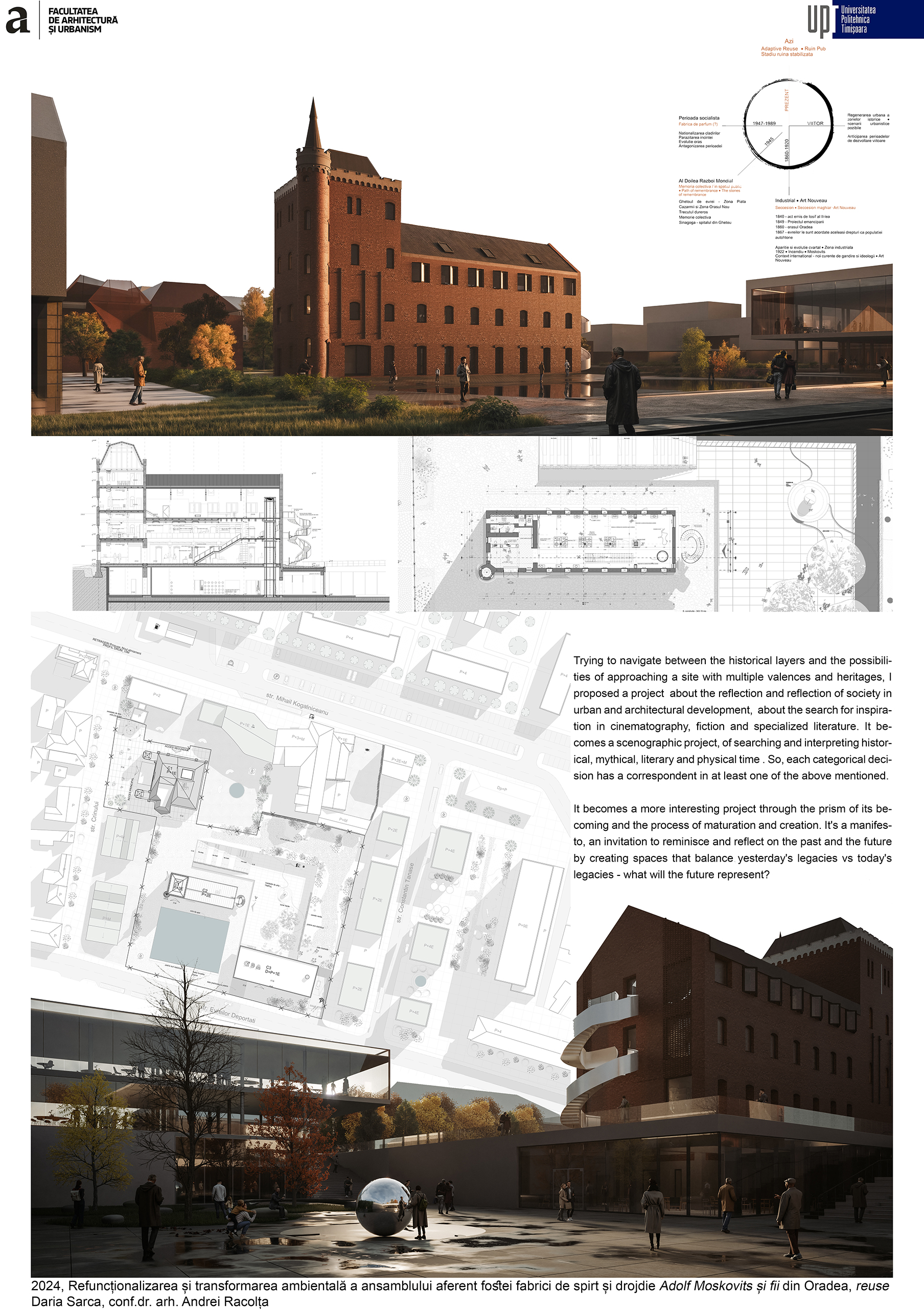
Trying to navigate between the historical layers and the possibilities of approaching a site with multiple valences and heritages, I proposed a project about the reflection and reflection of society in urban and architectural development, about the search for inspiration in cinematography, fiction and specialized literature. It becomes a scenographic project, of searching and interpreting historical, mythical, literary and physical time. So, each categorical decision has a correspondent in at least one of the above mentioned.
It becomes a more interesting project through the prism of its becoming and the process of maturation and creation. It’s a manifesto, an invitation to reminisce and reflect on the past and the future by creating spaces that balance yesterday’s legacies vs today’s legacies – what will the future represent?
Urban Planning
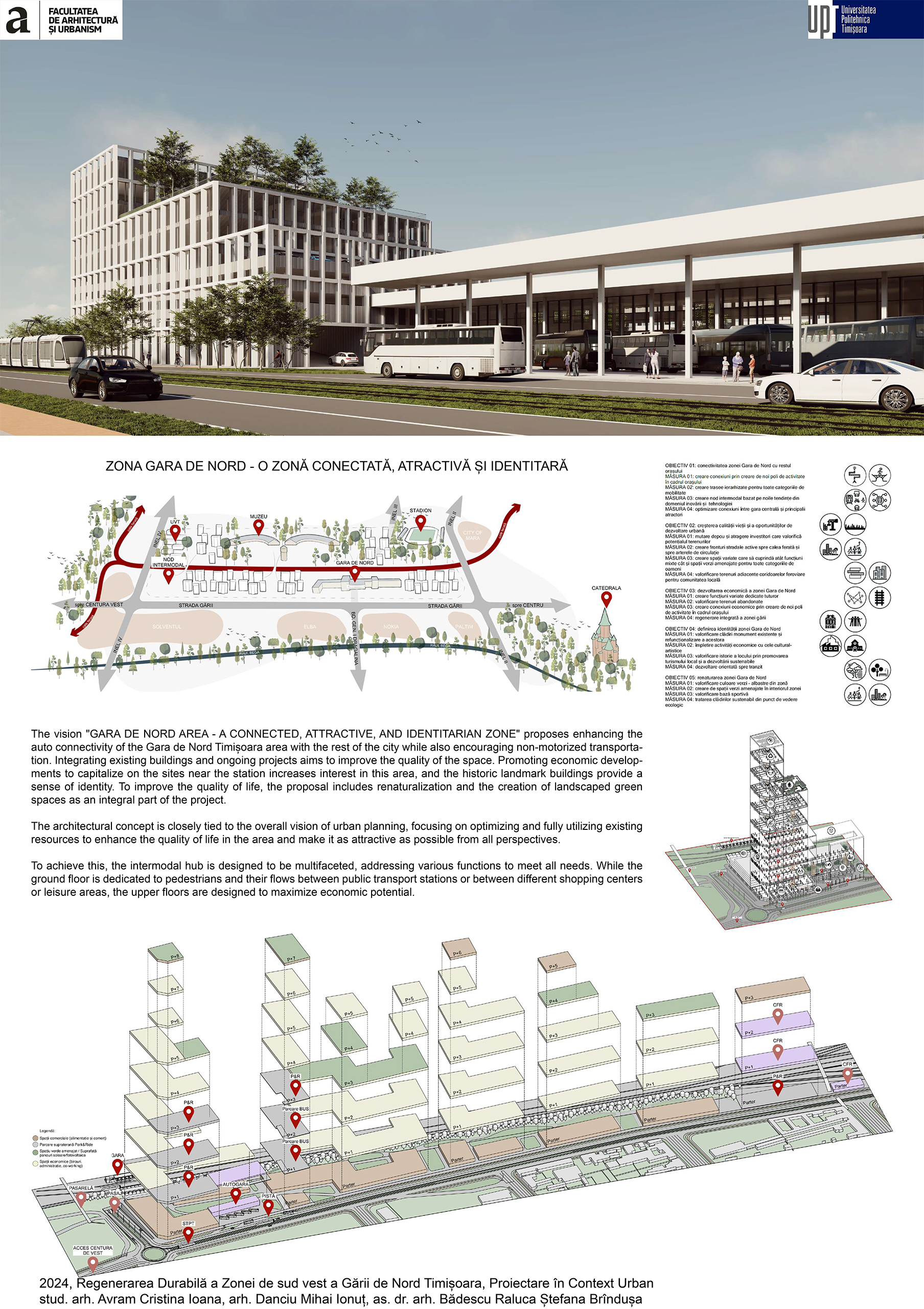
Student: Avram Cristina
Coordinating Professors: Asist.dr.arh. Ștefana Bădescu, Arh. Mihai Danciu
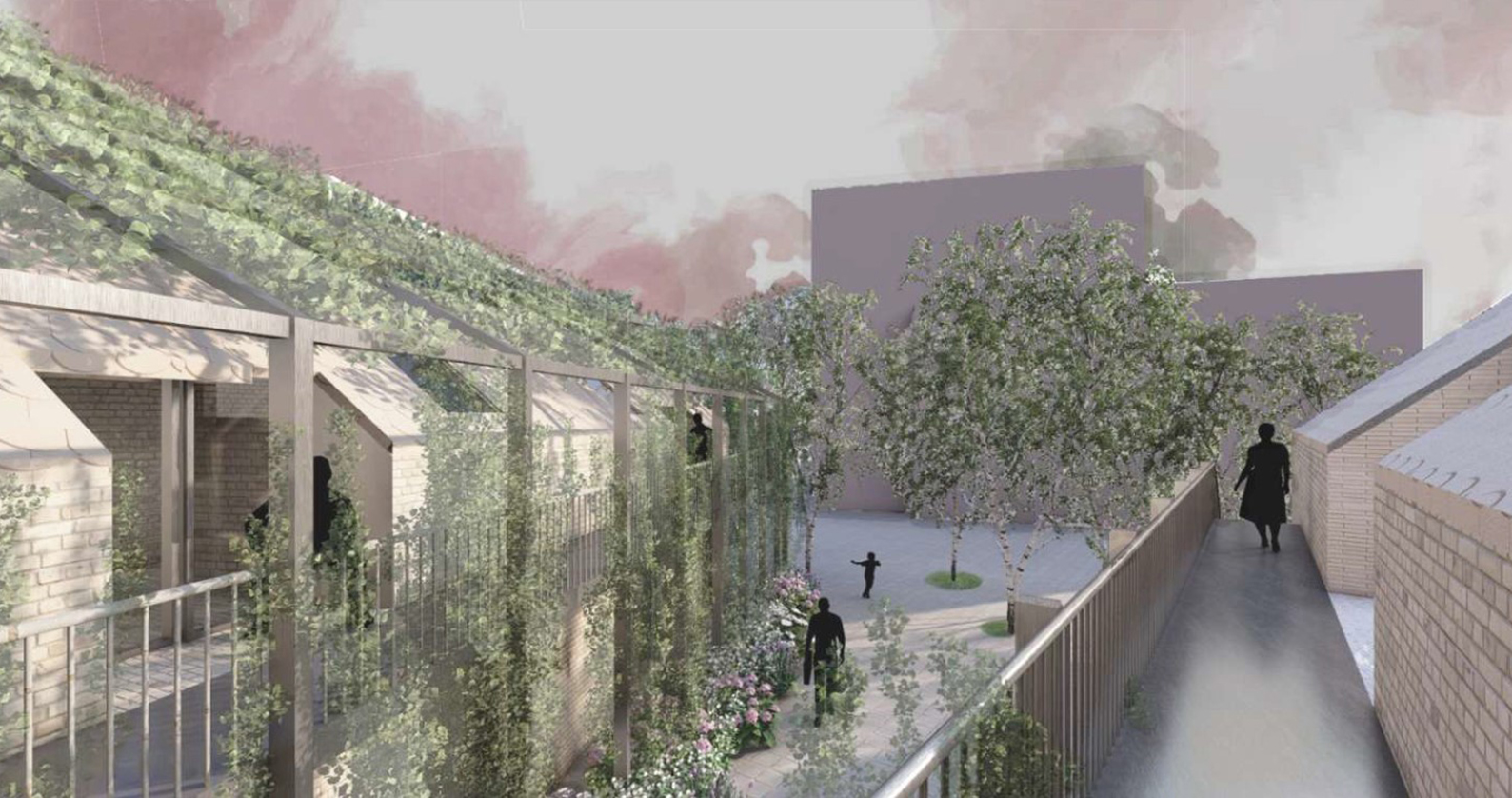
The vision “GARA DE NORD AREA – A CONNECTED, ATTRACTIVE, AND IDENTITARIAN ZONE” proposes enhancing the auto connectivity of the Gara de Nord Timișoara area with the rest of the city while also encouraging non-motorized transportation. Integrating existing buildings and ongoing projects aims to improve the quality of the space. Promoting economic developments to capitalize on the sites near the station increases interest in this area, and the historic landmark buildings provide a sense of identity. To improve the quality of life, the proposal includes renaturalization and the creation of landscaped green spaces as an integral part of the project.
The architectural concept is closely tied to the overall vision of urban planning, focusing on optimizing and fully utilizing existing resources to enhance the quality of life in the area and make it as attractive as possible from all perspectives.
To achieve this, the intermodal hub is designed to be multifaceted, addressing various functions to meet all needs. While the ground floor is dedicated to pedestrians and their flows between public transport stations or between different shopping centers or leisure areas, the upper floors are designed to maximize economic potential.
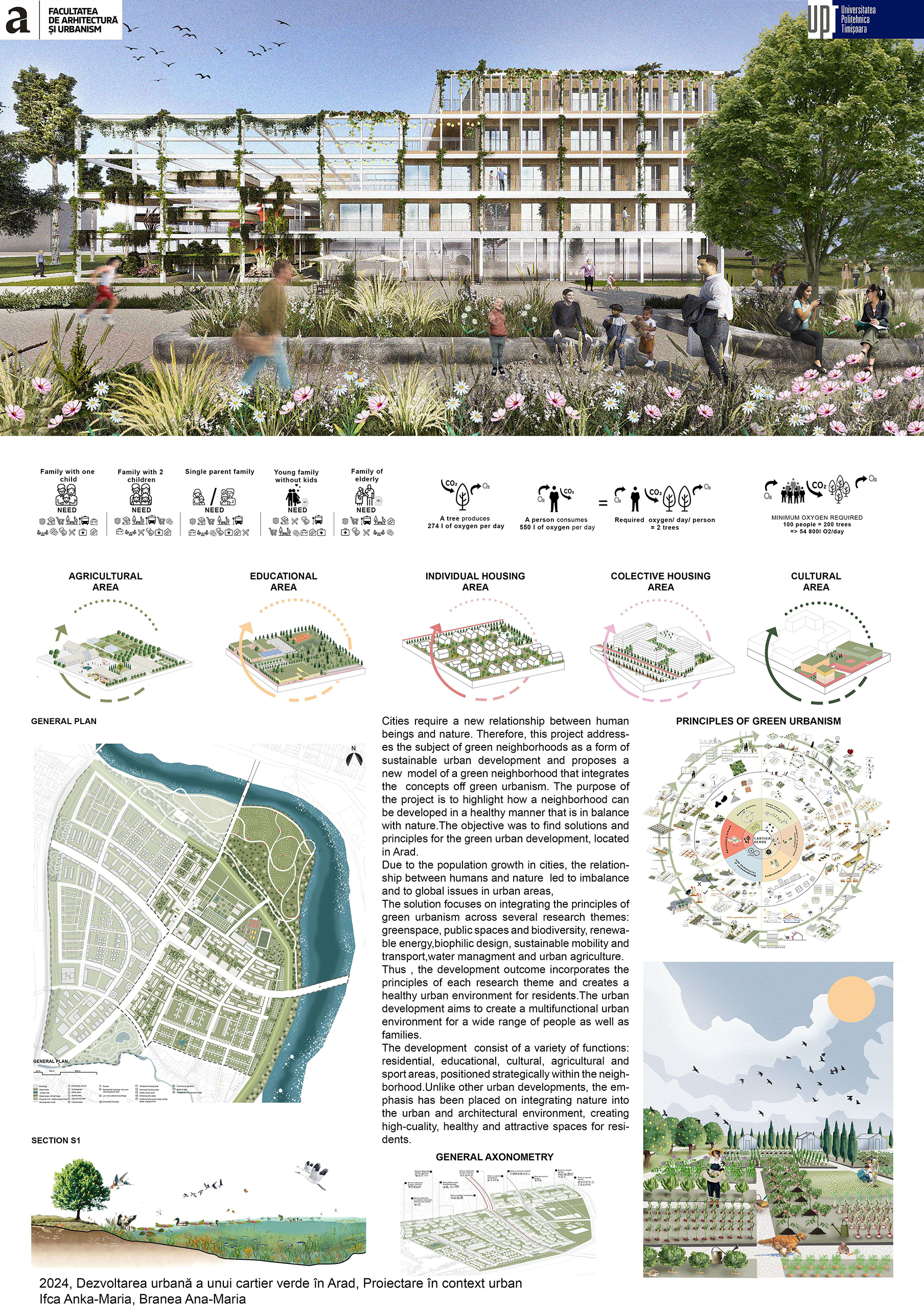
Students: Ifca Anka-Maria, Illyés Hannah Lilla
Coordinating Professor: Conf.dr.arh. Ana-Maria Branea
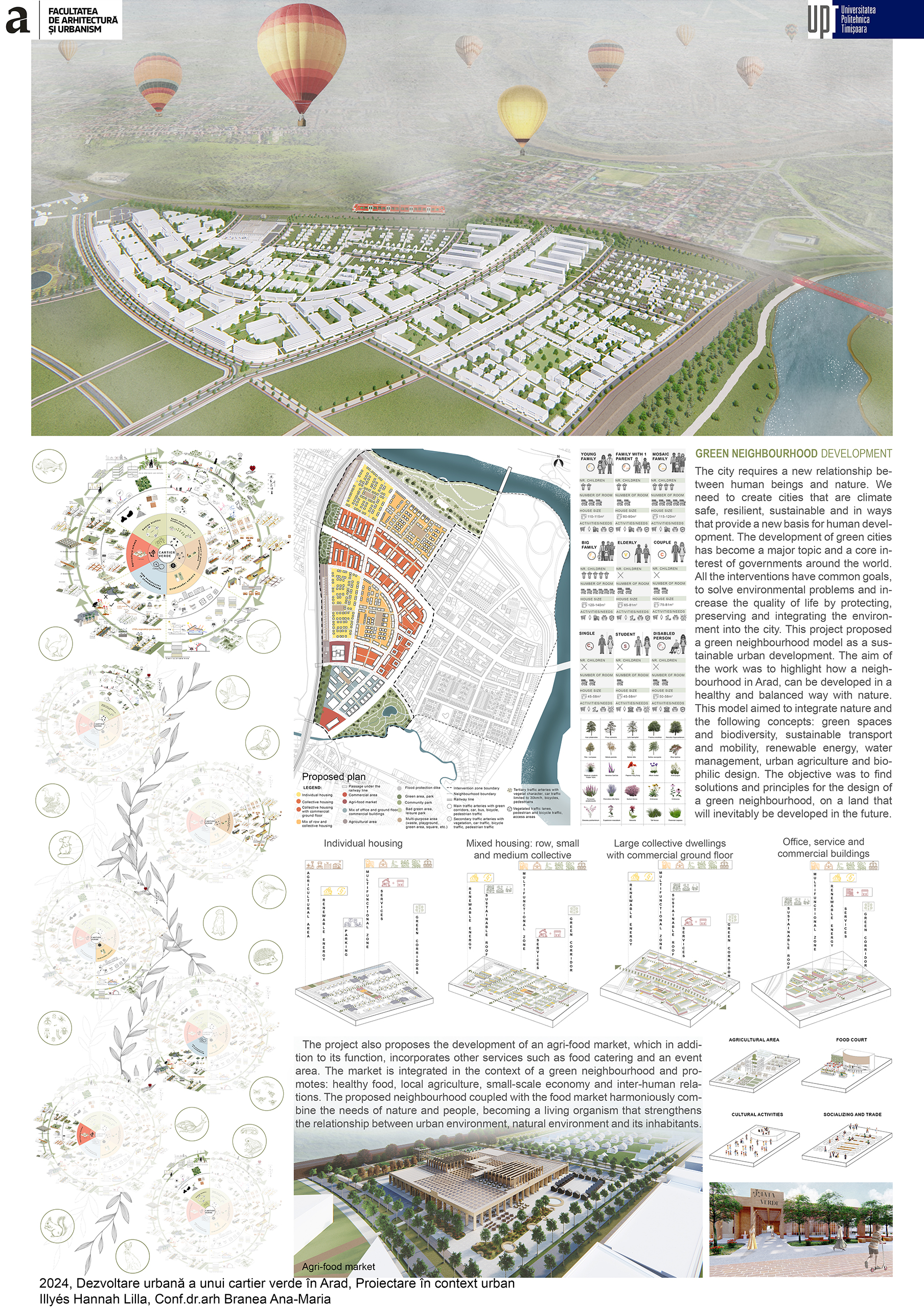
Cities require a new relationship between human beings and nature. Therefore, this project addresses the subject of green neighborhoods as a form of sustainable urban development and proposes a new model of a green neighborhood that integrates the concepts of green urbanism. The purpose of the project is to highlight how a neighborhood can be developed in a healthy manner that is in balance with nature. The objective was to find solutions and principles for the green urban development, located in Arad.
Due to the population growth in cities, the relationship between humans and nature led to imbalance and to global issues in urban areas.
The solution focuses on integrating the principles of green urbanism across several research themes: greenspace, public spaces and biodiversity, renewable energy, design, sustainable mobility and transport, water management and urban agriculture. Thus, the development outcome incorporates the principles of each research theme and creates a healthy urban environment for residents. The urban development aims to create a multifunctional urban environment for a wide range of people as well as families.
The development consist of a variety of functions: residential, educational, cultural, agricultural and sport areas, positioned strategically within the neighborhood. Unlike other urban developments, the emphasis has been placed on integrating nature into the urban and architectural environment, creating high-quality, healthy and attractive spaces for residents.
2024 | PROIECTARE 4 | A02
RO: Tema propune intervenția asupra unui sit situat la limita țesutului aferent zonei centrale a orașului Debrecen, prin dezvoltarea unui program mixt, adaptat nevoilor comunității locale. Funcțiunile propuse includ spații de birouri, un spațiu multifuncțional, o cafenea, spații dedicate workshopurilor, precum și 4–6 unități de cazare, configurate într-un ansamblu coerent și flexibil. Principalele provocări identificate derivă atât din complexitatea programului — care presupune coexistența și articularea armonioasă a unor funcțiuni diverse — cât și din specificul amplasamentului. Parcela se distinge în țesutul urban prin configurare, formă și relațiile cu vecinătatea, beneficiind de acces public pe două laturi aproape opuse. Această caracteristică generează o dinamică aparte a fluxurilor și o relaționare complexă cu spațiile adiacente.
De asemenea, proiectul integrează reflecții asupra specificului local, evidențiat frecvent în discursurile administrației publice și ale mediului academic. Un reper important îl constituie tipologia locuințelor „cívis houses”, caracteristică orașului Debrecen, care păstrează vizibilă relația dintre ruralitate și urbanitate. Intervenția propusă își asumă acest context identitar, valorificând implicațiile spațiale și culturale ale acestei moșteniri în formularea unei soluții contemporane, ancorate în specificul locului.
EN: The project proposes an intervention on a site located at the edge of the central urban fabric of Debrecen, through the development of a mixed-use program tailored to the needs of the local community. The proposed functions include office spaces, a multifunctional space, a café, workshop areas, and 4–6 accommodation units, organized within a coherent and flexible ensemble. The main challenges arise both from the complexity of the program — which requires the harmonious coexistence and articulation of diverse functions — and from the specific characteristics of the site. The plot stands out within the urban fabric due to its configuration, shape, and relationships with neighboring areas, benefiting from public access on two almost opposite sides. This feature generates a particular dynamic of circulation and a complex interaction with the adjacent spaces.
The project also engages with the local specificity frequently highlighted in public administration and academic discourse. A key reference is the typology of the “cívis houses,” characteristic of Debrecen, which still reveals a visible relationship between rurality and urbanity, along with all the spatial and cultural implications this entails. The proposed intervention embraces this contextual identity, integrating it into a contemporary architectural response rooted in the spirit of the place.
2024 | PROIECTARE 3 | A02
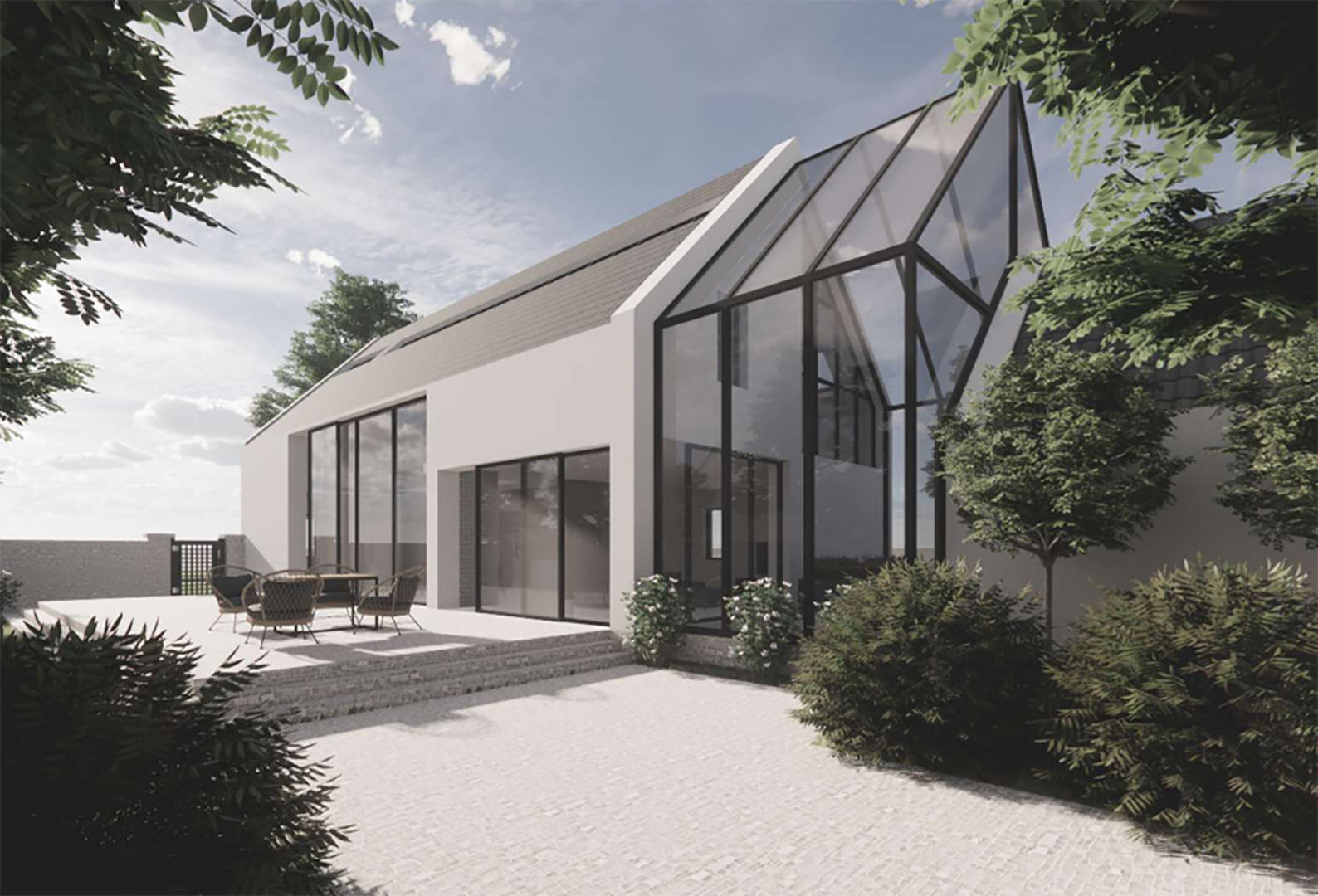
RO: Atelierul anului II, în semestrul 1, propune explorarea locuirii contemporane prin proiectarea unei case individuale integrate atent într-un context real. Exercițiul urmărește înțelegerea profundă a relației dintre spațiul privat și cel comun, dintre interior și exterior, precum și a modului în care arhitectura poate răspunde nevoilor actuale ale familiei. Locuința este abordată nu doar ca rezolvare funcțională, ci ca spațiu al identității, al intimității și al interacțiunii. Integrarea în sit, raportarea la vecinătăți, valorificarea orientării și a luminii naturale devin instrumente esențiale în definirea unei soluții coerente. Proiectele dezvoltate investighează scenarii diferite de locuire, având în comun preocuparea pentru relația cu grădina, cu comunitatea și cu dinamica vieții cotidiene. Accentul cade pe echilibrul dintre intimitate și socializare, dintre spațiul individual și cel comun, precum și pe construirea unei atmosfere capabile să susțină viața de zi cu zi.
EN: The second-year design studio, during the first semester, proposes an exploration of contemporary dwelling through the design of an individual house carefully integrated into a real context. The exercise aims to develop a deeper understanding of the relationship between private and shared space, between interior and exterior, and of the ways in which architecture can respond to the current needs of family life. The dwelling is approached not merely as a functional solution, but as a space of identity, intimacy, and interaction. Integration within the site, the relationship with neighboring contexts, and the careful use of orientation and natural light become essential tools in defining a coherent architectural proposal.The projects developed investigate different living scenarios, sharing a common concern for the relationship with the garden, the community, and the dynamics of everyday life. Emphasis is placed on balancing privacy and social interaction, individual and collective space, and on shaping an atmosphere capable of supporting daily living.
RO: Tema presupune realizarea unei locuințe însiruite într-un ansamblu care presupune, pe langă caracteristicile tipologiei amintite si realizarea unei legaturi între spațiile curților acestor locuințe. Acesta legătură trebuie să devină un spațiu social comun tuturor celor care înconjoară un mic parc/gradină, aflat în folosire și îngrijire comună. Tema propune imaginarea unei locuințe destinate unui cuplu, care prin configurare să speculeze atât relațiile interioare dintre spații cât și cele stabilite între interiorul protejat cu exteriorul deschis, natural, comun.
EN: The assignment involves the design of a terraced house within a residential ensemble which, in addition to the characteristics specific to this typology, also requires establishing a connection between the courtyard spaces of these dwellings. This connection should become a shared social space for all residents surrounding a small park or garden, intended for common use and collective care.The project proposes the design of a dwelling intended for a couple, whose configuration should explore both the internal relationships between spaces and the connections established between the protected interior and the open, natural, shared exterior.
RO: Tema propune imaginarea în localitatea Jimbolia a unei locuințe destinate unei familii compuse din doi părinți și doi copii, vârsta acestora din urmă fiind la latitudinea voastră. Indiferent de scenariul imaginat, locuința ar trebui să acomodeze locuri adecvate atât pentru intimitatea și solitudinea fiecărui membru, dar și locuri comune, în care să poată socializa și desfășura activități la comun. În fond, tema solicită imaginarea unui spațiu de locuit care poate susține și potența, concomitent, intimitatea individului dar și conexiunea între membrii familiei. Spațiile imaginate, interioare sau exterioare, ele însele dar și relația dintre ele, ar trebui să propună un scenariu funcțional care să urmărească această particularitate a locuirii bigeneraționale. Completând spațiul locuit și urmărind ocupația principală a familiei, grădinăritul, pe lângă spațiul necesar locuinței, soluția trebuie să propună un spațiu destinat expunerii și comercializării plantelor și legumelor crescute în gradina proprie și/ sau pe un teren învecinat.
EN: The assignment proposes imagining, in the town of Jimbolia, a dwelling intended for a family composed of two parents and two children, whose ages are left to your choice. Regardless of the scenario envisioned, the house should accommodate spaces suitable both for the intimacy and solitude of each family member and for shared areas where they can socialize and carry out common activities. Ultimately, the project calls for the design of a living environment capable of simultaneously supporting individual privacy and fostering connections between family members. The interior and exterior spaces, as well as the relationships established between them, should propose a functional scenario that addresses this particular aspect of multi-generational living. Complementing the living space and reflecting the family’s main occupation, the design—besides the space required for the dwelling—must also propose an area dedicated to the display and sale of plants and vegetables grown in their own garden and/or on a neighboring plot.
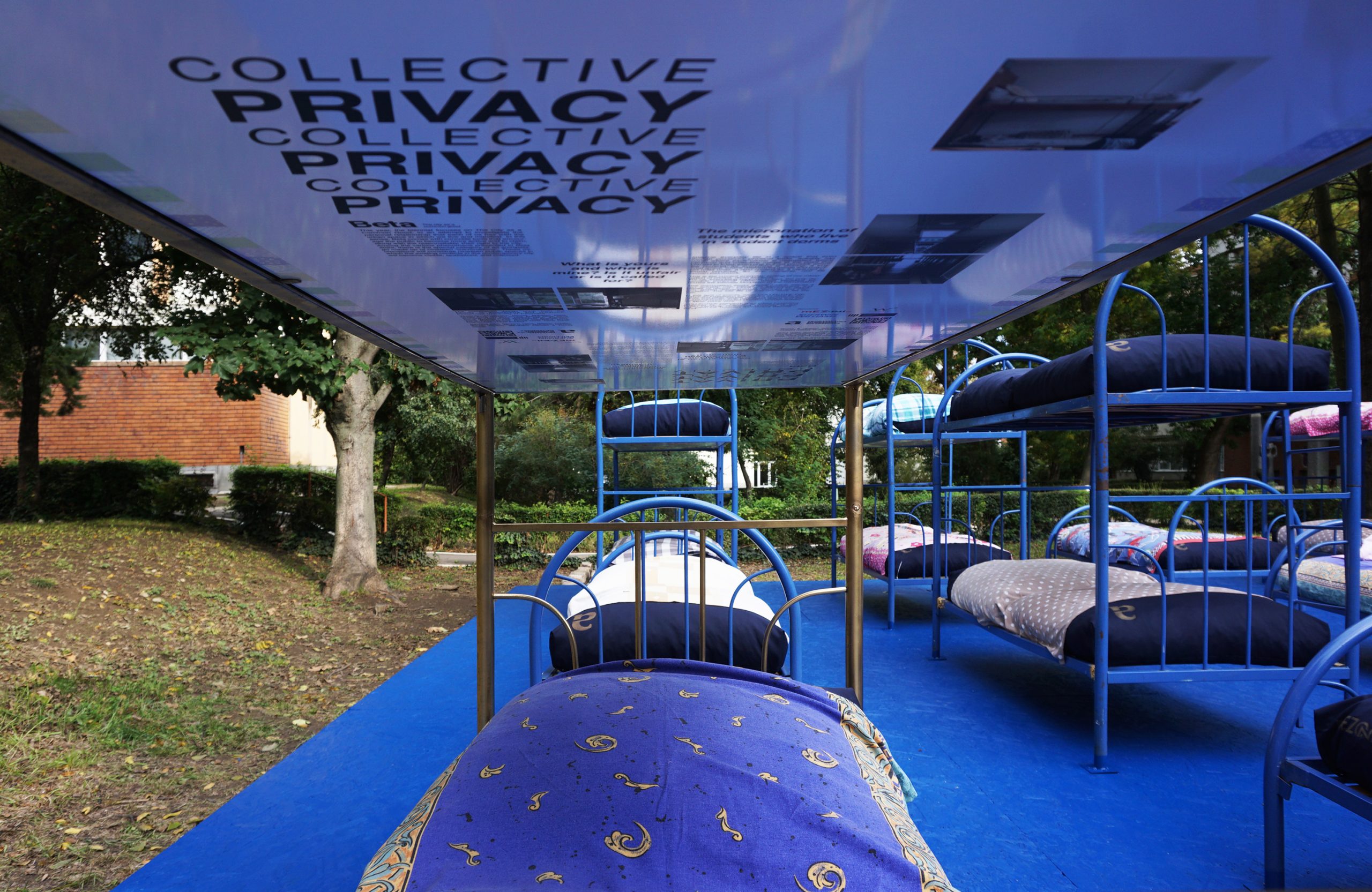
2022 | BEDONIA – PRIVAT COLECTIV
Pavilionul FAUT in BETA 2022
RO
Ce este al meu şi ce este al tău? E nedrept sau motiva(n)t?
Imaginează-ţi viaţa de zi cu zi într-un spaţiu care, deşi delimitat fizic, nu are limite; unde fiecare colţ este negociat; unde spaţiul personal şi colectiv se contopesc până în punctul în care ajungi să cunoşti pe toată lumea, dar nu şi pe tine; unde moneda este schimbul; un spaţiu cu adevărat trăit, unde diferenţele se amestecă şi regulile…
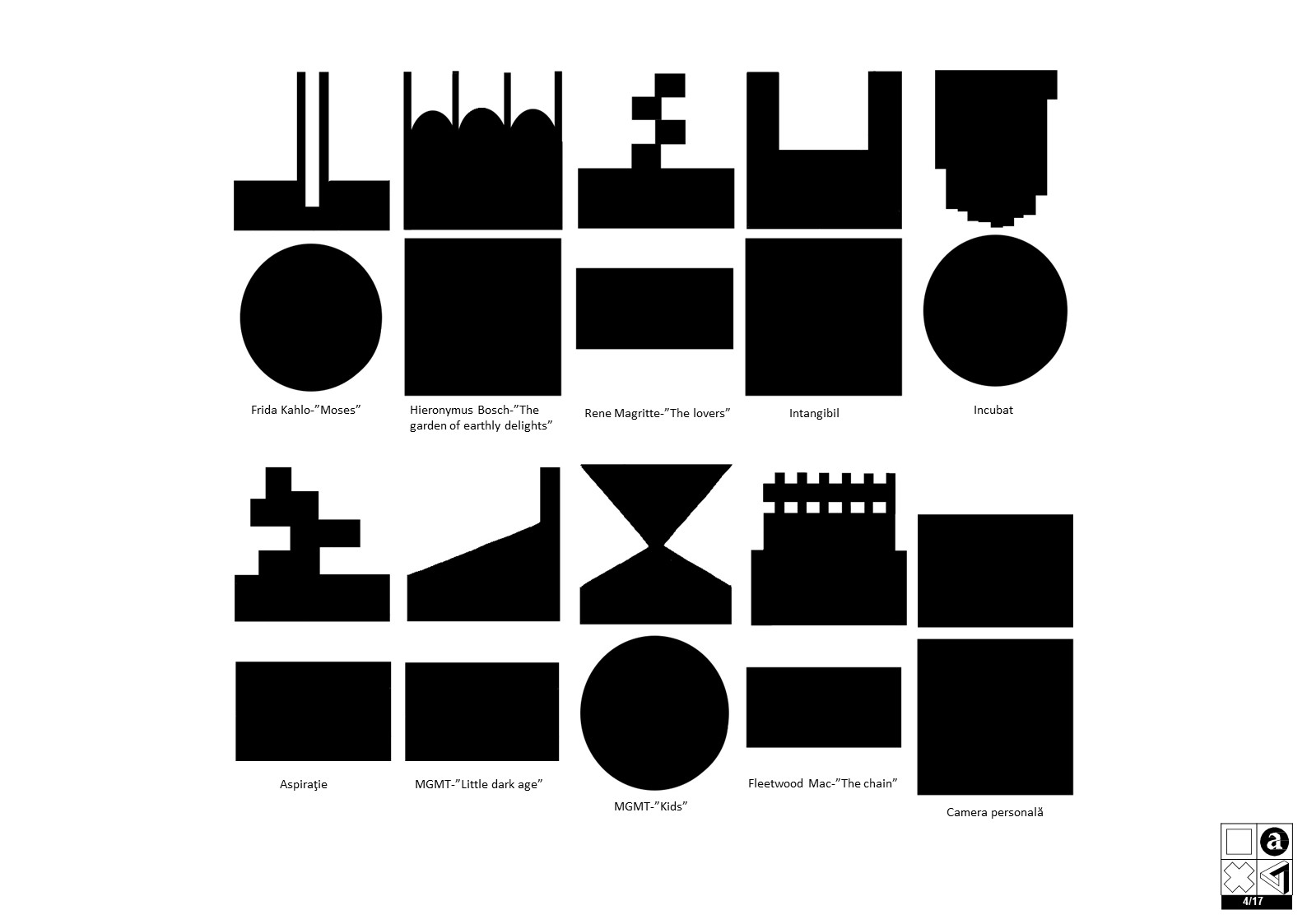
2021 | PROIECTARE 1 | A01
Din spatele fiecărei camere deschise întrevedem o altă CAMERĂ, a noastră ca într-o oglindă, dar şi a celorlalţi. 100 de
camere. Putem construi o lume şi un oraş din toate aceste locuri neştiute? O comunitate a celor “închişi” în spatele unor ferestre digitale. Ne putem imagina acest proiect virtual ca o întâlnire a unor spaţii a ate la zeci sau chiar sute de kilometri distanţă? Camere mari sau mici, joase sau înalte, întunecoase sau luminate, pline de lucruri, suveniruri şi memorii sau goale şi austere, camere ce pulsează ritmic, sonor, cu sens, fiecare conform locurilor pe care cineva le-a creat întrînsele. Camere ce cresc, se transformă şi multiplica imaginativ într-un palat fictiv al minţii izolate între patru pereți.
Behind each opened camera, we catch a glimpse of another ROOM, ours as if in a mirror, but also of others. 100 rooms. Can we build a world and a city from all these unknown places? A community of those “locked” behind digital windows. Can we imagine this virtual project as a meeting of spaces located tens or even hundreds of kilometers away? Large or small, low or high, dark or illuminated, full of objects, souvenirs, and memories or empty and austere, rooms that pulsate rhythmically, sonorously, with meaning, each according to the places that someone has created within them. Rooms that grow, transform and multiply imaginatively into a fictitious palace of the mind isolated between four walls.